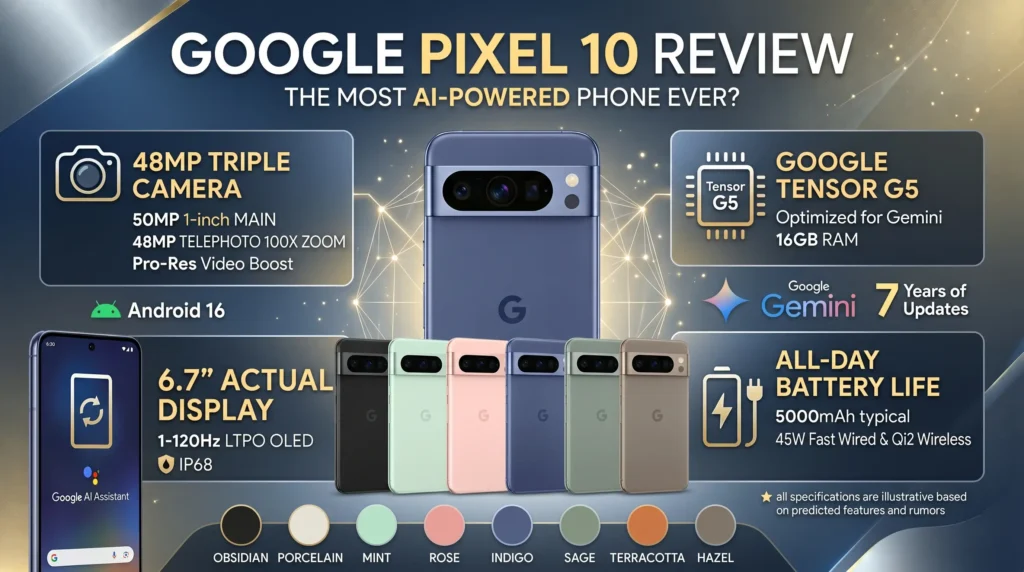
Google Pixel 10 is one of the most important standard flagship phones because it finally fixes one of the biggest weaknesses of previous non-Pro Pixel models: the lack of a dedicated telephoto camera. With the Tensor G5 chip, a bright 6.3-inch 120Hz OLED Actua display, a new triple rear camera system, long software support, and Google’s most advanced AI features, the Pixel 10 feels like a more complete flagship than the Pixel 9.
It is not the most powerful gaming phone in its price range, and its charging speed still does not match the fastest Android competitors. However, for users who care about camera reliability, clean Android software, AI tools, compact flagship design, and long-term updates, the Google Pixel 10 is one of the best Android phones to consider in 2026.
Google lists the Pixel 10 with a 6.3-inch OLED display, Tensor G5 processor, 12GB RAM, 4,970mAh battery, 48MP + 13MP + 10.8MP rear cameras, Android 16, and 7 years of OS/security/Pixel Drop updates.
TL;DR Verdict Box
Google Pixel 10 Rating: 8.8/10
One-Sentence Verdict:
The Google Pixel 10 is a smart, compact, camera-focused flagship that finally gives the standard Pixel a proper telephoto lens, making it a stronger everyday choice than the Pixel 9.
Pros
- Excellent triple rear camera setup with 5x telephoto zoom
- Bright and smooth 6.3-inch 120Hz OLED display
- Clean Android 16 experience with 7 years of updates
- Useful Google AI features like Magic Cue, Gemini, Camera Coach, and Add Me
- Qi2-certified Pixelsnap wireless charging support
Cons
- Tensor G5 is improved, but not the strongest flagship chip for heavy gaming
- Charging speed is still behind many Android rivals
- No expandable storage
- Design is very similar to the Pixel 9
- Some Pixel 10 series display/camera bugs have required software fixes after launch
Best For
The Google Pixel 10 is best for users who want a reliable camera phone, clean Android software, smart AI features, compact flagship size, and long-term software support without paying extra for the Pixel 10 Pro.
Google Pixel 10 Key Specifications
| Feature | Google Pixel 10 |
|---|---|
| Display | 6.3-inch Actua OLED |
| Resolution | 1080 x 2424 pixels, 422 PPI |
| Refresh Rate | 60–120Hz Smooth Display |
| Peak Brightness | Up to 3000 nits |
| Processor | Google Tensor G5 |
| Security Chip | Titan M2 |
| RAM | 12GB |
| Storage | 128GB / 256GB |
| Rear Camera | 48MP wide + 13MP ultrawide + 10.8MP 5x telephoto |
| Front Camera | 10.5MP autofocus selfie camera |
| Battery | 4,970mAh typical |
| Wired Charging | Up to 55% in about 30 minutes with 30W USB-C PPS charger |
| Wireless Charging | Pixelsnap Qi2-certified up to 15W |
| OS | Android 16 |
| Updates | 7 years of OS, security, and Pixel Drop updates |
| Durability | Gorilla Glass Victus 2, IP68 |
| Weight | 204g |
| Colors | Indigo, Frost, Lemongrass, Obsidian |
Google’s official specs confirm the Pixel 10 display, RAM/storage, Tensor G5 processor, battery size, charging details, and camera hardware.
Design & Build Quality
The Google Pixel 10 design does not completely reinvent the Pixel look. Instead, it keeps the familiar Pixel camera bar style and improves the overall flagship feel with a polished glass-and-aluminum build. The phone measures 152.8 x 72 x 8.6 mm and weighs 204g, making it compact enough for users who do not want a huge Pro XL-style phone.
The Pixel 10 uses Corning Gorilla Glass Victus 2 on the front and back, paired with a satin-finish aluminum frame. It also comes with IP68 dust and water resistance, which is expected from a modern flagship phone.
In hand, the Pixel 10 feels premium without being oversized. The weight is slightly on the heavier side for a 6.3-inch phone, but the balanced frame and rounded edges make it comfortable for daily use. The available colors — Indigo, Frost, Lemongrass, and Obsidian — give the phone more personality than many plain flagship phones.
Design Verdict
The Pixel 10 is not a dramatic redesign, but it looks clean, modern, and instantly recognizable. If you liked the Pixel 9 design, the Pixel 10 will feel familiar. If you wanted something completely new, the design may feel too safe.
Display & Audio Experience
The Pixel 10 has a 6.3-inch Actua OLED display with a 1080 x 2424 resolution, 422 PPI, and a 60–120Hz refresh rate. It also reaches up to 2000 nits HDR brightness and 3000 nits peak brightness, making it much easier to use outdoors compared with older Pixel models.
For everyday use, this display is excellent. Scrolling feels smooth, text looks sharp, and videos look bright with good contrast. The 6.3-inch size also gives the Pixel 10 a practical balance: it is large enough for YouTube, social media, browsing, and gaming, but not so large that it becomes uncomfortable in one hand.
The stereo speakers are also strong enough for casual media consumption. Google lists stereo speakers, three microphones, noise suppression, and Spatial Audio support for the Pixel 10.
Display Verdict
The Pixel 10 display is one of its strongest everyday features. It may not have the LTPO panel of the Pro models, but it is bright, smooth, sharp, and very comfortable for daily use.
Performance & Thermal Management
The Google Pixel 10 is powered by the Tensor G5 chip, paired with 12GB RAM and the Titan M2 security coprocessor.
For normal daily tasks, the Pixel 10 feels fast and responsive. Apps open quickly, scrolling is smooth, multitasking feels stable, and Google’s AI features run more naturally than before. Tensor G5 is especially important because Pixel phones are not only about raw benchmark numbers; Google designs Tensor around camera processing, AI features, voice tools, security, and real-world Android experience.
However, this is still not the phone to buy if your main priority is maximum gaming performance. Compared with Snapdragon-powered flagship phones, the Pixel 10 is more focused on AI and camera intelligence than extreme GPU power. The Guardian also found Tensor G5 to be a noticeable improvement over previous Tensor chips, but still behind the strongest Qualcomm flagship processors in raw performance.
Gaming Experience
For casual and moderate gaming, the Pixel 10 performs well. Games like PUBG Mobile, Call of Duty Mobile, Asphalt, and other popular titles should run smoothly at reasonable settings. But for long sessions in heavy games, a dedicated gaming phone or Snapdragon flagship may deliver better sustained performance.
Performance Verdict
The Pixel 10 is fast enough for almost every regular user. It is excellent for productivity, photography, AI tools, and daily Android use, but it is not the best choice for hardcore mobile gamers.
Google Pixel 10 Camera Deep-Dive
The camera is the biggest reason many users choose a Pixel phone, and the Google Pixel 10 camera system is a major upgrade over the Pixel 9 because it finally adds a dedicated telephoto lens to the standard model.
The Pixel 10 has a triple rear camera setup:
- 48MP wide camera with Macro Focus
- 13MP ultrawide camera
- 10.8MP telephoto camera with 5x optical zoom
- Super Res Zoom up to 20x
- 10.5MP autofocus front camera
Google officially lists optical/electronic stabilization on the wide and telephoto cameras, Super Res Zoom up to 20x, Multi-zone LDAF, and a spectral/flicker sensor.
Main Camera
The 48MP main camera is the safest and most reliable camera on the Pixel 10. It captures sharp details, balanced colors, strong dynamic range, and very good low-light shots. Pixel phones are known for “point-and-shoot” reliability, and the Pixel 10 continues that strength.
For everyday photos — people, pets, food, travel, street shots, documents, and indoor scenes — the Pixel 10 produces images that look polished without requiring manual editing.
Ultrawide Camera
The 13MP ultrawide camera is useful for landscapes, buildings, group photos, and tight indoor spaces. It also supports Macro Focus, which helps capture close-up shots with more detail. The ultrawide is not as advanced as the Pro models, but it is good enough for most users.
Telephoto Camera
The 5x telephoto camera is the biggest upgrade. Previous standard Pixel phones lacked proper optical zoom, which made the Pro models much more attractive for camera users. With the Pixel 10, Google finally gives the base model a real zoom lens.
This makes a big difference for portraits, concerts, travel photography, animals, street photography, and far-away subjects. The Pixel 10 also supports Super Res Zoom up to 20x, though the best quality will naturally come closer to the optical zoom range.
Selfie Camera
The 10.5MP front camera supports autofocus and a wide 95-degree field of view, making it useful for solo selfies, group selfies, and video calls.
Video Recording
The Pixel 10 supports 4K video recording at 24/30/60fps from the rear camera and 4K video at 30/60fps from the front camera. It also includes Audio Magic Eraser, 10-bit HDR video, Cinematic Blur, Cinematic Pan, optical image stabilization, and fused video stabilization.
Camera AI Features
Google includes several useful camera and editing features, including:
- Camera Coach
- Add Me
- Night Sight
- Astrophotography
- Real Tone
- Auto Best Take
- Magic Eraser
- Photo Unblur
- Zoom Enhance
- Portrait Light
- Reimagine
- Auto Frame
These features make the Pixel 10 more than just a camera phone. It is also a smart editing phone for users who want to improve photos quickly without using professional editing apps.
Camera Verdict
The Pixel 10 is one of the best standard flagship camera phones because it finally has a complete rear camera setup. The 5x telephoto lens makes the phone far more versatile than the Pixel 9.
Battery Life & Charging Speeds
The Google Pixel 10 has a 4,970mAh typical battery, which is larger than the Pixel 9’s 4,700mAh battery. Google rates it for 24+ hour battery life and up to 100 hours with Extreme Battery Saver.
In normal use, the Pixel 10 should comfortably last a full day for most users. With lighter use, it can stretch longer. Heavy users who spend hours gaming, recording video, using 5G, or taking many photos may still need to charge before the end of the second day.
Wired charging reaches up to 55% in about 30 minutes with a compatible 30W USB-C PPS charger, but the charger is sold separately. Wireless charging is supported through Pixelsnap Qi2-certified charging up to 15W.
Pixelsnap Wireless Charging
Pixelsnap is a major convenience upgrade. It gives the Pixel 10 magnetic wireless charging support, making it easier to align wireless chargers and use magnetic accessories. This is one of the best lifestyle improvements in the Pixel 10 series.
Battery Verdict
Battery life is good, but not class-leading. Charging is reliable but not very fast compared with some Android competitors. The addition of Pixelsnap makes the charging experience more modern and convenient.
Software, AI Features & Ecosystem
The Pixel 10 launched with Android 16 and comes with 7 years of OS, security, and Pixel Drop updates.
This is one of the biggest reasons to buy a Pixel. Long-term support means the phone should remain useful, secure, and updated for many years. For users who keep their phones for a long time, this is a major advantage over many Android brands.
Google AI Features
The Pixel 10 includes Google AI features such as:
- Gemini Nano
- Gemini assistant
- Gemini Live
- Pixel Screenshots
- Magic Cue
- Circle to Search
- Live Translate
- Call Assist
Google lists these AI features officially for the Pixel 10. Google Pixel 10 Review
Magic Cue
Magic Cue is one of the most interesting Pixel 10 AI features. It is designed to proactively surface helpful information from your apps when you need it. For example, it can help bring up relevant details during calls, messages, or other daily tasks. Google introduced the Pixel 10 series as its most proactive Pixel lineup powered by Tensor G5 and Gemini Nano.
Software Stability Note
As of May 2026, Google has continued releasing fixes for Pixel devices, including Pixel 10 series fixes related to display behavior, wireless charging, camera freezing during zoom adjustment, and keyboard/input issues. For the best experience, Pixel 10 users should keep the phone updated.
Software Verdict
The Pixel 10 offers one of the cleanest and smartest Android experiences available. The software is a major buying reason, especially for users who want long updates and useful AI features instead of heavy customization.
Google Pixel 10 vs Pixel 9: What Changed?
The Pixel 10 may look similar to the Pixel 9, but there are several meaningful upgrades:
| Feature | Pixel 10 | Pixel 9 |
|---|---|---|
| Processor | Tensor G5 | Tensor G4 |
| Rear Cameras | Triple camera with 5x telephoto | Dual camera, no telephoto |
| Battery | 4,970mAh | 4,700mAh |
| Wireless Charging | Pixelsnap Qi2-certified | Standard wireless charging |
| OS at Launch | Android 16 | Android 14 |
| AI Features | Newer Gemini/Magic Cue experience | Older Pixel AI feature set |
The biggest upgrade is clearly the 5x telephoto camera. If you already own a Pixel 9 and mostly take normal 1x photos, you may not need to upgrade immediately. But if you want better zoom, improved AI features, newer software, and better battery capacity, the Pixel 10 is a strong upgrade.
Buying Decision: Should You Buy the Google Pixel 10?
You should buy the Google Pixel 10 if you want:
- A compact flagship Android phone
- One of the best point-and-shoot camera systems
- A real 5x telephoto camera without buying the Pro model
- Clean Android software
- Long-term 7-year update support
- Google AI features
- Qi2 magnetic wireless charging
You should skip it if you want:
- The fastest gaming performance
- Ultra-fast wired charging
- A bigger display
- Pro-level camera hardware
- 1TB storage option
- The best battery endurance in the flagship category
Value-for-Money Analysis
Starting at $799 in the US, the Pixel 10 competes directly with standard flagship phones from Apple and Samsung. Google confirmed the Pixel 10 series started at $799 for the base model.
The value is strong because the Pixel 10 now includes a telephoto camera, Tensor G5, Qi2 Pixelsnap charging, 12GB RAM, and 7 years of software support. The biggest reason it feels more valuable than the Pixel 9 is that the base model no longer feels heavily limited in camera hardware.
Best Alternatives to Google Pixel 10
1. Google Pixel 10 Pro
Choose the Pixel 10 Pro if you want a more advanced display, stronger camera hardware, more premium features, and a better overall flagship experience. It is better for photography enthusiasts and users who want the best compact Pixel.
2. Samsung Galaxy S25
Choose the Galaxy S25 if you want stronger raw performance, a more customizable Android experience, and Samsung’s ecosystem features. It is a better option for users who prefer One UI and stronger gaming performance.
3. iPhone 16
Choose the iPhone 16 if you are already inside the Apple ecosystem and want iOS, Face ID, iMessage, AirDrop, and long-term Apple software support. The Pixel 10 is better for Google AI, Android flexibility, and Pixel camera processing.
Final Verdict
The Google Pixel 10 is the standard Pixel phone many users were waiting for. It keeps the clean Android experience, compact flagship size, excellent camera processing, and long update promise that Pixel phones are known for — but now it adds the missing piece: a dedicated 5x telephoto camera.
It is not perfect. Tensor G5 still does not beat the fastest flagship chips for raw gaming power, and Google’s charging speeds remain conservative. But as a complete everyday smartphone, the Pixel 10 is a major step forward.
For users searching for the best Android phone with clean software, reliable cameras, useful AI features, and long-term updates, the Google Pixel 10 is an easy recommendation.
Final Rating: 8.8/10