- The Fold8 uses a wide 4:3 inner display and a 10:16 cover screen aimed at media, reading and multitasking.
- At 201g and 4.5mm when unfolded, it is notably light and slim for a book-style foldable.
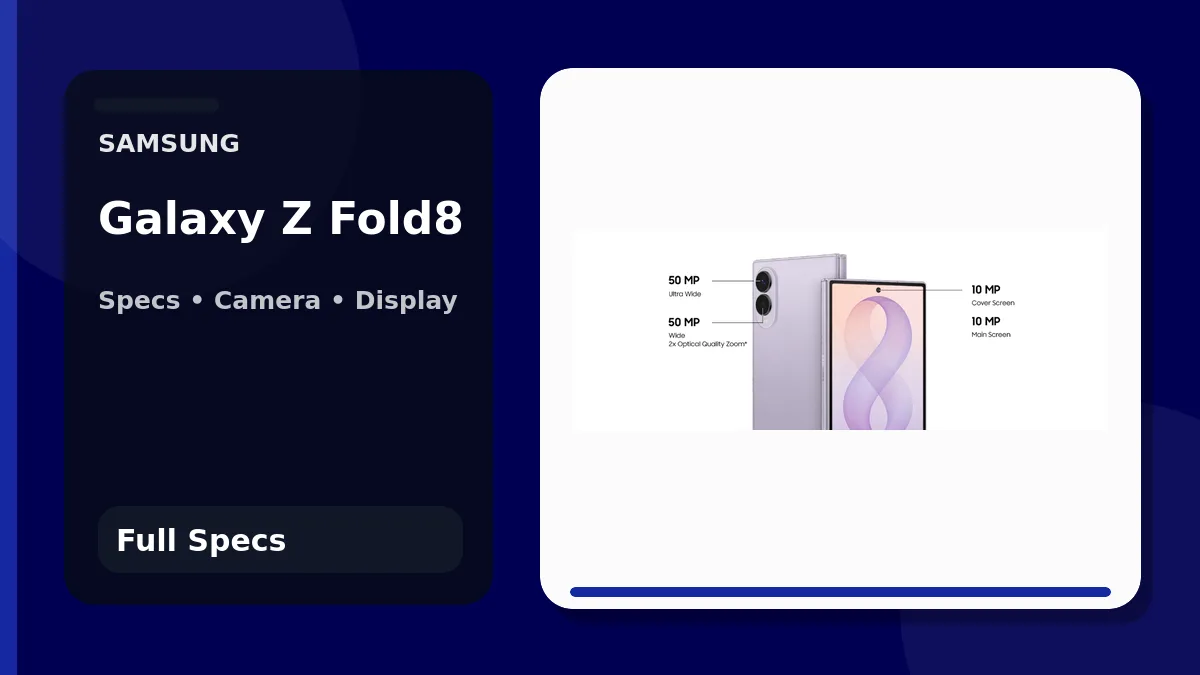
- Two 50MP rear cameras cover wide and ultra-wide views; Dual Recording and My FanCam expand video options.
- The 4,800mAh battery supports 45W wired and 20W wireless charging, while Android 17 and One UI 9 ship out of the box.
Samsung Galaxy Z Fold8 at a glance
The Samsung Galaxy Z Fold8 specifications describe a lighter, wider take on the book-style foldable. Its 7.6-inch inner display uses a 4:3 shape for video, reading and multitasking, while the 5.5-inch outer panel has a taller 10:16 ratio for quick phone-like interactions. Samsung pairs those screens with Qualcomm’s Snapdragon 8 Elite Gen 5 for Galaxy, up to 16GB of RAM and a 4,800mAh battery.
This article assesses the official specification rather than claiming hands-on experience. The strongest points on paper are the low 201g weight, dual 50MP rear cameras, 45W charging and long software-support promise. The unusual wide folded shape and $1,899.99 US launch price will be the more consequential trade-offs for many buyers.
Key specifications
| Feature | Galaxy Z Fold8 specification |
|---|---|
| Main display | 7.6-inch QXGA+ Dynamic AMOLED 2X, 1848 × 2448, 403ppi, adaptive 1–120Hz |
| Cover display | 5.5-inch WUXGA+ Dynamic AMOLED 2X, 1248 × 1972, 428ppi, adaptive 1–120Hz |
| Processor | Snapdragon 8 Elite Gen 5 for Galaxy |
| Memory/storage | 12GB/256GB, 12GB/512GB or 16GB/1TB |
| Rear cameras | 50MP wide with OIS + 50MP ultra-wide |
| Selfie cameras | 10MP on cover + 10MP on main display |
| Battery | 4,800mAh; 45W wired; 20W wireless |
| Software | Android 17 with One UI 9 |
| Durability | IP48 and Flex Titanium display structure |
| Connectivity | 5G, LTE, Wi-Fi 7, Bluetooth 6.0 |
| Weight | 201g |
| US launch price | From $1,899.99 |
Wide foldable design and dimensions
Unlike Samsung’s familiar tall Fold shape, the Galaxy Z Fold8 is almost square when closed and becomes wider than it is tall when opened. Folded dimensions are 81.9 × 123.9 × 9.7mm. Unfolded, it measures 161.4 × 123.9 × 4.5mm. The 201g weight is unusually low for a book-style foldable and even undercuts some conventional flagship phones.
The wider body is intended to make landscape video and reading feel more natural, but it will also feel different in a pocket or one-handed use. Samsung’s Flex Titanium structure combines a titanium-alloy film with an enhanced plate to support the foldable display. The Armor FlexHinge balances display tension, magnetic force and opening resistance.
Color choices include Graphite, Cream and Lavender. Pistachio is exclusive to Samsung.com in markets where it is offered.
7.6-inch main display
The inner screen is a 7.6-inch QXGA+ Dynamic AMOLED 2X panel with an 1848 × 2448 resolution and 403ppi density. It supports an adaptive 1–120Hz refresh rate, Vision Booster and up to 3,000 nits of claimed peak brightness. Samsung also applies a low-reflection finish.
Its approximate 4:3 ratio is the defining design choice. That shape supplies more horizontal room for documents, web pages, games and side-by-side apps without producing the very tall canvas of earlier Folds. It should also fit older video formats more efficiently, although widescreen movies will still show letterboxing.
5.5-inch cover display
The outer panel is a 5.5-inch WUXGA+ Dynamic AMOLED 2X screen with a 1248 × 1972 resolution, 428ppi density and adaptive 1–120Hz refresh. Samsung uses an approximate 10:16 ratio, so the cover display resembles a compact conventional phone despite the broad chassis.
The smaller diagonal measurement is a deliberate consequence of the short, passport-like body. It is suited to messaging, social updates and quick browsing, while the inner screen handles longer sessions. Buyers who want a narrow one-handed cover screen should compare the feel carefully before choosing this design.
Snapdragon performance and storage
The Snapdragon 8 Elite Gen 5 Mobile Platform for Galaxy powers the Fold8. Samsung combines it with 12GB of RAM and either 256GB or 512GB of storage. The top 1TB version increases memory to 16GB. There is no microSD expansion.
The flagship processor is responsible for multitasking across the broad inner display, camera processing and Galaxy AI workloads. On paper, even the 12GB models have enough memory for demanding split-screen use. Sustained gaming speed, thermal behavior and battery efficiency still require independent testing, so Samsung’s performance statements should be read as manufacturer claims.
Dual 50MP rear cameras
The rear camera system is unusual for placing the same 50MP resolution on both principal sensors. The wide camera has Dual Pixel autofocus, optical image stabilization, an f/1.8 aperture and 2× optical-quality zoom. The 50MP ultra-wide has Quad Pixel autofocus, an f/1.9 aperture and a 120-degree field of view.
A 10MP f/2.2 camera sits on the cover screen, and another 10MP camera is built into the main display. The cover screen can preview a shot for the subject, while Dual Recording captures both sides of an interaction. My FanCam automatically follows a selected subject and reframes footage for a chosen aspect ratio, subject to feature limits and account requirements.
The Fold8 does not include a dedicated telephoto camera, so buyers who prioritize long-range zoom should consider that omission against the flexible two-screen shooting experience.
Battery and charging
Samsung rates the dual-cell battery at 4,800mAh typical and 4,660mAh rated. That is a substantial capacity for the 201g chassis, though the two bright displays and large inner panel can make endurance highly dependent on use.
Wired charging reaches 45W. Samsung says a compatible 45W adapter and 3A USB-C cable can charge up to 63% in around 30 minutes under laboratory conditions with services and screens turned off. Wireless charging is rated at 20W, and Wireless PowerShare can recharge compatible accessories. Chargers are sold separately, and real charging speed varies with heat, settings and battery state.
Software, multitasking and AI
The Fold8 ships with Android 17 and One UI 9. The wide inner display is designed for split-view multitasking, drag-and-drop workflows and larger AI-assisted workspaces. Now Brief, Now Nudge and Gemini Intelligence are among the promoted features, but their availability depends on language, region, supported apps, accounts and network access.
Samsung also includes Knox security, Knox Vault and controls for on-device or cloud-based AI processing. The company promises up to seven operating-system upgrades and security updates, an important advantage for a device this expensive.
Connectivity, water resistance and durability
Network support includes 5G and LTE, while local connectivity includes Wi-Fi 7 and Bluetooth 6.0. Wi-Fi 7 needs a compatible router and market support. SIM options and network bands vary by carrier and region.
The IP48 rating covers water immersion under Samsung’s stated test conditions and provides limited resistance to solid objects 1mm or larger. It is not dust-tight, and Samsung advises against beach or pool use. Foldable screens and hinges still benefit from more careful handling than rigid phones.
Price, release date and configurations
Samsung announced the Galaxy Z Fold8 on July 22, 2026 and released it on August 7. The US launch price started at $1,899.99 for 256GB, with higher pricing for 512GB and 1TB. Promotions can change quickly, so that figure is a launch reference rather than a current deal.
The Fold8 targets buyers who want a tablet-like workspace in a 201g device. Shoppers who prefer a compact clamshell can read our Samsung Galaxy Z Flip8 specifications. For a conventional flagship shape, see the Samsung Galaxy S26 specifications.
Verdict
The Samsung Galaxy Z Fold8 specifications show a purposeful shift toward a wider, lighter foldable. A 201g body, 4:3 inner display, dual 50MP cameras and 45W charging create a strong productivity and media package, while Android 17, One UI 9 and seven-generation support strengthen its long-term case.
The $1,899.99 launch price remains a major barrier, and the absence of a telephoto camera is conspicuous at that level. Still, buyers who value a portable large-screen workspace may find the Fold8’s low weight and unusual display proportions more meaningful than another incremental processor upgrade.
Pros & Cons
Pros
- Very light 201g book-style design
- Wide 7.6-inch 4:3 main display
- Dual 50MP rear cameras
- 45W wired and 20W wireless charging
- Seven-generation software support
Cons
- High $1,899.99 US launch price
- No dedicated telephoto camera
- IP48 is not dust-tight
- Wide folded shape may not suit one-handed use