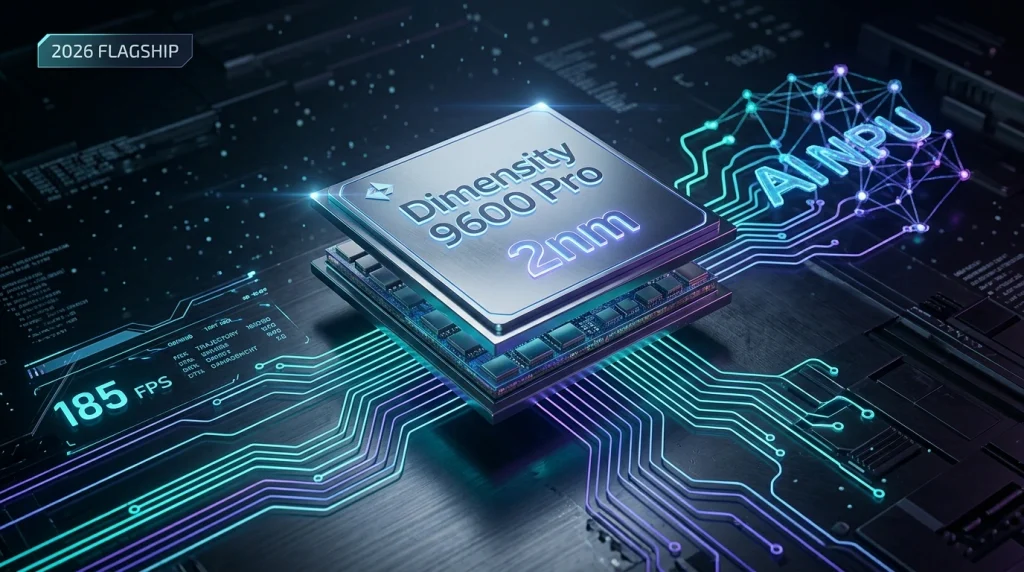
MediaTek officially launched the Dimensity 9600 Pro on September 15, 2026, positioning the 2nm flagship smartphone SoC around higher performance per watt, more capable on-device AI, faster gaming graphics and a substantially upgraded imaging pipeline. The first phones using the Dimensity 9600 Pro and the related Dimensity 9600M are expected this quarter, but MediaTek has not named specific retail models in its launch announcement.
Dimensity 9600 Pro: key takeaways
- Process: MediaTek describes the 9600 Pro as a first-wave 2nm smartphone chip.
- CPU: eight all-big cores in a 2+3+3 layout, led by two Arm C2-Ultra cores up to 4.55GHz.
- AI: NPU 1090 plus Super Efficient NPU 2.0, with MediaTek claiming 51% faster LLM prefill and 55% higher token generation per watt versus its previous flagship generation.
- Gaming: Arm Mali-G2 Ultra NX GPU, native 185+fps support and hardware-accelerated ray-tracing features.
- Imaging: Imagiq 1290 ISP, up to 200MP camera support and up to 4K240 slow motion.
- Memory/storage: support for LPDDR6 and UFS 5.0.
- Availability: MediaTek says the first 9600 Pro/9600M phones are expected during Q3 2026; exact models and regional release dates were not identified in the announcement.
Why the 2nm move matters
The headline is the manufacturing process, but a smaller process node is not a guarantee that every finished phone will be faster or last longer on a charge. Cooling, memory configuration, software tuning, modem behavior and the phone maker’s performance targets all affect the result. MediaTek’s launch figures are therefore best treated as vendor performance claims until independent tests of shipping phones are available.
Reuters reported that MediaTek is using TSMC’s advanced 2nm technology for the 9600 Pro as the company pushes further into premium smartphones. That makes the chip strategically important as well as technically interesting: it gives Android manufacturers another new-generation platform for late-2026 flagships.
CPU: new 2+3+3 all-big-core design
The Dimensity 9600 Pro uses eight CPU cores rather than mixing traditional efficiency cores with performance cores. MediaTek’s published specification lists two C2-Ultra cores with 2MB L2 cache each, three C2-Pro cores with 1MB L2 each, and three C2-Pro cores with 512KB L2 each. The platform also carries 16MB of L3 cache and 10MB of system-level cache.
MediaTek says the design reaches up to 17% higher single-core performance and 15% higher multi-core performance than its previous flagship, while claiming a 61% reduction in multi-core power consumption at the comparison point used by the company. Those percentages come from MediaTek rather than independent retail-device testing.
NPU 1090 pushes harder on on-device AI
The NPU 1090 is paired with MediaTek’s Agentic AI Engine and a second-generation Super Efficient NPU intended for low-power background AI. MediaTek claims 51% higher LLM prefill performance and 55% higher token generation per watt versus its previous-generation flagship. It also says the platform can support complex on-device applications using models up to 30 billion parameters.
Those capabilities do not mean every 9600 Pro phone will run the same AI models locally. RAM capacity, OEM software, model quantization and app support will determine what users actually get. The more meaningful change is that MediaTek is allocating dedicated hardware and power-management features to persistent, device-side AI workloads rather than treating AI as an occasional accelerator task.
GPU, 185fps gaming and ray tracing
The official product page identifies the GPU as the Arm Mali-G2 Ultra NX. MediaTek advertises native 185+fps gameplay support, up to 27% higher peak graphics performance, 24% better power efficiency at peak performance and up to 18% faster ray tracing compared with the prior flagship generation. Hardware-accelerated OMM ray tracing and a GPU-NPU Neural Graphics Architecture are also part of the platform.
Actual frame rates will depend on the game, resolution, thermal design and whether developers support the relevant features. A 185Hz-capable pipeline is useful only when the phone display and game can make use of it.
Imagiq 1290: 200MP cameras and 4K240 video
MediaTek’s Imagiq 1290 ISP supports camera sensors up to 200MP. Published video capabilities include 8K60 capture, 4K120 with electronic stabilization and 4K240 slow motion. The company also highlights 4K60 HDR with content-aware semantic processing and a 17EV imaging pipeline.
This is a chipset capability ceiling, not a promise that every Dimensity 9600 Pro phone will ship with a 200MP camera or expose every recording mode. Sensor choice, cooling, storage throughput and the manufacturer’s camera stack remain decisive.
LPDDR6 and UFS 5.0 raise the memory ceiling
The 9600 Pro supports LPDDR6 as well as LPDDR5X memory and UFS 5.0 storage. MediaTek says UFS 5.0 can double read/write performance versus dual-channel UFS 4 in its comparison, while LPDDR6 provides higher effective bandwidth at equivalent frequency. Phone makers can choose supported configurations, so buyers should check the specification of the individual handset rather than assuming all 9600 Pro devices use the newest memory and storage standards.
Display and multimedia support
The platform supports WQHD+ displays at up to 180Hz and a tri-port MIPI interface for tri-fold display designs. It also adds hardware H.266/VVC decoding, MV-HEVC support for spatial video and an end-to-end BT.2020 color pipeline. These features widen what OEMs can build, but the final screen resolution, refresh rate, codecs and foldable design remain device-specific decisions.
5G, Wi-Fi 7 and Bluetooth 6.2
The integrated 5G-Advanced modem supports sub-6GHz 5CC carrier aggregation across up to 350MHz and a stated peak above 7.4Gbps under supported network conditions. Wi-Fi 7 supports triple-band triple concurrency and speeds up to 7.3Gbps in the chipset specification. Bluetooth moves to version 6.2 with a dual-Bluetooth engine.
Network speed figures are theoretical platform capabilities. Carrier spectrum, network configuration, antennas, local regulations and OEM implementation determine real-world performance.
Security features include post-quantum protections
MediaTek lists a hardware root of trust, post-quantum cryptography defenses and AISeal hypervisor isolation using pKVM among the 9600 Pro’s security capabilities. These provide a hardware foundation, while the security of a finished phone still depends on the manufacturer’s firmware, update policy, boot-chain implementation and application ecosystem.
When will Dimensity 9600 Pro phones arrive?
MediaTek’s September 15 release says the first smartphones powered by the Dimensity 9600 Pro and Dimensity 9600M are expected to launch this quarter. The announcement itself does not name the first commercial handset, its price or its countries of sale. Reuters reported that upcoming phones from manufacturers including Xiaomi, Oppo and Vivo are expected to use the new chips, but buyers should wait for each manufacturer to confirm exact model-chip pairings before treating a rumored device as official.
For examples of current phones from manufacturers that regularly compete in the premium Android market, see PhoneSpecX’s Oppo Find X9 Pro specifications, Vivo X300 Pro specifications and Xiaomi 17T specifications. These links provide market context; they do not imply that those existing models use the Dimensity 9600 Pro.
What buyers should watch next
The most important evidence will come from shipping phones: sustained CPU/GPU performance, battery drain under AI and gaming loads, modem efficiency, camera processing quality and thermal behavior. The 2nm node and new architecture create headroom, but OEM tuning will decide whether that headroom becomes longer battery life, higher sustained speed or a mix of both.
Independent benchmarks should also be interpreted by workload rather than reduced to one score. MediaTek’s own percentage improvements use defined internal comparison conditions; retail devices can produce different results.
Frequently asked questions
Is the Dimensity 9600 Pro a 2nm chip?
Yes. MediaTek officially describes the Dimensity 9600 Pro as a 2nm flagship smartphone SoC.
How many CPU cores does it have?
Eight. The official configuration is two C2-Ultra cores, three higher-clocked C2-Pro cores and three additional C2-Pro cores.
Does it support LPDDR6 and UFS 5.0?
Yes. Both standards appear in MediaTek’s official 9600 Pro specification. Individual phones may use different supported memory or storage configurations.
Can every Dimensity 9600 Pro phone record 4K240 video?
No such assumption should be made. The chipset supports up to 4K240 slow-motion capture, but an OEM must implement compatible sensors, software, thermal management and recording modes.
Which phone will use the Dimensity 9600 Pro first?
MediaTek did not identify a first retail model in its September 15 launch release. It said the first smartphones using the 9600 Pro and 9600M are expected this quarter.
Related reading
- Oppo Find X9 Pro full specifications
- Vivo X300 Pro full specifications
- Xiaomi 17T specifications and price