Fairphone’s listed €50 premium buys a newer chipset and 12GB rather than 8GB of RAM. The practical choice depends on whether you are buying now or already own a Gen 6.
- Listed prices checked September 7: Gen 6 €599; Gen 6+ €649.
- The Plus moves to Snapdragon 7s Gen 4 and 12GB RAM, compared with Gen 3 and 8GB.
- A €50 difference between new phones is not the cost of replacing a phone you already own.
Quick comparison
Fairphone Gen 6 vs Gen 6+ is a choice between a lower purchase price and newer processor and memory specifications. For existing owners, keeping or repairing the original model deserves a separate calculation.
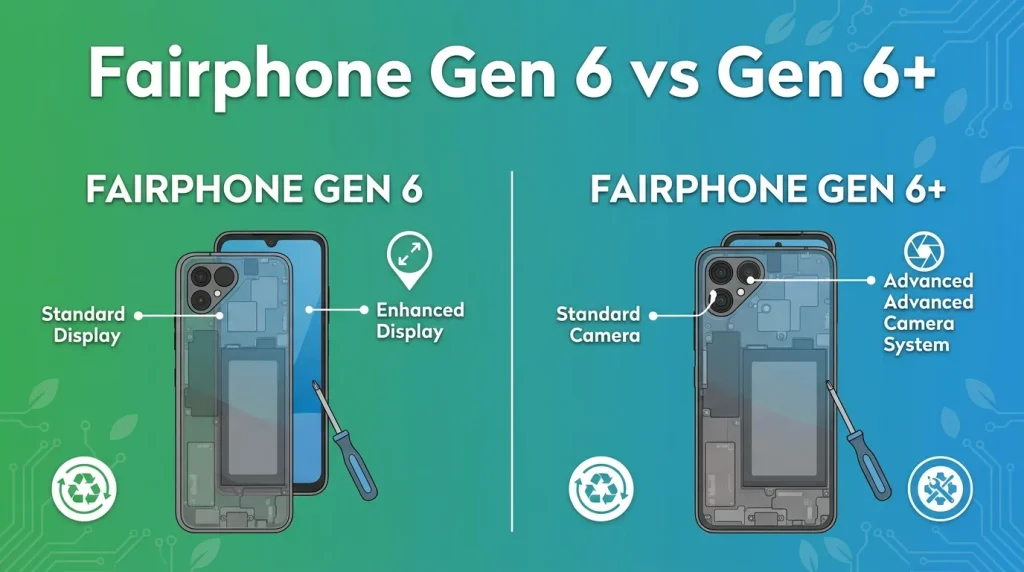
Fairphone lists the Gen 6 at €599 and the Gen 6+ at €649 on its European-facing pages checked September 7. Its official comparison identifies the processor, RAM, colors and price as the differences between the models.
- Gen 6: Snapdragon 7s Gen 3, 8GB RAM, €599.
- Gen 6+: Snapdragon 7s Gen 4, 12GB RAM, €649.
Those are the displayed euro prices, not a promise of identical pricing or stock in every country. This is a specification-based comparison, without a claim of hands-on testing.
The key differences
The Plus has a newer processor and more memory. It also offers Cobalt Blue, while the original offers Cloud White; Forest Green and Horizon Black are common options.
For a new buyer, the listed premium is €50. For someone who already owns a Gen 6, however, the upgrade cost is the price of a replacement minus whatever the existing phone actually returns. Confusing those two situations makes an upgrade look cheaper than it is.
Design and display
The official specification comparison lists the remaining hardware as shared, including a 6.31-inch LTPO AMOLED display with a 10–120Hz adaptive range. This is not presented as a move to a larger screen.
If screen size is your reason for replacing a phone, the Plus designation alone should not decide the purchase. Try to establish whether text size, brightness in your normal surroundings or physical reach is the issue. A processor change does not automatically solve those problems.
Performance: chipset and memory
The Plus changes both the chipset and memory capacity. Comparable app and gaming tests are still needed to quantify the difference in daily use; specifications alone cannot tell you how much quicker a particular task will feel.
Extra RAM can provide additional capacity for keeping work available, but whether you notice it depends on applications and memory management. A user moving between large apps may value that capacity differently from someone who mostly calls, messages and browses.
If demanding games or lengthy processing tasks are the priority, look for direct testing before treating the Plus as the right answer. A newer midrange chipset should not be described as flagship-class simply because it is newer.
Battery, charging and repairability
The official Gen 6 page describes a user-removable 4,415mAh battery and 12 user-replaceable spare parts. Fairphone lists support and spare-parts availability through 2033. These ownership features matter independently of the processor upgrade.
For an owner whose main problem is an aging battery or a damaged module, investigating repair can be more relevant than buying a complete replacement. Check the exact part, instructions and total cost before deciding; repairability is useful when the practical repair route works for your situation.
Equal capacity does not guarantee equal endurance: workload and power use matter. Neither a battery-life winner nor a charging-time advantage can be established here without comparable measurements.
Software and long-term ownership
The support horizon is part of the ownership case, but it is a calendar commitment. Buying later does not restart a fresh period that ends beyond the stated date.
Before purchase, confirm the operating-system option you intend to order and the requirements of your essential apps. A long-lived phone still needs to work with your employer, banking setup and accessibility preferences. Those checks are personal to the buyer rather than a universal advantage for either model.
For an owner planning to keep a phone for several years, protecting data and making a workable backup plan also matter. Repairable hardware does not replace backups, and replacing a module should not be the first time you discover whether your data is recoverable.
Price and value
At the displayed prices, the Plus costs about 8.3% more: €50 divided by €599. That is a comparison of the listed purchase prices, not a forecast of resale value, maintenance expense or total lifetime cost.
For a new purchase at those prices, the Plus is the more attractive performance-oriented option if the additional €50 is affordable. The original remains a reasonable budget choice when its capability fits your needs, particularly if a genuine local discount widens the difference.
Compare equivalent packages. Storage, shipping, accessories, payment terms and the seller’s return conditions can change the practical price gap. A headline saving is less useful if it compares unlike offers.
Which one should you buy?
Choose the Plus when you are buying a new Fairphone and value the newer chipset and additional memory at the listed premium. Choose the original when the lower total cost matters more and your everyday tasks are already comfortably covered.
If you own a functioning Gen 6, identify an actual limitation before replacing it. The comparison does not establish that every owner should upgrade. Keeping or repairing a device that still meets your needs is a coherent choice.
If you are still comparing different Android approaches, our Pixel 10 review and Nothing Phone 4b specifications provide separate model coverage. They are further reading, not claims that those devices share Fairphone’s repairability commitments.
Final verdict
For a new buyer facing the listed €50 difference, the Gen 6+ has a straightforward case: spend a little more for the processor and memory changes. Existing Gen 6 owners face a different calculation, where a full replacement needs a concrete benefit. The right choice follows the actual price and problem you need to solve.
Quick Comparison
| Feature | Gen 6 | Gen 6 Plus |
|---|---|---|
| Processor | Snapdragon 7s Gen 3 | Snapdragon 7s Gen 4 |
| RAM | 8GB | 12GB |
| Listed euro price, September 7 | €599 | €649 |
What to Read Next
Frequently Asked Questions
What does the extra €50 buy on the Fairphone Gen 6+?
Does Gen 6+ have a larger screen or a new camera system?
Should an existing Gen 6 owner replace their phone?
Does buying later extend support beyond 2033?
Sources & References
- Fairphone Gen 6+ official specifications and model comparison — Primary model comparison for prices, processor, RAM, colors and shared hardware.
- Fairphone Gen 6 official product and repairability details — Primary product reference for the original model and repairability and support details.