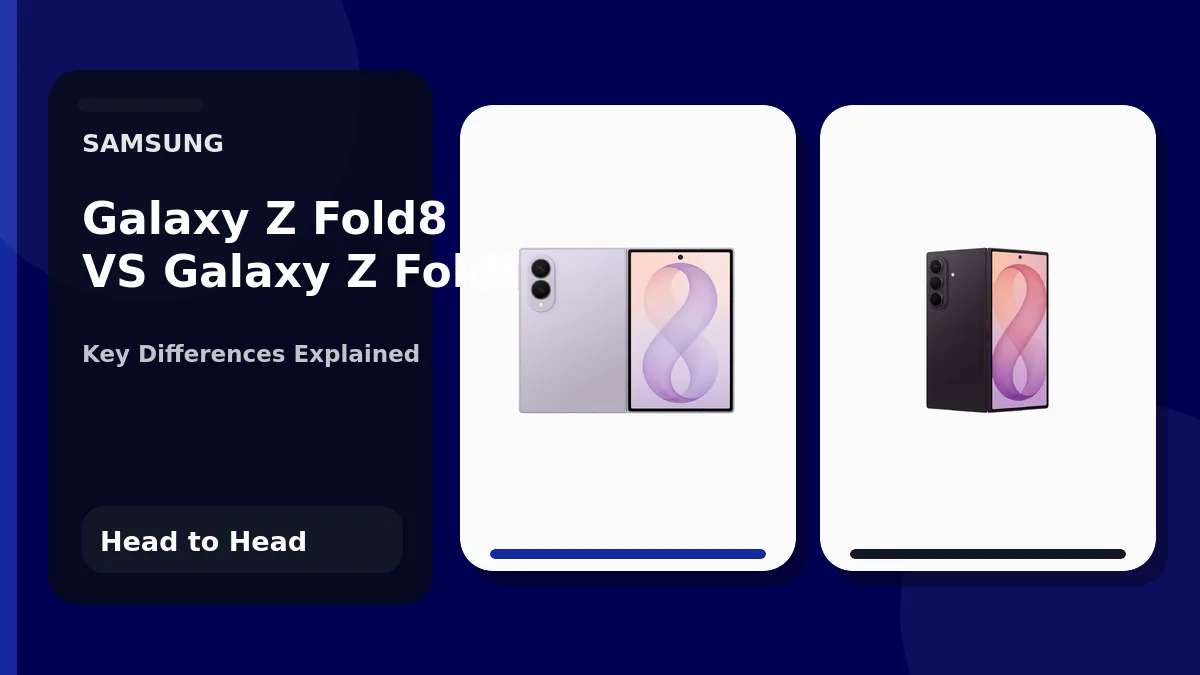
The Galaxy Z Fold8 is lighter, more compact and less expensive. The Fold8 Ultra adds larger screens, a 200MP triple-camera system, a bigger battery and a thinner unfolded body for a $200 higher US launch price.
- Fold8 weighs 201g and has a compact 7.6-inch main display; Fold8 Ultra weighs 215g and opens to 8.0 inches.
- Both use Snapdragon 8 Elite Gen 5 for Galaxy, Android 17, One UI 9, Wi-Fi 7 and up to 1TB of storage.
- Ultra adds a 200MP main camera, 3x telephoto, 5,000mAh battery and creator video features.
- Official US launch prices were $1,899.99 for Fold8 and $2,099.99 for Fold8 Ultra.
Quick comparison
Galaxy Z Fold8 vs Z Fold8 Ultra is mainly a choice between portability and maximum capability. The regular Fold8 is 14g lighter, shorter when folded and $200 cheaper at Samsung’s official US launch price. The Ultra answers with a larger workspace, a much more ambitious camera system, a 200mAh battery increase and an even slimmer unfolded body.
Neither model is the automatic winner. Both use the same flagship chipset, software generation, storage tiers, 45W wired charging class and IP48 rating. The better buy depends on whether a pocket-friendlier foldable matters more than camera versatility and an 8-inch canvas.
| Feature | Galaxy Z Fold8 | Galaxy Z Fold8 Ultra |
|---|---|---|
| US launch price, 256GB | $1,899.99 | $2,099.99 |
| Main display | 7.6-inch, 1–120Hz | 8.0-inch, 1–120Hz |
| Cover display | 5.5-inch, 1–120Hz | 6.5-inch, 1–120Hz |
| Folded size | 81.9 × 123.9 × 9.7mm | 72.8 × 158.4 × 8.9mm |
| Unfolded size | 161.4 × 123.9 × 4.5mm | 143.2 × 158.4 × 4.1mm |
| Weight | 201g | 215g |
| Rear cameras | 50MP wide + 50MP ultrawide | 200MP wide + 50MP ultrawide + 10MP 3x telephoto |
| Battery | 4,800mAh | 5,000mAh |
| Chip | Snapdragon 8 Elite Gen 5 for Galaxy | Snapdragon 8 Elite Gen 5 for Galaxy |
| Charging | 45W wired, 20W wireless | 45W wired, 20W wireless |
| Storage | 256GB, 512GB or 1TB | 256GB, 512GB or 1TB |
| Water resistance | IP48 | IP48 |
| Software | Android 17, One UI 9 | Android 17, One UI 9 |
The key differences in plain English
The Fold8 is not simply a discounted Ultra. Samsung gave it a different, wider-when-open shape and a notably compact folded height. Its 5.5-inch cover screen is suited to quick tasks, while the 7.6-inch inner panel prioritizes reading, video and games. At 201g, it is the easier model to carry for long periods.
The Fold8 Ultra follows a taller book-style format. Its 6.5-inch cover screen behaves more like a normal phone, and its 8.0-inch inner display offers more room for split-screen work. The Ultra also carries the decisive hardware upgrades: a 200MP main camera, a dedicated 3x telephoto and a 5,000mAh battery.
Design and displays: compact square or larger workspace?
The Fold8 measures 81.9 × 123.9 × 9.7mm folded. Unfolded, its 161.4 × 123.9mm footprint produces a broad 4:3-style canvas. That can suit books, documents and landscape media, but the small 5.5-inch cover screen is less conventional for long typing sessions.
The Ultra measures 72.8 × 158.4 × 8.9mm folded and 143.2 × 158.4 × 4.1mm open. It is thinner in either state and its 6.5-inch cover screen is easier to treat as an everyday phone display. The tradeoff is weight: 215g versus 201g.
Both Dynamic AMOLED 2X main screens support 1–120Hz, Vision Booster and up to 3,000 nits in Samsung’s launch material. The Ultra’s 8.0-inch panel has 2,504 × 2,256 pixels, while Fold8 uses 1,848 × 2,448 across 7.6 inches. See our Galaxy Z Fold8 specifications guide for the smaller model in detail.
Performance and storage are effectively tied
Samsung uses the Snapdragon 8 Elite Gen 5 for Galaxy in both phones. The memory and storage ladder is also the same: 12GB of RAM with 256GB or 512GB, and 16GB with 1TB. Availability can vary by market and channel, but there is no lower-tier processor penalty for choosing Fold8.
Routine speed, gaming potential and Galaxy AI features should therefore be broadly comparable under similar conditions. The Ultra’s expanded graphite cooling structure is the meaningful distinction for sustained heavy workloads. It may be the better choice for long editing sessions, although published specifications do not replace independent thermal testing.
Cameras: the Ultra earns its name
Galaxy Z Fold8 has a 50MP f/1.8 wide camera with optical stabilization and a 50MP f/1.9 ultrawide. Samsung also supplies 10MP cameras on the cover and main screens. Dual Recording and My FanCam make it capable for everyday capture without turning it into a camera-first purchase.
Fold8 Ultra moves to a stabilized 200MP f/1.7 main camera, retains a 50MP ultrawide and adds a stabilized 10MP 3x optical telephoto. Samsung also highlights 200MP HDR capture, improved Nightography, 8K video using APV and Cine LUT controls. Anyone who regularly shoots distant subjects or wants optical zoom has a clear reason to choose Ultra.
Our Pixel 11 Pro Fold versus Galaxy Z Fold8 Ultra comparison places Samsung’s top foldable in the wider flagship-camera field.
Battery and charging: a modest Ultra advantage
Fold8 contains a 4,800mAh typical dual battery; Fold8 Ultra increases that to 5,000mAh. Samsung rates the regular model for up to 26 hours of video playback and Ultra for up to 27 hours, so the extra capacity mainly supports the bigger screens rather than promising a dramatic endurance leap.
Both support 45W wired charging, 20W fast wireless charging and Wireless PowerShare. Samsung says Fold8 can reach up to 63% in around 30 minutes from empty, while Ultra can reach up to 67% under laboratory conditions. Actual results vary, and the 45W adapter is sold separately.
Software, connectivity and durability
Both ship with Android 17 and One UI 9, including Samsung’s foldable multitasking and Galaxy AI features. Connectivity is matched at 5G, LTE, Wi-Fi 7 and Bluetooth 6.0. Both carry an IP48 rating, which covers freshwater immersion under Samsung’s test conditions but does not make either phone dustproof in the usual sense.
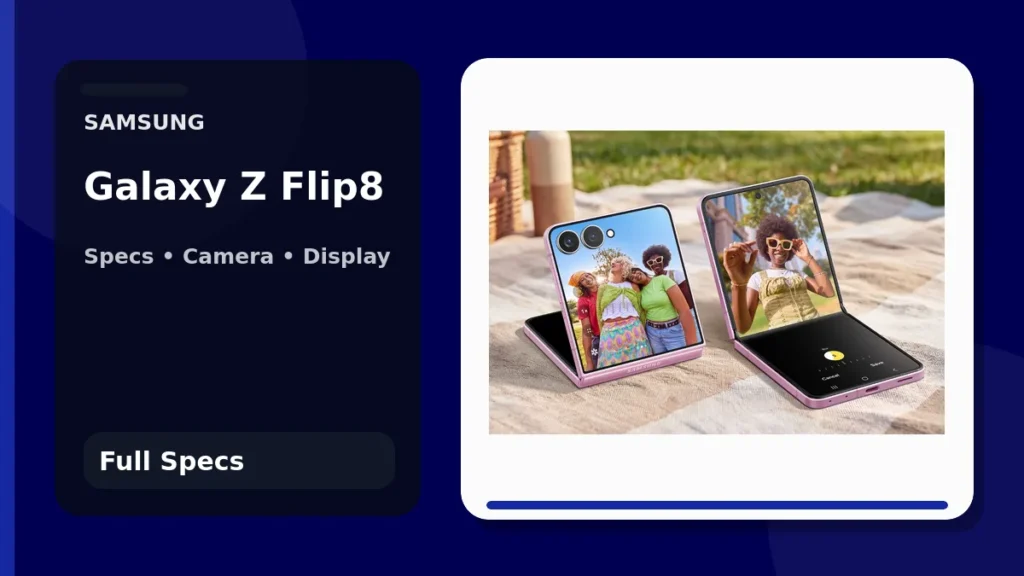
Samsung’s Flex Titanium display structure is shared across the lineup. Buyers comparing form factors may also want our Galaxy Z Flip8 specifications, which trades the book-style workspace for a smaller clamshell design.
Price and value: what does the extra $200 buy?
Samsung listed the unlocked 256GB Galaxy Z Fold8 at $1,899.99 and Fold8 Ultra at $2,099.99 in the United States at launch. Promotions, trade-ins and regional taxes change frequently, so those figures are launch-positioning references rather than a promise of today’s checkout price.
The $200 premium buys larger displays, a thinner chassis, 200MP main and 3x telephoto cameras, 200mAh more battery capacity and creator-focused video options. It does not buy a faster processor, more base storage, higher charging wattage or a better water-resistance rating. The regular Fold8 is stronger value if cameras and the 8-inch panel are not priorities.
Winner by category
- Portability: Galaxy Z Fold8. It is 14g lighter and dramatically shorter when folded.
- Cover screen: Galaxy Z Fold8 Ultra. The 6.5-inch outer display is closer to a conventional phone.
- Main display: Galaxy Z Fold8 Ultra. Its 8.0-inch panel offers more working space.
- Performance: Tie. Chipset and storage tiers match, though Ultra has more ambitious cooling.
- Cameras: Galaxy Z Fold8 Ultra. The 200MP main sensor and 3x telephoto are decisive.
- Battery: Galaxy Z Fold8 Ultra. Capacity and playback estimate are slightly higher.
- Value: Galaxy Z Fold8. It preserves the shared flagship platform for $200 less at US launch.
Which Galaxy Fold should you buy?
Choose Galaxy Z Fold8 if you want Samsung’s lightest Z Fold, prefer compact proportions, mostly use the main display for reading and entertainment, or want to keep the price below the Ultra tier. It is also logical if a 50MP wide and ultrawide pair covers your photography needs.
Choose Galaxy Z Fold8 Ultra if the cover screen will be your primary everyday interface, you multitask heavily on the inner display, or you care about telephoto photography, high-resolution capture and advanced video tools. The larger battery and thinner unfolded body reinforce that premium position.
Final verdict
Galaxy Z Fold8 wins on portability and value; Galaxy Z Fold8 Ultra wins on display space and camera range. Because the processor, software, storage options and charging standards are shared, the decision rests on physical format and imaging more than raw speed.
For buyers who specifically like the Fold8’s compact shape, the regular model is the rational purchase. Ultra is worth the extra $200 for creators, frequent multitaskers and anyone who wants Samsung’s most complete foldable camera system.