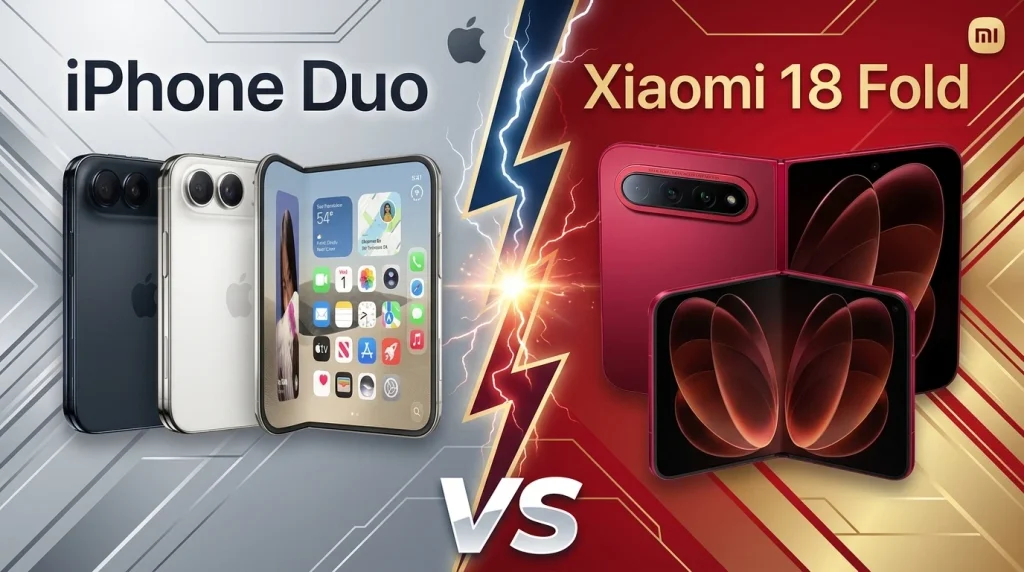
Apple’s iPhone Duo and Xiaomi’s 18 Fold are two of 2026’s most ambitious book-style foldables, but they are not straightforward substitutes. Apple is selling the Duo broadly from October with iOS 27.1, a compact 5.4-inch cover screen and a 7.6-inch inner display. Xiaomi’s 18 Fold is a China-first device with a larger battery, a Leica-branded triple-camera system and Xiaomi’s in-house Xring O3 platform. For buyers who can actually purchase both, the better choice depends less on a single specification and more on ecosystem, camera priorities, charging, size and warranty access.
This is an evidence-based comparison, not a hands-on review. Apple’s figures below come from its September 9 announcement. Xiaomi details are based on launch reporting published after its September 7 China unveiling; where a claim is manufacturer-reported rather than independently tested, we say so.
iPhone Duo vs Xiaomi 18 Fold: key differences
| Area | iPhone Duo | Xiaomi 18 Fold |
|---|---|---|
| Launch position | Apple’s first foldable iPhone; broad international rollout | Xiaomi flagship foldable; China launch |
| Inner display | 7.6-inch Super Retina XDR, ProMotion, Always On, up to 3,000 nits outdoor peak | Large inward-folding display; launch reporting emphasizes a wide-format design |
| Platform | A20 Pro, iOS 27.1 | Xring O3, HyperOS 4 |
| Rear-camera emphasis | 48MP Fusion Main plus folding-specific capture features | 200MP main + 50MP ultrawide + 50MP 3.5x periscope, according to launch reporting |
| Battery/charging | Dual-battery design; Apple rates up to 24 hours mixed-display use; 50% in about 20 minutes wired | 6,000mAh; 67W wired and 50W wireless |
| Starting price | US$1,999 for 256GB in the U.S. | CNY 10,999 for 12GB/256GB in China |
Design and displays: compact cover versus wide-fold approach
The Duo’s defining choice is its unusually compact outer screen. Apple specifies a 5.4-inch outer Super Retina XDR panel and a 7.6-inch inner display. Both support ProMotion and Always On, while Apple quotes 3,000 nits peak outdoor brightness. Apple also says the inner panel uses a nano-texture finish intended to reduce glare and make the crease less visually prominent. The frame uses grade 5 titanium, and the hinge cover uses 3D-printed recycled titanium.
Xiaomi takes a different route. Launch coverage describes the 18 Fold as a wider, more conventional book-style foldable intended to provide more keyboard room on the outside. Xiaomi says its Dragon Bone Hinge, 7-series aluminum frame and Dragon Crystal Glass 3.0 contribute to durability, while a double-layer UTG structure protects the folding panel. Those are manufacturer durability claims rather than our own drop-test results.
If you want more background on each device before comparing them, PhoneSpecX has separate guides to the iPhone Duo specifications and release details and the Xiaomi 18 Fold specifications and camera features.
Performance and software
| Feature | iPhone Duo | Xiaomi 18 Fold |
|---|---|---|
| Chip | A20 Pro, 2nm | Xring O3, reported 3nm |
| CPU/GPU claims | Apple claims 6-core CPU up to 20% faster and 7-core GPU up to 40% faster than A19 Pro | Xiaomi claims 60% higher multi-core CPU and 85% higher GPU performance versus its previous generation |
| AI hardware | Dual 16-core Neural Engine; Apple Intelligence | Xring O3 NPU reported at 200 TOPS tensor compute |
| Software | iOS 27.1 at retail | HyperOS 4 |
Raw manufacturer performance percentages should not be compared directly across the two platforms: Apple and Xiaomi use different baselines, workloads and test conditions. Without controlled cross-platform testing, it would be misleading to declare either chip universally faster. The practical difference is ecosystem. Duo buyers get Apple’s iOS continuity and fold-specific multitasking, while Xiaomi buyers remain in the Android/HyperOS environment.
Cameras: Xiaomi offers more focal-length flexibility on paper
Apple highlights a 48MP Fusion Main camera capable of 4K Dolby Vision recording at up to 120fps. The folding body enables Duo Preview, rear-camera selfies using the outer display, Smart Take and other modes that use both screens. Apple also places a FaceTime camera beneath the inner display.
Xiaomi’s launch configuration is more aggressive on camera hardware: a Leica-branded system with a 200MP main camera, 50MP ultrawide and 50MP periscope telephoto with 3.5x optical zoom. That gives Xiaomi a dedicated telephoto option that matters for portraits and distant subjects. Resolution alone, however, does not establish better image quality. Sensor behavior, processing, stabilization, lens quality and low-light performance require controlled testing, which this comparison does not claim to provide.
Battery and charging
| Battery item | iPhone Duo | Xiaomi 18 Fold |
|---|---|---|
| Capacity | Apple does not state a mAh figure in its launch release; one battery sits on each side | 6,000mAh high-silicon battery |
| Claimed endurance | Up to 31h video on inner display, 44h on outer, or 24h mixed-display usage | No directly comparable Apple-style playback figure used here |
| Wired charging | Up to 50% in about 20 minutes under Apple’s stated conditions | 67W |
| Wireless charging | MagSafe/Qi2; 50% in about 30 minutes under Apple’s stated conditions | 50W |
Xiaomi wins the simple capacity-and-wattage comparison, but battery life cannot be inferred from mAh alone. Screen area, modem behavior, software scheduling and workload all matter. Apple publishes usage-time claims rather than battery capacity in its launch material, so a direct endurance winner requires independent testing.
Price and availability may decide the comparison
| Market detail | iPhone Duo | Xiaomi 18 Fold |
|---|---|---|
| Base configuration | 256GB | 12GB + 256GB |
| Official/local launch price | US$1,999 starting price in the U.S. | CNY 10,999 starting price in China |
| Higher storage | 512GB, 1TB and 2TB offered | Up to 16GB + 1TB; limited Ceramic Special Edition also reported |
| Availability | Pre-orders October 16; sales October 23 in more than 70 countries/regions, then 28 more on October 30 | China sales began September 10; no global launch confirmed in the sources checked as of September 20 |
The prices are not directly convertible into a fair global comparison because taxes, distribution, warranty and import costs differ. For most buyers outside China, Apple’s official local sales and support may outweigh Xiaomi’s lower China-market starting price. Importing the Xiaomi can also complicate warranty service, network compatibility and software expectations.
Which one makes more sense?
Choose iPhone Duo if…
- You already use Apple services and want iOS continuity.
- You value official availability and warranty support across many countries.
- You prefer a compact outer screen and Apple’s fold-specific camera and multitasking features.
- You need storage above 1TB; Apple offers a 2TB configuration.
Choose Xiaomi 18 Fold if…
- You can buy it in China or are comfortable importing it.
- You prioritize a 6,000mAh battery and higher quoted charging wattages.
- You want a dedicated 3.5x periscope telephoto camera.
- You prefer Android/HyperOS and Xiaomi’s wider foldable layout.
Neither device is automatically the “best foldable.” The Duo is the easier recommendation for an international Apple user because it has official multi-market distribution. The 18 Fold is the more hardware-aggressive option in several areas, especially battery and rear-camera versatility, but its China-first availability is a major practical constraint.
Related PhoneSpecX reading
For other current foldable comparisons, see iPhone Duo vs Galaxy Z Fold8 Ultra and iPhone Duo vs Pixel 11 Pro Fold. These provide useful context if you are choosing among ecosystems rather than only these two devices.
Frequently asked questions
Is the iPhone Duo cheaper than the Xiaomi 18 Fold?
Not on their headline launch prices: Apple starts at US$1,999 in the U.S., while Xiaomi starts at CNY 10,999 in China. Those prices belong to different markets and should not be compared using currency conversion alone.
Does Xiaomi 18 Fold have the bigger battery?
Xiaomi states a 6,000mAh battery. Apple does not publish a mAh capacity in its Duo launch announcement, instead quoting usage and video-playback times, so a clean capacity comparison is not available from the two launch materials.
Which has the better camera?
There is no verified overall winner without controlled image testing. Xiaomi offers a more versatile rear-camera layout on paper, including a dedicated 3.5x periscope telephoto. Apple emphasizes its 48MP Fusion Main camera, 4K120 Dolby Vision and fold-specific capture modes.
Can I buy Xiaomi 18 Fold globally?
No broad global release was confirmed in the sources checked on September 20, 2026. Its announced sales are in China. Apple, by contrast, has confirmed Duo availability across more than 70 countries and regions in its first wave.
Does iPhone Duo support physical SIM cards?
No. Apple says iPhone Duo is eSIM-only worldwide. Carrier support should still be checked before purchase, especially when travelling or switching providers.