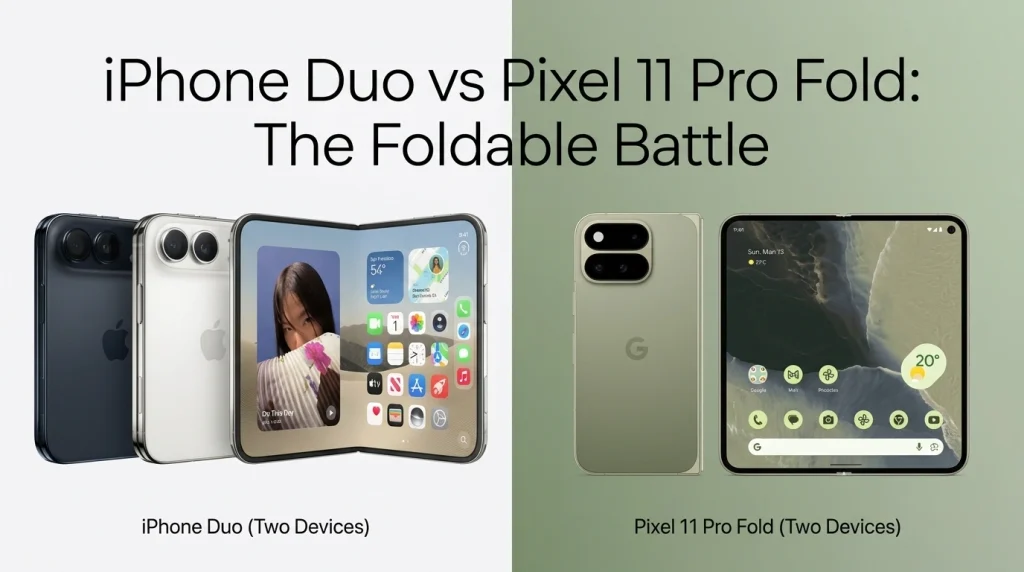
Apple’s iPhone Duo and Google’s Pixel 11 Pro Fold take sharply different approaches to a book-style foldable. The iPhone is built around a compact 5.4-inch outer screen, a dense 7.6-inch inner display and tightly adapted iOS 27.1 software. Google counters with larger 6.5-inch and 8-inch displays, a lighter body, a true 5x telephoto camera and the flexibility of Android 17. This official-specification comparison explains where each phone has the clearer advantage and which buyers should choose it.
- Pixel 11 Pro Fold offers the larger outer and inner displays, weighs 16 grams less and costs $100 less at U.S. list price.
- iPhone Duo is thinner when open, supports storage up to 2TB and promises faster wired charging to 50 percent.
- Google provides a dedicated 5x telephoto camera and up to 30x zoom; Apple emphasizes two 48MP rear cameras and 4K Dolby Vision recording.
- Both have IP68 protection and 25W-class magnetic wireless charging, but their software ecosystems and regional launch timing differ.
Quick comparison
This iPhone Duo vs Pixel 11 Pro Fold comparison uses official Apple and Google specifications to explain the practical differences. The most important difference is scale. Google’s foldable behaves more like a conventional flagship when closed because its 6.5-inch outer screen is substantially larger than the iPhone Duo’s compact 5.4-inch panel. Open them and the Pixel again provides more room, with an 8-inch inner display versus 7.6 inches on the iPhone. Apple answers with a smaller passport-like footprint, a premium titanium build and a display shape designed to keep content proportional across both screens.
The Pixel 11 Pro Fold is the more practical choice for buyers who want a roomy cover screen, lower weight, a long-range camera and a lower starting price. The iPhone Duo makes more sense for committed Apple users who value iOS continuity, Apple-specific accessories, 2TB storage and Apple’s video features.
| Feature | Apple iPhone Duo | Google Pixel 11 Pro Fold |
|---|---|---|
| Starting U.S. price | $1,999 | $1,899 |
| Outer display | 5.4-inch OLED, up to 120Hz | 6.5-inch OLED, 1–120Hz |
| Inner display | 7.6-inch OLED, up to 120Hz | 8-inch OLED, 1–120Hz |
| Weight | 254 g | About 238 g |
| Processor | Apple A20 Pro | Google Tensor G6 |
| Storage | 256 GB to 2 TB | 256 GB to 1 TB; 16 GB RAM |
| Rear cameras | 48MP main + 48MP ultrawide | 48MP main + 10.5MP ultrawide + 10.8MP 5x telephoto |
| Charging claim | 50% in around 20 minutes; MagSafe/Qi2 up to 25W | 50% in about 30 minutes; Qi2.2 up to 25W |
| Launch software | iOS 27.1 | Android 17 |
Key differences that matter most
Pixel wins on screen area, weight and optical zoom reach. It is about 16 grams lighter, provides a 5x telephoto camera and starts $100 below the iPhone in the United States. Its 16GB RAM specification is also clearly published across all storage configurations.
The iPhone Duo wins on maximum storage, ultrawide resolution and claimed charging time. Apple offers a 2TB configuration, while Google tops out at 1TB. The Duo’s 48MP ultrawide is much higher resolution on paper than the Pixel’s 10.5MP unit, although sensor processing and real-world output cannot be judged from specifications alone. Apple says a suitable 60W adapter can bring the Duo to 50 percent in around 20 minutes; Google quotes about 30 minutes with a 30W PPS charger.
Design, displays and durability
Apple uses grade 5 titanium, Ceramic Shield surfaces and a precision hinge containing more than 100 components. The Duo measures 5.2mm when open and 11.3mm when closed, but its 254g weight makes it the heavier device. Its compact 5.4-inch outer screen favors one-handed tasks; the 7.6-inch inner panel has a nano-texture finish intended to reduce glare and make the crease less distracting.
Google’s Pixel is roughly 238g and is almost 10 percent lighter than its predecessor. The larger 6.5-inch cover display is easier for typing and regular phone use, while the 8-inch inner display gives multitasking and media more space. Both Pixel panels reach a quoted 3,600-nit peak, compared with Apple’s 3,000-nit outdoor peak. Both devices carry IP68 ratings, an unusually strong dust-and-water specification for foldables, though neither should be treated as damage-proof.
Performance and everyday use
The iPhone Duo uses Apple’s A20 Pro with a six-core CPU, seven-core GPU and dual 16-core Neural Engine. Apple pairs it with a vapor chamber and says sustained performance is up to 35 percent better than iPhone 17 Pro. That is a manufacturer comparison, not a direct benchmark against Tensor G6, so it should not be used to declare an overall winner.
Google’s Tensor G6 is paired with 16GB RAM and a Titan M3 security coprocessor. Google prioritizes on-device Gemini features, camera processing, translation and Pixel-specific assistance. For conventional gaming and creative apps, the A20 Pro hardware proposition appears stronger on paper; for Google’s AI services and Android flexibility, Tensor G6 is the more integrated platform. Actual sustained speed, heat and battery drain require controlled cross-device testing.
Camera comparison
Apple’s rear system has a 48MP Fusion Main camera and a 48MP Fusion Ultra Wide. The main sensor supplies an optical-quality 2x crop, but there is no dedicated long telephoto. The Duo supports 4K Dolby Vision recording up to 120 fps on the main camera, sensor-shift stabilization, macro capture and Duo Preview, which uses the foldable form for framing.
Google provides three rear focal lengths: a 48MP main, 10.5MP ultrawide with autofocus and Macro Focus, and a 10.8MP telephoto with 5x optical zoom. Super Zoom reaches 30x. That makes the Pixel the clearer choice for distant subjects and flexible framing. The iPhone’s 48MP ultrawide and advanced Dolby Vision options give it the more compelling paper specification for wide-angle detail and video creators. Image quality should still be judged from consistent sample comparisons rather than megapixels alone.
Battery and charging
The Pixel lists a 4,806mAh typical battery and more than 24 hours of battery life. Google says it reaches 50 percent in about 30 minutes with a compatible 30W USB-C PPS charger. Pixelsnap uses built-in Qi2.2 magnetic alignment and supports wireless charging up to 25W.
Apple does not publish battery capacity, so a direct milliamp-hour comparison would be misleading. Instead, it quotes up to 24 hours of mixed use, up to 44 hours of video playback on the outer display and up to 31 hours on the inner display. The Duo can reach 50 percent in around 20 minutes with a suitable 60W adapter and supports MagSafe and Qi2 charging up to 25W. Apple’s playback claims are impressive, but test methods differ from Google’s, so they are not head-to-head endurance results.
Software, multitasking and ecosystem
iPhone Duo arrives with iOS 27.1, a foldable-specific version with Split View, side-positioned controls, adapted Apple apps and continuity between the outer and inner screens. Apple Pencil support is scheduled for later in the year. Touch ID sits in the side button, and the phone is eSIM-only worldwide. Buyers already using a Mac, iPad, Apple Watch, AirPods or iCloud will get the strongest ecosystem benefits. Our detailed iPhone Duo specifications guide explains the hardware and release schedule, while the iOS 27 guide covers broader software compatibility.
Pixel ships with Android 17 and seven years of OS, security and Pixel Drop updates. It supports app bubbles, split screen, drag and drop, tabletop modes and Google’s Gemini Intelligence features. Sign-to-text translation, HiLight notifications and Pixel camera tools add differentiated utility. Readers comparing other Android foldables can also see our Motorola Razr Fold versus Pixel 11 Pro Fold comparison.
Price, storage and availability
Google launched Pixel 11 Pro Fold at $1,899 in the United States, with sales beginning August 20, 2026. The current Google Store may show trade-in or financing promotions, so buyers should distinguish the standard price from conditional offers. Storage options are 256GB, 512GB and 1TB, all with 16GB RAM.
Apple starts iPhone Duo at $1,999 in the United States. It adds a 2TB tier above 256GB, 512GB and 1TB. Pre-orders open October 16, followed by availability on October 23 in more than 70 countries and regions; 28 additional markets follow on October 30. The Pixel is therefore available sooner and costs less at launch, while the Duo reaches more storage-heavy buyers. Regional pricing, carrier support and feature availability should be checked locally.
Winner by category
Best outer display: Pixel 11 Pro Fold, because 6.5 inches is far more practical for normal phone use. Best inner display: Pixel, for its larger 8-inch canvas and higher quoted peak brightness. Best compact design: iPhone Duo, thanks to its smaller folded footprint. Best portability: Pixel, because it weighs less.
Best zoom camera: Pixel, with a dedicated 5x telephoto. Best ultrawide and video specification: iPhone Duo, with a 48MP ultrawide and 4K120 Dolby Vision on the main camera. Best storage range: iPhone, because it offers 2TB. Best starting value: Pixel, at $100 less in the U.S. Best ecosystem choice: whichever platform already contains the buyer’s apps, services, accessories and shared family purchases.
Which foldable should you buy?
Choose iPhone Duo if you want the first foldable built around Apple’s hardware and software ecosystem, prefer a smaller cover-screen footprint, record a lot of high-quality video, need up to 2TB of storage or rely on Apple-specific services and accessories. Its later launch also means buyers should wait for independent durability, camera and battery testing before committing.
Choose Pixel 11 Pro Fold if you want a foldable that feels like a full-size phone while closed, prefer a larger inner workspace, need a dedicated 5x zoom camera, value Android customization or want the lower list price. It is also lighter and already available. Neither is an automatic winner for everyone: app optimization, repair costs, local support and long-term hinge reliability may matter more than a single specification.
Final verdict
Pixel 11 Pro Fold is the stronger all-round hardware value. Its larger displays, lighter body, 5x telephoto camera, 16GB RAM and lower U.S. starting price answer more practical foldable-phone needs. It is the safer recommendation for buyers who are platform-neutral.
The iPhone Duo is the more distinctive ecosystem product. Its compact folded shape, titanium construction, high-resolution ultrawide, video tools, faster claimed charging and 2TB ceiling are meaningful advantages. For an existing Apple user who specifically wants a foldable without leaving iOS, those strengths can outweigh the Pixel’s better value. Everyone else should compare local pricing and wait for independent testing of cameras, heat, battery life and hinge durability.