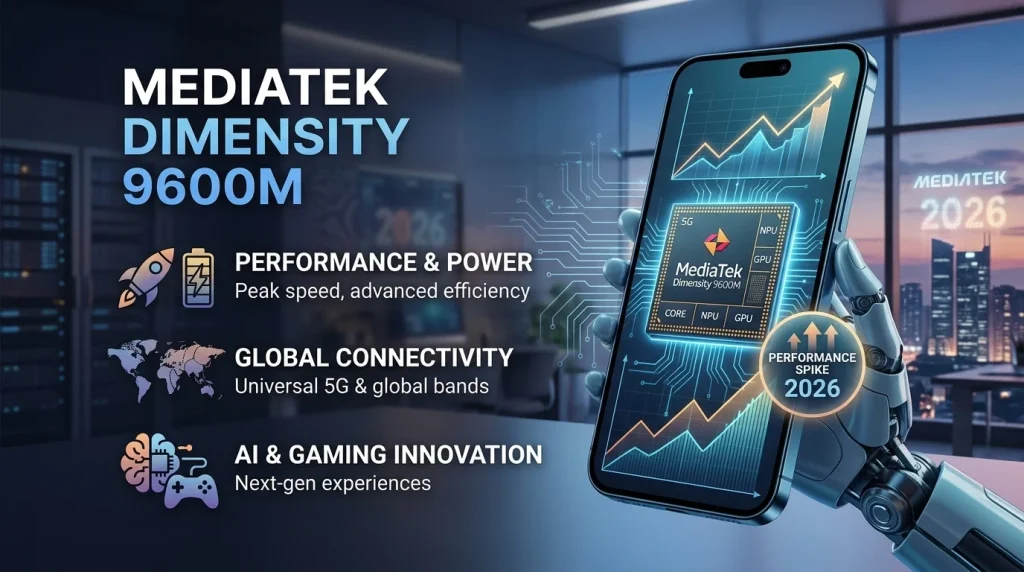
MediaTek’s Dimensity 9600M is the less expensive sibling to the 2nm Dimensity 9600 Pro, but its official specification sheet still reads like a flagship-class smartphone platform. MediaTek lists an all-big-core Arm CPU, Mali-G1 Ultra MC12 graphics, NPU 990 AI hardware, LPDDR5X-10667 memory, four-lane UFS 4.1 storage, support for cameras up to 320MP, 8K60 video, WQHD+ displays up to 180Hz, Wi-Fi 7 and Bluetooth 6.0. Reuters reported on September 15, 2026 that the 9600M uses TSMC’s 3nm process, while the 9600 Pro moves to 2nm.
This is a specification and platform analysis, not a benchmark or hands-on phone review. A chipset’s maximum supported features do not guarantee that every Dimensity 9600M phone will include them: phone makers choose their own display, camera sensors, memory, cooling, modem configuration and software limits.
Dimensity 9600M highlights
- 3nm premium mobile platform according to Reuters’ September 15 launch report.
- Eight-core all-big-core CPU: 1x Arm C1-Ultra, 3x C1-Premium and 4x C1-Pro.
- Arm Mali-G1 Ultra MC12 GPU with MediaTek gaming technologies and support for up to 185fps gaming scenarios.
- NPU 990 plus an efficiency-focused NPU for generative and agentic AI workloads.
- LPDDR5X-10667 memory and four-lane UFS 4.1 storage support.
- Up to 320MP camera sensor support, 8K60 capture and 4K120 video with EIS.
- WQHD+ displays up to 180Hz and tri-port MIPI support for tri-fold displays.
- Sub-6GHz 5G, Wi-Fi 7 and Bluetooth 6.0.
CPU, memory and storage
| Specification | Dimensity 9600M |
|---|---|
| CPU layout | 1x Arm C1-Ultra, 3x Arm C1-Premium, 4x Arm C1-Pro |
| CPU cores | 8 |
| L2 cache | 2MB on C1-Ultra; 1MB per C1-Premium; 512KB per C1-Pro |
| Shared cache | 16MB L3 + 10MB SLC |
| Memory | LPDDR5X 10667 |
| Storage | UFS 4.1, four lanes |
MediaTek calls this an all-big-core design because it does not use the conventional mix of big performance cores and small efficiency cores. The company also highlights Armv9.3 and SME2 instructions for AI and machine-learning work. Large caches and fast storage are intended to reduce waiting on data, but real-world responsiveness will still depend on a phone maker’s thermal design and software tuning.
Graphics, display and gaming
| Area | Official capability |
|---|---|
| GPU | Arm Mali-G1 Ultra MC12 |
| Maximum display class | WQHD+ up to 180Hz |
| Foldable support | Tri-port MIPI for tri-fold displays |
| Gaming claim | Up to 185fps in supported gaming scenarios |
| Ray-traced scenes | MediaTek claims true 120fps ray-traced scenes in supported workloads |
| Frame-rate technology | MRFC 3.0 can raise supported 60fps titles toward 120fps output |
The headline frame-rate numbers are platform capabilities, not promises that every game will run natively at those rates. Game support, rendering resolution, thermal headroom and the phone’s display refresh rate all matter. Buyers should therefore treat 185fps as a ceiling for supported scenarios rather than a universal performance result.
AI capabilities
| Feature | Support |
|---|---|
| Main AI processor | MediaTek NPU 990 |
| Efficiency AI | Additional Compute-in-Memory efficiency architecture for always-on tasks |
| Models named by MediaTek | Gemini Nano 4 and Qwen 3.5 Omni 4B |
| Generative imaging | 4K-resolution text-to-image support |
| Camera AI | Camera-agent support for photography suggestions |
These capabilities give phone makers a foundation for on-device AI, but the actual features available to a buyer will depend on each brand’s software. A handset using the 9600M does not automatically receive every model or AI feature MediaTek demonstrates.
Camera and video support
| Imaging capability | Maximum/support |
|---|---|
| Camera sensor | Up to 320MP |
| Video capture | 8K60 |
| High-frame-rate 4K | 4K120 with EIS |
| Cinematic mode | 4K60 |
| Decode | 8K60 10-bit HEVC, AVC, VP9 and AV1 |
| Encode | Up to 8K30 10-bit HEVC/AVC; 8K60 8-bit HEVC |
Again, 320MP and 8K60 describe what the platform can support. A finished phone can use a much lower-resolution sensor or limit video modes for heat, storage, stabilization or product-positioning reasons.
5G, Wi-Fi, Bluetooth and navigation
| Connectivity | Official specification |
|---|---|
| Cellular | 3GPP Release 17, sub-6GHz 5G, 2G-5G multi-mode |
| 5G aggregation | Sub-6GHz downlink 5CC, up to 350MHz aggregate bandwidth |
| MediaTek stated 5G speed | Up to 7.4Gbps in supported configurations |
| SIM features | 5G/4G Dual SIM Dual Active and dual data support |
| Wi-Fi | Wi-Fi 7; triple-band triple concurrency; up to 7.3Gbps platform rate |
| Bluetooth | Bluetooth 6.0 with dual Bluetooth engine; up to 12Mbps |
| GNSS | GPS, BeiDou, GLONASS, Galileo, QZSS and NavIC bands listed by MediaTek |
How the 9600M differs from the Dimensity 9600 Pro
The naming can make the two chips sound like minor variants, but the launch positioning is more substantial. Reuters reports that the 9600 Pro is manufactured on TSMC’s 2nm technology while the 9600M uses 3nm. MediaTek’s 9600M specification page also lists C1-generation CPU cores, LPDDR5X and UFS 4.1. By contrast, our Dimensity 9600 Pro launch analysis covers the newer flagship platform and its higher-end positioning.
That does not make the 9600M a low-end chip. Its display, imaging, AI and connectivity ceilings are firmly premium. The more useful interpretation is that MediaTek now has two tiers within its 9600 family: the 9600 Pro for maximum-generation flagship hardware and the 9600M for premium phones that can trade some silicon-generation advantages for a different cost/performance balance.
What this means for upcoming phones
The 9600M gives manufacturers considerable flexibility. A brand could pair it with a high-refresh WQHD+ panel, large camera sensor and fast UFS 4.1 storage, or use a more conservative display and camera package to hit a lower price. That is why chipset support should never be copied directly into a phone specification sheet before the phone maker confirms the hardware.
For context, PhoneSpecX is also tracking the Vivo X500 Pro Max launch and the broader Dimensity 9600 Pro platform. Those stories show why final device implementation matters as much as the silicon’s maximum capabilities.
Should buyers care about the Dimensity 9600M?
Yes, but the phone around it matters more than the model number alone. The 9600M’s official feature set is strong enough for premium Android phones, especially for buyers interested in high-refresh displays, advanced camera pipelines, on-device AI and modern wireless connectivity. The unknown for any future handset is sustained performance: cooling, battery capacity, power profiles and software optimization determine how much of the chipset’s capability is available over long sessions.
Frequently asked questions
Is the Dimensity 9600M a 2nm chip?
No. Reuters reported at launch that the Dimensity 9600M uses TSMC’s 3nm process, while the Dimensity 9600 Pro uses 2nm technology.
Does the Dimensity 9600M support 320MP cameras?
Yes. MediaTek’s official specification page lists a maximum supported camera sensor of 320MP. That does not mean every 9600M phone will use a 320MP camera.
Can it record 8K video at 60fps?
The platform officially supports 8K60 capture. Individual phones may expose lower limits depending on their sensors, thermal design and software.
Does the Dimensity 9600M support Wi-Fi 7?
Yes. MediaTek lists Wi-Fi 7 with triple-band triple concurrency and a platform rate of up to 7.3Gbps under supported conditions.
Is 185fps gaming guaranteed?
No. MediaTek advertises support for gaming scenarios up to 185fps, but actual frame rates depend on the game, display, phone cooling, power limits and software implementation.
Sources and References
- MediaTek — Dimensity 9600M official product page and specifications (accessed September 20, 2026)
- Reuters — MediaTek launches new mobile chip using TSMC’s most advanced technology (September 15, 2026)