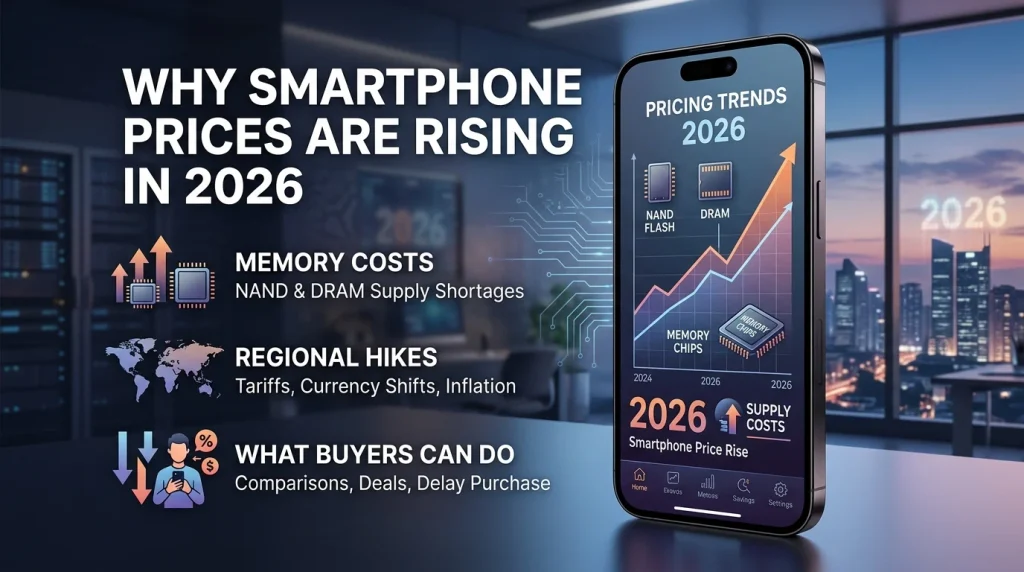
Smartphone prices are rising unusually fast in 2026, and the strongest evidence points to memory costs as a major driver rather than a single-brand pricing decision. Counterpoint Research reported on September 3 that prices of existing smartphones had risen by about 15% globally during 2026, while newly launched models were about 25% more expensive year over year. TrendForce separately documented sharp increases in mobile DRAM and NAND contract prices and warned that manufacturers are responding with higher retail prices, tighter memory configurations and changes to product portfolios.
For buyers, the practical takeaway is simple: compare the exact RAM/storage configuration and current street price instead of assuming a new generation will cost roughly the same as its predecessor. Budget and mid-range phones are especially exposed because memory represents a larger share of their bill of materials and margins are thinner.
Highlights
- Counterpoint says existing smartphone prices rose about 15% globally in 2026, while new launches were roughly 25% costlier year over year.
- Its regional tracker shows larger increases in India, Asia-Pacific, the Middle East and Africa than in the US and Europe.
- TrendForce says mobile DRAM prices surged through 2026 as suppliers prioritized higher-value server and AI-related demand.
- Manufacturers are responding not only with higher prices, but also with lower-capacity configurations and portfolio changes.
- Buyers should compare price per storage tier, launch promotions and older models rather than relying on headline launch prices alone.
How large are the 2026 smartphone price increases?
Counterpoint’s Global Smartphone Price Increase Tracker, based on a database of more than 4,000 currently sold models, found that more than 40% of smartphone models had seen price increases in 2026. Its September analysis put the average global increase for existing smartphones at about 15% and said new launches were about 25% more expensive year over year.
| Market / measure | Reported 2026 increase |
|---|---|
| Existing smartphones, global average | About 15% |
| New launches, year over year | About 25% |
| India | 21% |
| Asia-Pacific | 19% |
| Middle East & Africa | 18% |
| Latin America | 16% |
| China | 10% |
| Europe | 7% |
| United States | 5% |
These figures are market-level measurements, not a promise that every handset increased by the same percentage. Carrier subsidies, launch promotions, taxes, exchange rates, channel inventory and the mix of premium versus budget models can all change what an individual buyer actually pays.
Why memory is such a big part of the story
Phones need both DRAM for active workloads and NAND flash for storage. TrendForce reported in May that average selling prices for LPDDR4X mobile memory were expected to jump at least 70–75% quarter over quarter in Q2 2026, while LPDDR5X was expected to rise 78–83%. By July, it still expected conventional DRAM contract prices to rise 13–18% quarter over quarter in Q3 and NAND Flash contract prices to increase 10–15%.
The pressure is connected to a broader semiconductor allocation shift. Memory suppliers have been directing capacity toward server, HBM and enterprise products serving AI and data-center demand. That does not mean an AI server directly sets the price of a phone, but constrained capacity and stronger demand in higher-value segments can make mobile memory more expensive to procure.
Why budget phones can feel the pressure first
TrendForce estimated in February that memory historically represented around 10–15% of a smartphone bill of materials, but that the share had risen to roughly 30–40% under the 2026 price surge. It used a mainstream 8GB + 256GB configuration as an example, estimating its memory contract price in Q1 2026 had risen nearly 200% year over year.
That matters most where margins are already narrow. A premium phone has more room to absorb a component increase or spread it across a higher retail price. A low-cost model has less flexibility. TrendForce therefore expects entry-level phones to cluster around 4GB RAM, mid-range models around 8GB and 12GB to become more common at the high end while 16GB adoption declines.
Price increases are not the only response
Counterpoint says manufacturers are also managing costs through lower storage capacities, camera specification adjustments and, in some price bands, renewed use of 4G models. That makes specification-by-specification comparison more important than simply comparing model generations.
A phone that keeps the same headline price can still become worse value if the base storage tier shrinks, a higher-capacity variant becomes disproportionately expensive or another component is downgraded. Conversely, an older model with adequate software support may become more attractive if retailers discount remaining inventory.
What the regional differences mean
Counterpoint’s data shows the biggest measured increases in price-sensitive emerging markets: India at 21%, Asia-Pacific at 19% and the Middle East and Africa at 18%. It reported smaller increases in China, Europe and the US. The research firm attributes part of that difference to product mix and purchasing structures: premium-heavy or carrier-led markets can absorb or mask increases differently, while lower-priced markets have less margin available to cushion component costs.
PhoneSpecX has already seen this issue surface in individual markets. Our report on the Galaxy S26 India price-hike reports illustrates how component pressure can become a retail-price story, while the OnePlus 13s 16GB/512GB India analysis shows why comparing the exact memory tier matters. Buyers considering cheaper hardware can also use our OPPO K14 Lite specifications and price guide as an example of checking the complete configuration rather than only the headline price.
Should you buy now or wait?
There is no universal answer. The available industry evidence does not establish that every phone will keep getting more expensive indefinitely, and memory contract prices can change. However, the September 2026 data does not support assuming a rapid return to 2025 pricing either.
If your current phone works well, waiting for a major sale, trade-in offer or a well-supported previous-generation model can still make sense. If you need a replacement now, compare the final checkout price, RAM/storage tier, update policy, battery, camera hardware and warranty. A nominally cheaper model is not automatically better value if it requires a storage upgrade immediately.
Frequently asked questions
Are all smartphones 15% more expensive in 2026?
No. Counterpoint’s roughly 15% figure is a global average for existing smartphones in its tracker. Individual models and regions vary substantially.
Why are phone memory prices rising?
TrendForce links the increases to tight DRAM and NAND supply, with memory capacity increasingly prioritized for server, HBM and enterprise applications amid strong AI and data-center demand.
Which regions have seen the largest smartphone price increases?
Counterpoint’s September 2026 data shows India at 21%, Asia-Pacific at 19% and the Middle East and Africa at 18%, above the global average.
Will phones start shipping with less RAM?
In some tiers, that is already part of the industry response. TrendForce says 4GB is common again in entry-level planning, 8GB is central in the mid-range, and 12GB is becoming more mainstream at the high end while 16GB adoption declines.
Does a higher launch price mean a phone is bad value?
Not necessarily. Value depends on the complete package, including storage, software support, cameras, battery, warranty and local promotions. Compare equivalent configurations rather than price alone.
Sources and References
- Counterpoint Research — Global Existing Smartphone Prices Climb About 15% in 2026 — September 3, 2026.
- TrendForce — Mobile DRAM Contract Prices Continue Rising in 2Q26 — May 14, 2026.
- TrendForce — AI Server Demand Continues to Support Memory Prices in 3Q26 — July 3, 2026.
- TrendForce — Memory Price Surge Intensifies Retail Pricing Pressure — February 11, 2026.