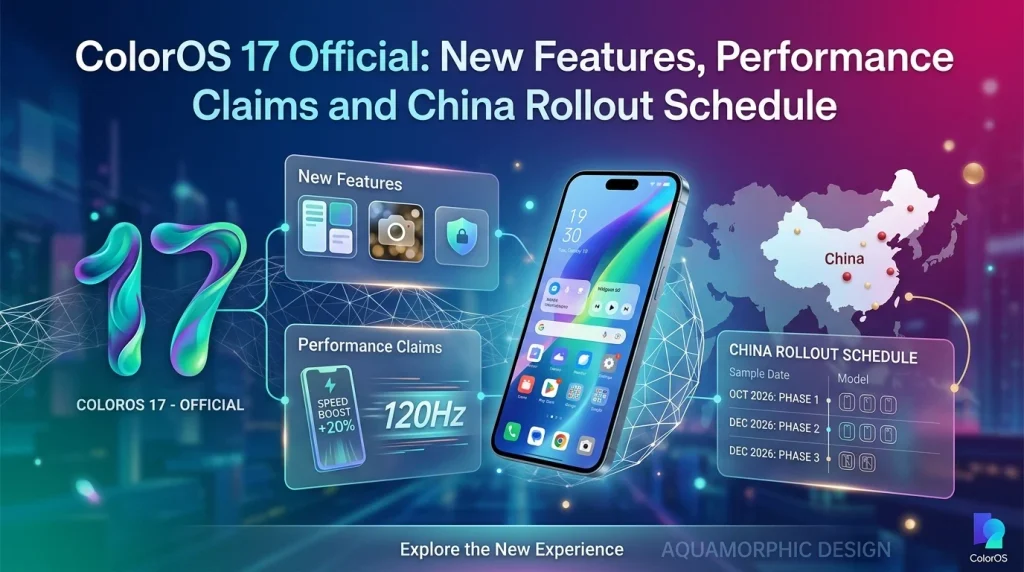
OPPO officially introduced ColorOS 17 in China on September 17, 2026, bringing a redesigned interface, new system engines, expanded AI tools and a staged upgrade plan for OPPO, OnePlus and realme devices in the Chinese market. The important qualification is geographic: the dates announced so far are for China. OPPO has not yet published a matching global or India-specific stable rollout calendar.
This is an evidence-based software overview, not a hands-on review. Performance percentages below are manufacturer claims reported from OPPO’s launch presentation; they should not be treated as independent benchmark results.
ColorOS 17 highlights at a glance
| Area | Confirmed launch information |
|---|---|
| Base platform | Android 17 |
| Design direction | Fluid Design with translucent effects, revised system surfaces and smoother visual transitions |
| Performance systems | Polar Light/Aurora-class engine, Fusion Rendering Architecture and next-generation Tidal Engine |
| AI focus | Xiaobu assistant upgrades, AI Retoucher, AI Notes and memory/productivity features |
| First stable push | October 8, 2026 in China |
Fluid Design: what actually changes
ColorOS 17’s most visible change is its new Fluid Design language. Launch coverage shows greater use of translucent surfaces, glow effects, rounded controls and connected animations across the lock screen, home screen, notifications and system apps. The purpose is not simply cosmetic: OPPO is presenting the visual system and rendering pipeline as parts of the same smoothness strategy.
| Interface element | ColorOS 17 change |
|---|---|
| Control Center | Rounded controls and revised visual effects |
| Lock screen | More customization and connected clock/home transitions |
| Notifications | Reworked presentation with translucent/frosted visual treatment |
| System apps | Updated navigation and more consistent design language |
Performance claims: Polar Light, Fusion Rendering and Tidal Engine
OPPO is making specific performance claims for ColorOS 17. These figures are useful for understanding the engineering targets, but they remain vendor measurements until independently reproduced across multiple devices. Hardware, storage condition, thermal state and installed apps can materially affect real-world results.
| Claim | OPPO-reported figure / purpose |
|---|---|
| App startup/runtime memory | About 25% reduction/improvement attributed to the new system engine |
| Rendering workload | About 30% lower rendering load |
| Background app stability | Up to 55.6% improvement claimed with next-generation Tidal Engine scheduling |
| Long-term smoothness | OPPO claims sustained smooth performance over extended multi-year use; this is not an independent longevity test |
AI and productivity features
ColorOS 17 expands OPPO’s system-level AI layer. The China build centers heavily on Xiaobu, OPPO’s assistant, so feature names and availability may differ if and when the global build is announced. Users outside China should therefore avoid assuming every China-specific AI service will transfer unchanged.
| Feature | What OPPO announced |
|---|---|
| Xiaobu assistant | Next-generation assistant functions including Xiaobu Space, Calls, Memory and personalized interaction |
| AI Retoucher | System-supported AI photo editing/retouching workflow |
| AI Notes | Redesigned notes experience with sharing and inspiration-card functions |
| Earbud intelligence | AI conversation interpretation is part of the broader connected-device feature set on compatible hardware |
Cross-device, security and accessibility additions
The release is broader than a phone UI refresh. OPPO is extending information and activity handoff across phones, tablets, watches, earphones and compatible cars. Some functions depend on specific hardware or services, so device eligibility for ColorOS 17 does not automatically guarantee every ecosystem feature.
| Capability | Launch detail |
|---|---|
| Fluid Cloud | Information synchronization across supported devices |
| Car+ | Navigation handoff and connected-car functions on compatible systems |
| Wearables | Exercise-data integration and new watch functions including FatMax mode on supported products |
| Security | Expanded fraud/deepfake-oriented protections were highlighted in launch coverage |
Confirmed China rollout: October 8
The first stable ColorOS 17 push is scheduled to begin in China on October 8, 2026. A push-start date does not mean every eligible unit receives the update simultaneously; staged OTA deployments can take time.
| October 8 group | Confirmed models/families |
|---|---|
| OPPO foldable | Find N6 family, including listed China variants |
| OPPO flagship | Find X9 family |
| OnePlus | OnePlus 15 and OnePlus 15T |
| realme | realme GT 8 Pro family |
Confirmed China rollout: October 16 and later
A second major wave starts October 16. Additional products are scheduled through November and December 2026, with further eligible devices extending into the first quarter of 2027. The exact sequence matters because OPPO, OnePlus and realme are coordinating the China roadmap rather than updating every supported device at once.
| Wave | Examples confirmed in the China schedule |
|---|---|
| October 16 — OPPO | Find N5, Find X8 family, Pad 5 Pro and Pad Mini families |
| October 16 — OnePlus | OnePlus 13 family, Ace 6 family and Pad 3 Pro |
| October 16 — realme | GT 8 family and GT 7 Pro among the listed models |
| November–December | Additional OPPO Pad, OnePlus Ace/Pad and realme GT/Neo products |
| Q1 2027 | Further supported devices in the China roadmap |
New phones shipping with ColorOS 17
OPPO’s upcoming Find X10 series is expected to ship with ColorOS 17 in China, while OnePlus has confirmed ColorOS 17 for the China-market OnePlus 16. PhoneSpecX has separate coverage of the OPPO Find X10 series launch and the OnePlus 16’s confirmed 165Hz display and ColorOS 17 software.
| Product | ColorOS 17 position |
|---|---|
| OPPO Find X10 series | New-generation China flagship family associated with ColorOS 17 out of the box |
| OnePlus 16 | Confirmed to run Android 17-based ColorOS 17 in China |
| OPPO Watch S2 | Part of the wider ColorOS 17 ecosystem announcement with new health/fitness functions |
What global users should know
The biggest limitation in the current announcement is simple: China dates are not global dates. As of September 18, 2026, no equivalent official India or worldwide stable schedule has been announced. Global OPPO software may also differ in AI assistant branding, services and regulatory features. OnePlus devices sold internationally generally use OxygenOS rather than the China-market ColorOS branding, so owners should wait for their region’s official OnePlus roadmap instead of applying the China ColorOS dates directly.
For context on devices likely to matter early in the cycle, see our OPPO Find X9 Pro research review and OPPO Find X9 Ultra specifications. These are existing PhoneSpecX articles, not claims that every regional variant will receive ColorOS 17 on the same date.
Should you install ColorOS 17 immediately?
If your phone receives the stable OTA through its normal system updater, the sensible approach is to check the changelog, back up important data and confirm that critical banking, work and accessibility apps are compatible. Users who prioritize stability may prefer to wait for early rollout feedback. Do not install firmware intended for another model or region merely to get ColorOS 17 sooner.
ColorOS 17 FAQ
Is ColorOS 17 based on Android 17?
Yes. OPPO announced ColorOS 17 as its Android 17-based software generation.
When does the stable ColorOS 17 rollout begin?
The confirmed China rollout begins October 8, 2026 for the first group of eligible devices. That date is not a confirmed global rollout date.
Will OnePlus phones receive ColorOS 17?
In China, supported OnePlus devices are included in the ColorOS 17 roadmap. International OnePlus software branding and schedules can differ, so global users should follow their regional OxygenOS announcements.
Will realme phones use ColorOS 17?
Supported realme devices are included in the China ColorOS 17 rollout plan. Availability and branding outside China should be verified against regional announcements.
Are OPPO’s performance percentages independently verified?
No. The roughly 25% memory/startup, 30% rendering-load and up-to-55.6% background-stability figures are manufacturer claims from the launch information, not independent PhoneSpecX laboratory measurements.