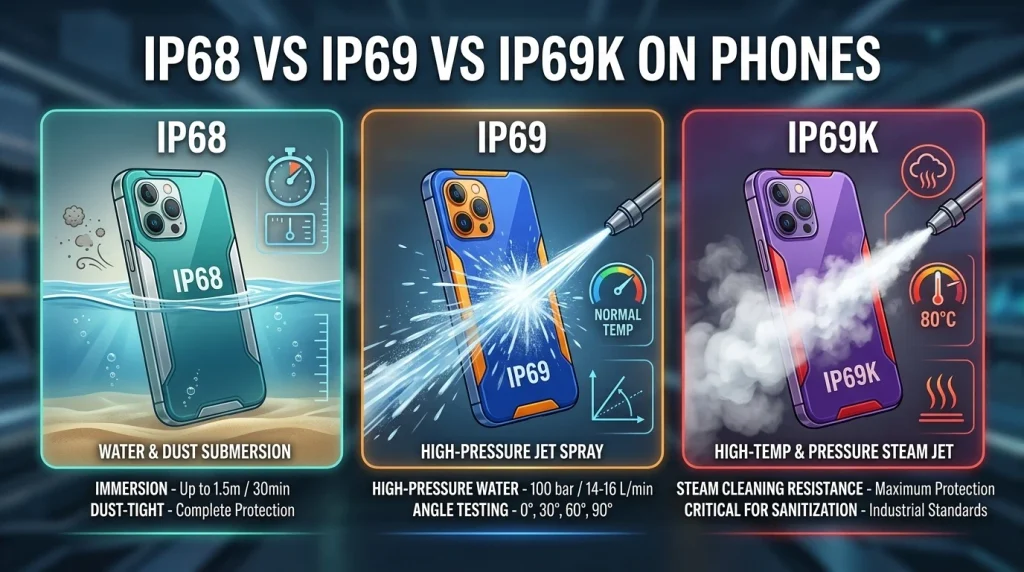
IP68, IP69 and IP69K are not interchangeable labels for a phone being ‘waterproof.’ They describe different controlled ingress tests. IP68 is primarily associated with immersion, while IP69 addresses high-pressure, high-temperature water jets; IP69K is a related high-pressure/high-temperature designation used under standards such as ISO 20653. A phone can therefore carry several ratings because passing one test does not automatically prove that it passed the others.
Quick answer: IP68 vs IP69 vs IP69K
| Rating | What it principally demonstrates | What buyers should remember |
|---|---|---|
| IP68 | Dust-tight enclosure plus immersion protection under the manufacturer’s stated test conditions. | Depth and duration matter. Check the maker’s footnotes rather than assuming every IP68 phone has identical limits. |
| IP69 | Protection against powerful, hot water jets under specified laboratory conditions. | It tests a different hazard from still-water immersion, so manufacturers often list IP68 and IP69 together. |
| IP69K | A high-pressure/high-temperature jet test associated with standards including ISO 20653 for road-vehicle electrical equipment. | Read which standard and test method the phone maker cites; the letter K should not be treated as a generic synonym for every IP69 claim. |
Why one phone can have IP66, IP68 and IP69 at the same time
The second digit in an IP code describes protection against water ingress, but the tests represent different exposure patterns. That is why modern durability-focused phones increasingly advertise a combination such as IP66/IP68/IP69 rather than one number alone.
OPPO’s current A6 product documentation is a useful real-world example. OPPO says the phone was tested to IP66, IP68 and IP69 under controlled conditions. Its published IP68 condition is still-water immersion at 1.5 metres for 30 minutes. Its IP69 condition uses water at 80±5°C with a flow of 15±1 litres per minute for two minutes, applied from multiple jet angles. Those are plainly different stresses, so the combined labels communicate more than a single immersion rating would.
What IP68 actually tells you
For smartphones, IP68 is commonly the rating buyers recognize. The first digit ‘6’ indicates the highest dust-ingress category in the familiar IP code system: dust-tight protection. The ‘8’ identifies a water-ingress category involving continuous immersion under conditions agreed or specified for the product.
The important detail is that the exact immersion claim is not universal across every handset. For example, OPPO states 1.5 metres for 30 minutes for several current devices, while realme publishes 2.5 metres for 30 minutes for the realme 14T 5G. Both can legitimately be described as IP68, yet their manufacturer-stated test conditions are not identical. When comparing phones, the footnote is therefore more useful than the badge alone.
What IP69 adds
IP69 addresses forceful water jets and, in current smartphone implementations, manufacturers often document high-temperature water as part of the test. This matters because immersion and a concentrated jet create different stresses on seals, speaker openings, microphones, buttons and joints.
That does not mean an IP69 phone is safe for every liquid or every high-pressure cleaning situation. OPPO explicitly warns that water resistance can decline with wear and that its stated protection does not extend to salt water and certain other liquids such as soapy water or alcohol. The company also advises against charging a wet phone. Those limitations are more representative of real ownership than the shorthand phrase ‘waterproof phone.’
Where IP69K fits
IP69K appears increasingly often in smartphone marketing, but buyers should pay attention to the cited standard. ISO 20653:2023 is formally titled Road vehicles — Degrees of protection (IP code) — Protection of electrical equipment against foreign objects, water and access. Its scope concerns enclosures for electrical equipment in road vehicles.
Some phone manufacturers nevertheless use testing based on that methodology. OPPO India, for example, states that the F33 5G’s IP69K test was conducted by SMQ in accordance with ISO 20653:2023. HONOR also markets current devices such as the X9d with IP69K alongside IP68 and IP66. The practical lesson is to look beyond the badge: identify the standard, laboratory conditions and manufacturer limitations attached to the claim.
Does a higher number mean a phone is safer underwater?
Not necessarily. This is the most common misunderstanding. IP69’s jet-resistance test does not simply replace the IP68 immersion test with a ‘better’ version. The exposure is different. A phone advertised with both IP68 and IP69 has evidence for both categories under its stated laboratory conditions; a lone IP69 label should not be interpreted as unlimited submersion protection.
This is why multi-rating claims have practical value. Phones such as the OPPO F33 Pro 5G combine several durability claims, while newer ruggedized mainstream models are making high-pressure resistance more common outside specialist outdoor phones. PhoneSpecX has also covered the IP69K-equipped HONOR 600 Elite 5G and the thin Nubia Air Pro, illustrating how these ratings now span very different device designs.
Why ‘water-resistant’ is more accurate than ‘waterproof’
Laboratory certification is a controlled test, not a lifetime guarantee. Adhesives, seals and gaskets can age; drops and repairs can alter enclosure integrity; and exposure to salt, soap, alcohol, chlorinated water or other chemicals can behave differently from clean laboratory water.
Warranty language matters too. Both OPPO and realme state on current product pages that liquid-immersion damage is not covered by their warranties despite the advertised ingress ratings. That apparent contradiction is important for buyers: certification describes tested resistance, while warranty coverage is a separate commercial policy.
How to compare water resistance before buying a phone
Start with the exact rating, then read the manufacturer’s test footnote. Note the water depth, duration, temperature, jet pressure or flow where supplied, and the standard cited. Check whether the claim applies to fresh water only and whether the maker excludes salt water, soap, alcohol or other liquids. Finally, read the warranty terms rather than assuming certification automatically covers liquid damage.
For example, the TECNO SPARK 50C represents the broader trend of durability ratings moving into more affordable phones. The useful buying question is no longer simply ‘Does it have an IP rating?’ but ‘Which exposure was actually tested, under what conditions, and what does the warranty exclude?’
FAQs
Is IP69 better than IP68?
It is better for a different type of exposure, not automatically better in every situation. IP68 concerns immersion under specified conditions, whereas IP69 addresses powerful water jets. A device carrying both ratings has been tested for both categories under the maker’s stated conditions.
Can I swim with an IP68 or IP69 phone?
An ingress rating should not be treated as permission for recreational swimming. Manufacturer conditions commonly specify controlled fresh-water tests, and companies may exclude salt water, chemicals and liquid damage from warranty coverage.
Does IP69 mean hot-water protection?
On several current smartphones, manufacturers explicitly state high-temperature water-jet conditions for their IP69 testing. OPPO, for example, publishes an 80±5°C condition for its A6. Always verify the exact model’s documentation because the badge alone does not replace the test footnote.
What is the difference between IP69 and IP69K?
They should not be assumed to be identical labels without checking the referenced standard. IP69 is used in IEC 60529-based product claims, while IP69K is also associated with the ISO 20653 methodology for road-vehicle electrical equipment. Smartphone makers may state exactly which test standard they used.
Does an IP rating guarantee liquid-damage warranty coverage?
No. Certification and warranty coverage are separate. Current OPPO and realme documentation explicitly warns that water resistance can diminish and that liquid damage may not be covered.