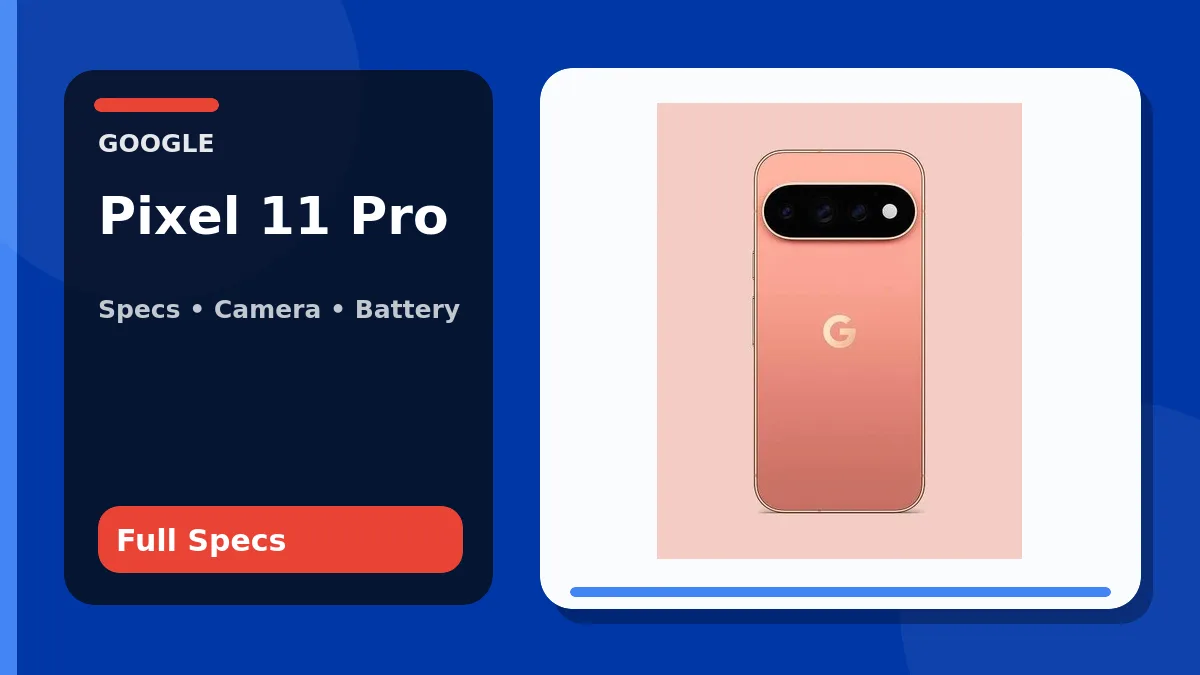
A source-checked guide to the Pixel 11 Pro hardware, cameras, charging, software support, price and practical trade-offs.
- The 6.3-inch Super Actua display reaches up to 3,600 nits, while Gorilla Glass Victus 2 improves scratch resistance.
- Tensor G6, 16GB of RAM and a vapor chamber target sustained flagship performance and on-device AI.
- The rear system combines 50MP wide, 48MP ultrawide and 48MP telephoto cameras, with up to 120x Pro Zoom.
- Google rates battery life at more than 30 hours and supports up to 25W Qi2.2 Pixelsnap charging.
- Seven years of OS, security and Pixel Drop updates strengthen the long-term value.
Quick highlights
Google Pixel 11 Pro specifications place this model between the standard Pixel 11 and the larger Pro XL. It keeps a compact 6.3-inch footprint while carrying Google’s full Pro camera system, Tensor G6 silicon, 16GB of RAM and up to 1TB of storage.
The strongest upgrades are not about screen size. They center on a brighter display, longer-range zoom, faster charging and a security platform built for a seven-year support window. Google’s battery, speed and durability figures are manufacturer claims rather than results from PhoneSpecX hands-on testing.
Design, colors and HiLight
The Pixel 11 Pro is offered in Canyon, Fog, Olive and matte Obsidian. Its familiar camera bar now incorporates HiLight, a set of LEDs around the flash designed to provide a brighter, softer light for photos and video in dark scenes.
Google says the phone is designed to comply with an IP68 water- and dust-resistance rating. That is useful protection against everyday accidents, but resistance can diminish with wear and is not a promise against all liquid damage. Buyers comparing generations can also see how the design direction evolved in our Google Pixel 10 review.
Display and durability
The Pro uses a 6.3-inch Super Actua display rated for up to 3,600 nits of peak brightness. That high ceiling is intended to improve outdoor visibility and HDR highlights, although sustained brightness depends on content, temperature and power conditions.
Corning Gorilla Glass Victus 2 protects the panel. Google claims more than twice the scratch resistance of the Pixel 10 Pro. The size is important: the 6.8-inch specification belongs to the Pixel 11 Pro XL, not this phone.
Tensor G6 performance
Google’s Tensor G6 powers the Pixel 11 Pro, paired with 16GB of RAM and a vapor chamber. The generous memory allocation is useful for camera processing, multitasking and the company’s expanding set of on-device AI features.
Across the Pixel 11 series, Google claims 25% faster browsing, 15% quicker app launches and 50% more TPU compute than the previous generation. It also says AI workloads can run up to 3.5 times faster while using less energy. These figures describe Google’s controlled comparisons, so real gains will vary by app and workload.
Rear and selfie cameras
The three-camera rear system consists of a 50MP wide camera, a 48MP ultrawide and a 48MP telephoto. Google says the main camera uses a new sensor, while the telephoto captures 30% more light than before. The mix is designed to cover landscapes, close subjects, portraits and long-range shots without dropping to a lower-resolution auxiliary sensor.
On the front, a 42MP autofocus camera has a 103-degree field of view. That wider framing should help with group selfies and video calls. Camera quality will still depend on Google’s processing choices, motion, available light and the selected shooting mode.
Zoom and video features
The telephoto supports 5x portrait capture, while computational Pro Zoom extends the range to 120x. The highest setting should be treated as an emergency reach option rather than an optical-equivalent promise; detail and stability generally become more challenging at extreme magnification.
For video, Google lists 8K Video Boost and Pro Stable. Night Sight processing is also claimed to be 4.5 times faster. These cloud-assisted and computational modes may require extra processing time, a network connection or specific capture settings.
Battery and charging
Google rates the Pixel 11 Pro for more than 30 hours of battery life under its test profile. Battery endurance can change substantially with signal strength, camera use, display brightness, gaming and AI features, so the official figure is best used as a comparative baseline.
Wired charging is advertised to reach up to 75% in about 30 minutes with compatible hardware. Wireless charging uses the Qi2.2-based Pixelsnap system at up to 25W, and Google describes it as up to 29% faster than the preceding Pro generation. Chargers and magnetic accessories may be sold separately.
Software, security and updates
The Pixel 11 Pro ships as part of Google’s current Pixel software ecosystem, with seven years of operating-system upgrades, security updates and Pixel Drops. A long support promise is especially valuable on a device with 512GB or 1TB storage, because it gives owners more time to use the hardware before software support becomes the limiting factor.
Titan M3 anchors the security design, and Google says secure boot includes post-quantum cryptography. That does not remove the need for timely updates, strong account security and careful app permissions, but it strengthens the platform’s defense against future cryptographic threats.
Full specifications
| Feature | Google Pixel 11 Pro |
|---|---|
| Display | 6.3-inch Super Actua; up to 3,600 nits peak brightness |
| Display protection | Corning Gorilla Glass Victus 2 |
| Processor | Google Tensor G6 |
| Cooling | Vapor chamber |
| Memory | 16GB RAM |
| Storage | 256GB, 512GB or 1TB; Zoned UFS on 512GB and 1TB |
| Rear cameras | 50MP wide + 48MP ultrawide + 48MP telephoto |
| Front camera | 42MP autofocus; 103-degree field of view |
| Zoom | 5x portraits; up to 120x Pro Zoom |
| Battery claim | More than 30 hours |
| Wired charging | Up to 75% in about 30 minutes |
| Wireless charging | Pixelsnap Qi2.2, up to 25W |
| Durability | Designed to comply with IP68 |
| Software support | Seven years of OS, security and Pixel Drop updates |
Specifications and feature availability can vary by country, carrier and configuration. Google’s official regional store should be checked before purchase.
Price and availability
The Pixel 11 Pro reached shelves on August 20, 2026. Google’s US store lists it from $1,099 before trade-in, while Google’s Australian launch announcement set a starting RRP of AU$1,849. Promotions can make the checkout price look lower, so comparisons should separate the device’s list price from trade-in credits and limited-time offers.
All models start with 256GB. The 512GB and 1TB versions add Zoned UFS storage, but color and capacity combinations may vary by market.
Strengths and trade-offs
Where it stands out
- Full Pro camera array in a smaller 6.3-inch body
- Bright 3,600-nit display and stronger glass protection claim
- 16GB RAM with Tensor G6 and vapor-chamber cooling
- Seven-year update policy
- Qi2.2 Pixelsnap charging at up to 25W
What to weigh carefully
- The $1,099 list price is firmly in flagship territory
- Extreme 120x zoom relies heavily on computational processing
- Google’s endurance and speed figures still need independent testing
- Top storage and some features may differ by market
Alternatives to consider
The larger Pixel 11 Pro XL is the direct alternative for buyers who prioritize a 6.8-inch display over compactness. Existing Pixel owners should compare the new claims with the experience described in our Pixel 10 Pro XL review.
For a lower-cost Google option, the Pixel 10a review explains the compromises of the A-series approach. Shoppers focused on foldables, gaming performance or very fast wired charging should also compare equivalent flagships before committing.
Verdict
The Pixel 11 Pro is the most balanced choice in Google’s Pro pair for people who want the flagship camera and memory configuration without moving to a 6.8-inch phone. The 3,600-nit display, versatile three-camera system, 16GB of RAM, faster charging and seven-year support promise make a strong specification sheet.
Its value depends on how much those Google-specific camera, AI and software features matter. At $1,099 before trade-in, prospective buyers should wait for independent battery and sustained-performance testing if those are decisive priorities.
Pros & Cons
Pros
- Compact 6.3-inch Pro design
- Versatile 50MP/48MP/48MP camera system
- 16GB RAM and up to 1TB storage
- Seven years of updates
- Qi2.2 Pixelsnap charging
Cons
- Premium $1,099 starting list price
- Extreme zoom is computationally dependent
- Official performance and battery claims await independent verification