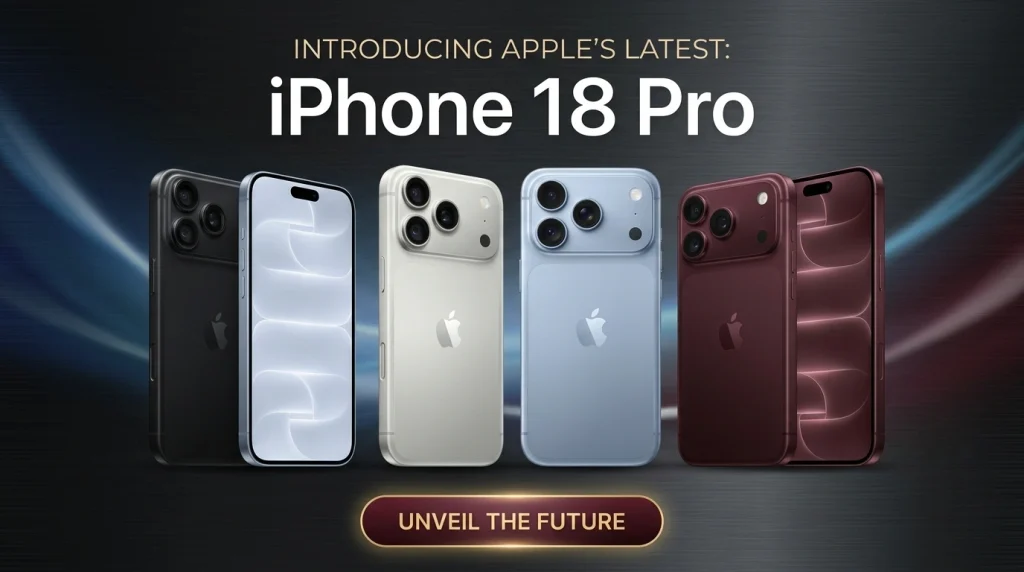
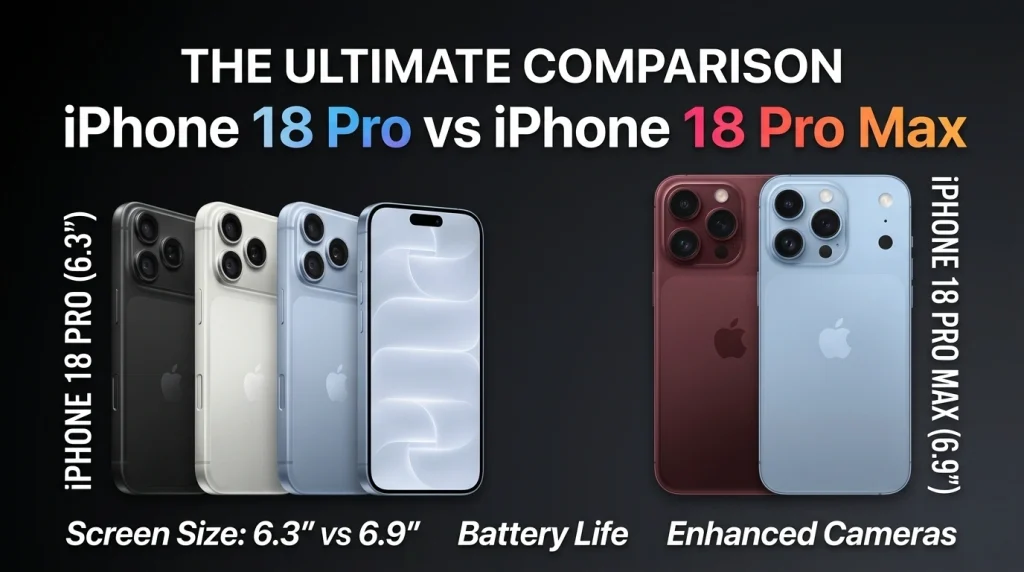
The iPhone 18 Pro is the more compact and lighter choice, while the iPhone 18 Pro Max adds a 6.9-inch display and substantially longer Apple-rated battery life for $100 more. Cameras, performance, storage choices, charging capabilities and core software are otherwise closely matched.
- The iPhone 18 Pro and Pro Max use the same A20 Pro chip, 120Hz OLED display technology and three-camera 48MP Pro Fusion system.
- The Pro is easier to carry at 150.0 mm tall and 211 g; the Pro Max is 163.4 mm tall and 249 g.
- The Pro Max has a 6.9-inch display versus 6.3 inches on the Pro, with the same 460 ppi density and up to 3000 nits outdoor peak brightness.
- Apple rates the Pro Max for up to 30 hours of typical use and 45 hours of video, compared with 24 and 36 hours respectively for the Pro.
- U.S. prices start at $1,199 for the Pro and $1,299 for the Pro Max, making screen size and endurance the main reasons to spend the extra $100.
iPhone 18 Pro vs Pro Max at a glance
The iPhone 18 Pro vs iPhone 18 Pro Max decision is unusually focused. Apple gives both phones the same A20 Pro platform, the same 48MP Pro Fusion rear-camera system, the same four storage capacities and the same display technologies. The meaningful choices are physical size, weight, rated battery life and a $100 difference in starting price.
The 6.3-inch iPhone 18 Pro is designed for buyers who want the full Pro feature set in a smaller body. The 6.9-inch Pro Max is for people who prioritize a larger canvas and Apple’s longest battery ratings, and who accept an extra 38 grams. Both were announced September 9, 2026; pre-orders opened September 12 and general availability begins September 18.
This comparison uses Apple’s final specifications and launch information. It does not claim hands-on testing, measured endurance or independent camera results. Apple also does not publish conventional RAM or battery-capacity figures in these consumer specifications, so none are inferred.
Quick comparison
| Feature | iPhone 18 Pro | iPhone 18 Pro Max |
|---|---|---|
| Display | 6.3-inch OLED, 2622 × 1206 | 6.9-inch OLED, 2868 × 1320 |
| Size | 150.0 × 71.9 × 8.75 mm | 163.4 × 78.0 × 8.75 mm |
| Weight | 211 g | 249 g |
| Typical-use rating | Up to 24 hours | Up to 30 hours |
| Video playback | Up to 36 hours | Up to 45 hours |
| Starting U.S. price | $1,199 | $1,299 |
Everything else important is close: both use 120Hz ProMotion OLED panels, A20 Pro, a three-camera 48MP system, an 18MP Center Stage front camera, iOS 27, Wi-Fi 7 and storage from 256GB to 2TB.
The four differences that matter
First, the Pro Max gives you 0.6 inch more diagonal display space. That is useful for video, games, photo editing, maps and larger text, but it also makes the phone 13.4 mm taller and 6.1 mm wider.
Second, the Pro is 38 g lighter. A 211 g phone is not especially light, but it is meaningfully easier to use one-handed or carry in a pocket than the 249 g Pro Max. Both are 8.75 mm thick, so the Max’s extra bulk comes mainly from its wider and taller footprint.
Third, Apple’s battery ratings strongly favor the larger model. The Pro Max adds six hours to the typical-use claim, nine hours to video playback and seven hours to streamed video. Fourth, the larger phone costs $100 more at each comparable starting point: $1,299 rather than $1,199 in the U.S.
Design and display
Both phones use an aluminum unibody, Ceramic Shield 2 on the front, Ceramic Shield on the back and IP68 resistance under Apple’s stated laboratory conditions. Black, Silver, Glacier and Burgundy are available on both. Camera Control, the Action button and the smaller Dynamic Island are also shared.
The display quality is matched more closely than the physical dimensions suggest. Both panels offer ProMotion up to 120Hz, always-on capability, a one-nit minimum, 1,600-nit HDR peak and up to 3,000 nits outdoors. Pixel density is the same 460 ppi, so the Pro Max does not trade sharpness for size; its 2868-by-1320 resolution simply covers the larger 6.9-inch panel.
Choose the Pro if reachability and pocket comfort matter every day. Choose the Pro Max if you routinely watch long videos, edit media or prefer larger controls and text. The larger display is the clearest experiential upgrade, but it cannot be separated from the extra width and weight.
Performance and cooling
There is no processor-based reason to prefer one model. Both use A20 Pro with a six-core CPU, seven-core GPU, Neural Accelerators, a dual 16-core Neural Engine and hardware-accelerated ray tracing. Apple also equips both with its next-generation vapor chamber for sustained workloads.
Because this is a specification comparison, it would be premature to claim identical benchmark or thermal results. A larger chassis can behave differently under sustained load, but Apple’s official material does not publish model-by-model benchmark data. On paper, app speed, gaming features, video workflows and on-device AI support start from the same hardware foundation.
Camera comparison
The camera systems are effectively equal. Both have a 48MP Fusion Main camera with variable aperture settings of f/1.48, f/1.8, f/2.8 and f/4.0; a 48MP Fusion Ultra Wide; and a 48MP Fusion Telephoto offering 4x optical and 8x optical-quality views. Each also has an 18MP Center Stage front camera with autofocus.
Apple lists the same Pro controls for aperture, shutter speed, white balance and histograms, plus ProRAW, ProRes RAW, Apple Log 2 and external 4K/120 fps recording support. The Max does not receive a longer telephoto reach or a higher-resolution sensor. Buyers should therefore choose between the two sizes based on handling, display and battery needs rather than expecting a camera upgrade on the Max.
The larger Max screen may be more comfortable as a viewfinder or editing surface, while the smaller Pro may be easier to stabilize and operate for longer periods. Those are ergonomic considerations, not differences in the published camera hardware.
Battery life and charging
Battery life is where the Pro Max earns its clearest specification win. Apple rates it for up to 30 hours of typical use, 45 hours of local video playback and 40 hours of streamed video. The Pro is rated for up to 24 hours of typical use, 36 hours of video and 33 hours streamed.
Those are Apple ratings rather than independent endurance tests, but the gaps are large enough to shape the buying decision. Frequent travelers, heavy camera users and people who spend long days away from a charger have the strongest reason to choose the Max.
Charging capabilities are shared. Apple says either model can reach up to 50% in around 15 minutes with a compatible 60W-capable or higher Adjustable Voltage Supply adapter. MagSafe and Qi2 wireless charging are supported up to 25W. Required high-power adapters and MagSafe equipment are sold separately.
Software and connectivity
Both models ship with iOS 27 and support Apple Intelligence and Siri AI. The operating system, privacy features, satellite functions, USB 3 data support and main app experience are the same, so software should not determine which size you buy.
Wireless capabilities include 5G, Wi-Fi 7 through Apple’s N1 networking chip, Bluetooth 6, Thread, NFC and Ultra Wideband. Apple lists its C2 modem for the Pro, while the common cellular experience and supported market configurations vary by model number and region. Apple says the new Pro models use eSIM without a physical SIM tray in a wider set of markets, so travelers should confirm carrier support before purchase.
Price, storage and availability
The iPhone 18 Pro starts at $1,199 in the United States, while the Pro Max starts at $1,299. The $100 premium pays for the larger display and longer rated battery life; it does not buy a faster chip, a different camera array or more starting storage.
Both come in 256GB, 512GB, 1TB and 2TB capacities. Matching storage tiers keep the comparison simple, although final prices rise as capacity increases. Local pricing, taxes, carrier offers and trade-in values differ by market.
Pre-orders opened September 12, 2026, with availability beginning September 18 in more than 65 countries and regions. Apple says 20 additional markets follow on September 25. Readers considering the larger model can also review the existing iPhone 18 Pro Max specifications, while the iPhone 18 Pro specifications cover the smaller model in depth.
Winner by category
| Category | Winner | Why |
|---|---|---|
| Portability | iPhone 18 Pro | Shorter, narrower and 38 g lighter |
| Display space | iPhone 18 Pro Max | 6.9 inches versus 6.3 inches |
| Battery rating | iPhone 18 Pro Max | 30-hour typical-use and 45-hour video claims |
| Camera hardware | Tie | Same three 48MP rear cameras and 18MP front camera |
| Performance | Tie on paper | Same A20 Pro platform and vapor-chamber design |
| Value | Depends on size needs | Pro saves $100; Max adds screen and endurance |
The Max wins two measurable categories, while the Pro’s lighter body can matter more often in daily use. Camera and performance parity prevent the larger phone from being an automatic upgrade.
Which iPhone 18 Pro should you buy?
Buy the iPhone 18 Pro if you want Apple’s full 2026 Pro camera and performance package in the more manageable size. It is the stronger default for one-handed use, smaller pockets and anyone who does not need the maximum battery rating. Saving $100 is useful, but portability is the more important long-term advantage.
Buy the iPhone 18 Pro Max if display area and endurance are your top priorities. Its 6.9-inch screen is better suited to media-heavy use, and Apple’s battery claims are meaningfully higher. The trade-off is a 249 g device that is much wider and taller.
Owners of a recent large Pro Max may want to compare the new model with the iPhone 17 Pro Max review before upgrading. A familiar size alone is not a reason to replace a working phone.
Final verdict
The iPhone 18 Pro is the better-balanced choice for most buyers because it preserves the Pro Max’s camera, chip, storage and display quality in a smaller and less expensive body. The Pro Max is the specialist choice for people who know they will benefit from the 6.9-inch screen and longer battery ratings.
The decision can be reduced to one practical question: are those two Max advantages worth $100 and 38 additional grams? If yes, choose the Pro Max. If not, the standard Pro gives up remarkably little.
What to Read Next
Frequently Asked Questions
What is the main difference between iPhone 18 Pro and Pro Max?
Do iPhone 18 Pro and Pro Max have the same cameras?
Which iPhone 18 Pro has better battery life?
Is iPhone 18 Pro Max worth $100 more?
Sources & References
- Apple iPhone 18 Pro and Pro Max technical specifications — Official dimensions, displays, cameras, battery ratings and connectivity
- Apple’s September 9, 2026 Pro lineup announcement — Official pricing and availability
- Apple iPhone 18 Pro product page — Official product overview