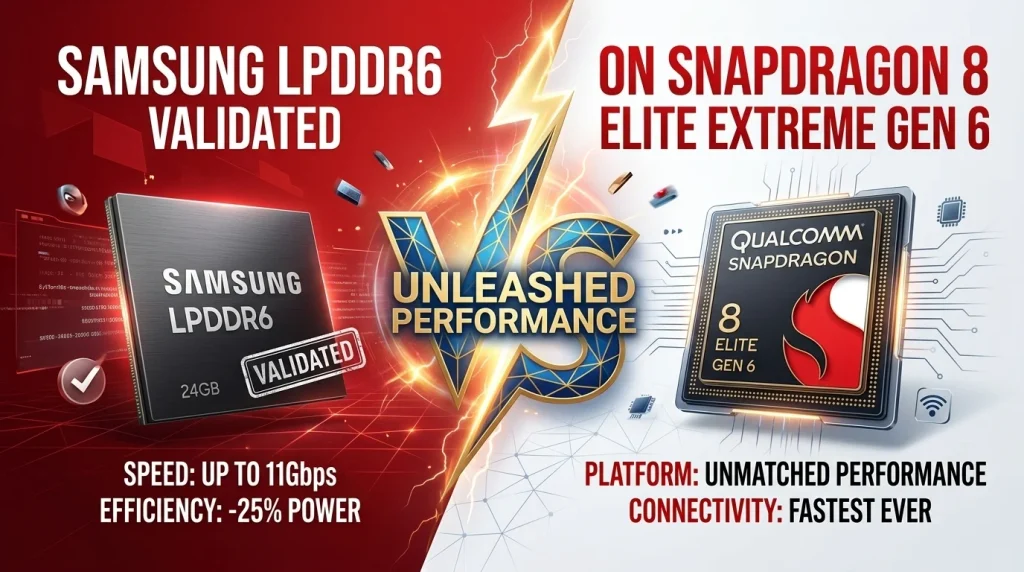
Samsung has completed an industry-first validation of its 16GB LPDDR6 mobile memory on Qualcomm’s Snapdragon 8 Elite Extreme Gen 6 platform. Samsung says the validated configuration operates at I/O speeds of up to 10.7Gbps, can deliver up to 114GB/s of memory bandwidth, and improves power efficiency by up to 21% versus LPDDR5X under Samsung’s stated comparison conditions.
The milestone matters because next-generation phone memory must be validated with the processor and system architecture before manufacturers can confidently commercialize it. It does not, however, confirm that a particular Galaxy, Xiaomi, OnePlus or other future phone will ship with Samsung LPDDR6. Device-level adoption, capacity, clocks and pricing remain decisions for each manufacturer.
What Samsung and Qualcomm actually confirmed
| Item | Confirmed detail |
|---|---|
| Memory | Samsung 16GB LPDDR6 |
| Validated platform | Qualcomm Snapdragon 8 Elite Extreme Gen 6 |
| Validated I/O speed | Up to 10.7Gbps |
| Memory bandwidth | Up to 114GB/s, according to Samsung |
| Power efficiency | Up to 21% improvement versus LPDDR5X, manufacturer claim |
| Status | Platform validation completed; individual commercial phone adoption is not established by this validation alone |
Why LPDDR6 matters for on-device AI
Modern on-device AI workloads repeatedly move model weights, intermediate data and other working information between memory and compute blocks. More bandwidth can reduce a memory bottleneck when the CPU, GPU or NPU needs large amounts of data quickly. Samsung specifically frames LPDDR6 around increasingly complex multimodal and agentic AI workloads.
Samsung says its LPDDR6 uses Dynamic Voltage and Frequency Scaling (DVFS) to adjust voltage and frequency with workload demand and a Dynamic Efficiency Mode (DEM) to reduce unnecessary power use during lower-utilization periods. The company also describes Per-Row Activation Counting (PRAC) as a reliability feature designed to manage repeated memory-row activation and associated disturbance risks.
Those are memory-level capabilities, not guarantees that a finished phone will be 21% more efficient overall. Display, modem, processor load, storage, cooling, battery size and software all contribute to a phone’s total power consumption.
Validation is not the same as a phone launch
Qualcomm platform validation shows that Samsung’s memory can operate with the Snapdragon 8 Elite Extreme Gen 6 under the companies’ qualification process. That is an important commercialization step, but it should not be confused with a handset announcement.
Reports and leaks are already discussing LPDDR6 for future flagship phones, including possible Galaxy S27-family configurations. Samsung has not used this memory-validation announcement to confirm a Galaxy S27 model, RAM capacity, regional chipset split, storage specification, launch date or price. Those details remain separate questions.
PhoneSpecX recently explained how rising memory costs can affect smartphone pricing. That context is relevant because newer memory can improve capability while also increasing bill-of-material pressure during a costly DRAM cycle.
How this fits the new Snapdragon generation
Snapdragon 8 Elite Extreme Gen 6 is Qualcomm’s highest-tier 2026 mobile platform. The new generation is designed around more demanding on-device AI, graphics and imaging workloads, so higher-bandwidth low-power memory is a logical companion technology. Qualcomm’s platform also supports LPDDR5X, meaning phone makers are not forced to use LPDDR6 in every implementation.
For comparison with the other major flagship silicon direction, see PhoneSpecX’s Dimensity 9600 Pro launch explainer. Different processors, memory configurations and manufacturer tuning can produce materially different real-world results even when headline component specifications appear similar.
What buyers should watch next
- Named commercial devices: wait for manufacturers to confirm which phones actually use LPDDR6.
- Capacity: this validation used 16GB, but it does not establish that every LPDDR6 phone will ship with 16GB.
- Operating speed: platform support and memory capability do not mean every retail device will use the maximum possible data rate.
- Independent testing: bandwidth and efficiency claims should eventually be evaluated in shipping phones under repeatable workloads.
- Price impact: next-generation DRAM arrives during a period of elevated memory costs, so adoption may differ by product tier and region.
Frequently asked questions
What is LPDDR6?
LPDDR6 is a newer generation of low-power double-data-rate memory designed for mobile and other power-sensitive systems. Its goal is to increase data throughput while maintaining tight power constraints.
Did Samsung validate LPDDR6 with Snapdragon 8 Elite Extreme Gen 6?
Yes. Samsung says its 16GB LPDDR6 was successfully validated on Qualcomm’s Snapdragon 8 Elite Extreme Gen 6 at I/O speeds of up to 10.7Gbps.
Does this confirm LPDDR6 for the Galaxy S27 Ultra?
No. The validation makes such an implementation technically possible, but Samsung has not confirmed a Galaxy S27 Ultra memory specification through this announcement.
Will LPDDR6 make a phone 21% more battery efficient?
No such conclusion can be drawn. Samsung claims up to a 21% power-efficiency improvement for its LPDDR6 versus LPDDR5X; whole-phone battery life depends on many other components and software behavior.
Why is memory bandwidth important for AI phones?
On-device AI can move large quantities of data between memory and processing units. Higher bandwidth can reduce memory-transfer bottlenecks in workloads that can use it, although actual application performance depends on the entire system.
Sources and References
- Samsung Semiconductor — LPDDR6 validation on Qualcomm’s Snapdragon platform (accessed September 23, 2026)
- MoneyToday — Samsung LPDDR6 industry-first Snapdragon validation (September 23, 2026)
- TrendForce News — LPDDR6 validation and mobile-memory context (September 23, 2026)