- The 7.58-inch inner and 5.38-inch outer displays share a wide square-root-of-two to one aspect ratio.
- Xiaomi’s 3nm XRING O3 chip combines a 10-core CPU, 16-core GPU and LPDDR6 support.
- A 200MP Leica main camera is joined by a 50MP periscope telephoto with an 80mm focal length.
- The 6,000mAh silicon-carbon battery supports 67W wired and 50W wireless charging; global availability is not confirmed.
Xiaomi 18 Fold at a glance
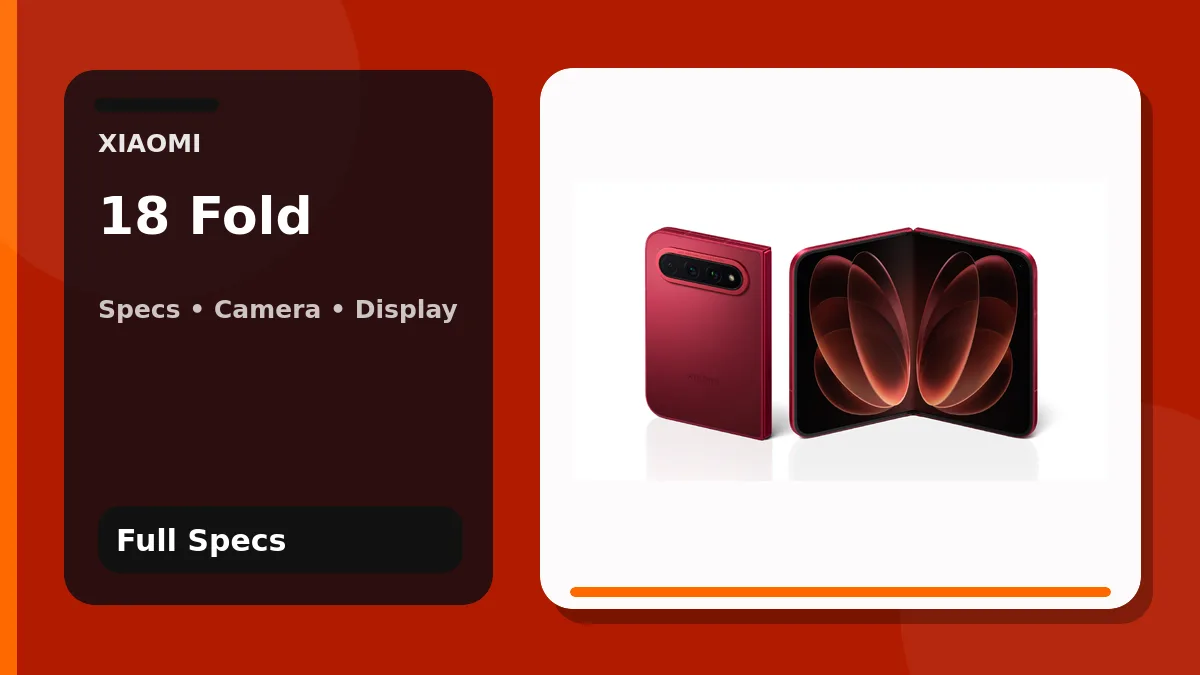
The Xiaomi 18 Fold specifications introduce the company’s first mid-size book-style foldable and its first flagship powered by the in-house XRING O3 processor. The phone folds into a short, passport-like body and opens to a 7.58-inch screen. A 5.38-inch outer display, 200MP Leica main camera and 6,000mAh battery complete an unusually ambitious hardware package.
This article is based on Xiaomi’s official September 7, 2026 announcement and does not claim hands-on testing. Xiaomi disclosed China prices but did not state global availability, so buyers outside China should treat the device as unconfirmed for their markets. Performance, camera quality, battery life and durability claims also require independent testing.
Key specifications
| Feature | Xiaomi 18 Fold specification |
|---|---|
| Inner display | 7.58-inch Xiaomi HyperRGB, LTPO 1–120Hz, up to 4,000 nits |
| Outer display | 5.38-inch Xiaomi HyperRGB, LTPO 1–120Hz, up to 4,000 nits |
| Processor | 3nm Xiaomi XRING O3, 10-core CPU, 16-core GPU |
| Memory/storage | 12GB/256GB, 12GB/512GB, 16GB/512GB or 16GB/1TB |
| Main camera | 200MP Leica, 1/1.56-inch HP5 sensor |
| Telephoto | 50MP Leica periscope, 80mm equivalent |
| Battery | 6,000mAh silicon-carbon |
| Charging | 67W wired; 50W wireless |
| Folded size | 117.8 × 83.6 × 10.68mm |
| Unfolded thickness | 5.02mm |
| Weight | 219g |
| China price | From RMB 10,999 |
Passport-style design and dimensions
Folded, the Xiaomi 18 Fold measures 117.8 × 83.6 × 10.68mm. It is wider and shorter than a conventional smartphone, giving it the footprint of a passport. Unfolded thickness is 5.02mm, and the entire device weighs 219g.
Both displays use the same approximate √2:1 aspect ratio, matching the proportions of A-series paper. Xiaomi says this improves the fit of 16:9 video, 4:3 photos and documents while making transitions between the outside and inside screens more consistent. Super-elliptical corners and flat edges define the exterior.
Standard versions come in Black, White and Red, while a Ceramic Version uses a silicon-nitride back. Xiaomi says that material is around 50% lighter than traditional zirconia ceramic.
7.58-inch inner and 5.38-inch outer displays
The inner screen measures 7.58 inches, while the cover panel measures 5.38 inches. Both are Xiaomi HyperRGB displays with full RGB subpixel structures, adaptive 1–120Hz LTPO refresh and a claimed peak brightness of up to 4,000 nits.
The outer screen is compact enough for typing, pull-down controls and back gestures with one hand. Opening the device provides a tablet-like canvas. Xiaomi HyperOS supports two-way split-screen layouts and a three-way split designed to keep each pane close to a normal phone shape.
Peak brightness figures describe limited conditions and should not be read as sustained full-screen brightness. Color accuracy, crease visibility and outdoor readability need independent measurements.
Hinge, glass and durability claims
Xiaomi builds the frame from 7000-series aluminum alloy and applies Xiaomi Shield Glass 3.0 to the outer display and back. A patented three-link hinge wraps around the flexible screen to add protection while creating more room for the display structure.
The inner panel uses two ultra-thin-glass layers: a 50μm upper layer and a 30μm supporting layer. Xiaomi also replaces an inorganic insulating layer with a more stretchable organic film. The company claims 258% greater inner-display impact resistance, support for drops up to 1.2m and average crease depth of no more than 30μm. Those are manufacturer test claims, not a promise against real-world damage.
XRING O3 performance
The Xiaomi 18 Fold debuts XRING O3, the company’s second fully in-house system-on-chip. It is manufactured on a 3nm process and contains 24 billion transistors. The 10-core CPU uses two Ultra, four Premium and four Pro cores, while the G2-Ultra NX GPU has 16 cores.
Xiaomi claims 60% higher CPU performance with 25% lower power consumption than the previous generation, plus 85% greater graphics performance and 64% lower GPU power consumption. The new quad-core NPU is rated at 200 TOPS for specified tensor workloads. These comparisons come from Xiaomi and require neutral benchmark validation.
Memory, storage and multitasking
Configurations start with 12GB of RAM and 256GB of storage. Other options include 12GB/512GB, 16GB/512GB and 16GB/1TB. XRING O3 supports LPDDR6 memory, with Xiaomi quoting up to 10,667Mbps and 113.8GB/s of bandwidth.
The wide display and HyperOS multi-window system are intended for two- and three-app layouts. Fast memory should help heavier multitasking, but actual behavior will depend on software scheduling, thermal limits and which memory standard Xiaomi uses in each configuration.
200MP Leica camera system
The triple rear camera is led by a 200MP Leica main camera using Samsung’s 1/1.56-inch HP5 sensor. Xiaomi lists native high dynamic range and in-sensor lossless zoom. The high resolution gives the camera flexibility to crop, but final image quality also depends on optics, processing and available light.
A 50MP Leica periscope telephoto uses an inverted design to reduce module size. Its 80mm-equivalent focal length is suited to portraits, and Xiaomi says in-sensor zoom extends the range to 160mm without loss. The official announcement does not fully detail the third rear camera, so this article does not add an unverified specification.
6,000mAh battery and charging
The 6,000mAh dual-cell battery uses silicon-carbon chemistry with 20% silicon content and a claimed energy density of up to 920Wh/L. That capacity is notable in a 219g foldable, although the two bright displays and high-performance chip can create demanding workloads.
Charging reaches 67W over a cable and 50W wirelessly through Xiaomi HyperCharge. Charger requirements and actual charging times were not detailed in the global announcement. As with every foldable, real endurance will vary sharply with display choice, brightness, camera use, gaming and network conditions.
Connectivity and Xiaomi HyperOS
Xiaomi highlights Wi-Fi 7, ultra-wideband and Astral Communication. The latter is marketed with roaming coverage across more than 210 countries and regions through more than 52 carriers, but plan and market support should be checked locally.
HyperOS is optimized for the shared display aspect ratio and multi-window layouts. Xiaomi also integrates AI acceleration across the XRING O3 CPU, GPU and NPU so lighter tasks can run without invoking the full NPU. The official announcement does not specify an Android version or update policy, so neither is asserted here.
China price and availability
Xiaomi announced the 18 Fold in Beijing on September 7, 2026. China pricing starts at RMB 10,999 for 12GB/256GB, rises to RMB 11,999 for 12GB/512GB, RMB 12,999 for 16GB/512GB and RMB 14,999 for 16GB/1TB. The 16GB/1TB Ceramic Version starts at RMB 15,999.
Xiaomi’s global announcement does not confirm international sales. Those yuan prices therefore should not be converted into assumed US, UK or European retail prices. Readers considering a locally available wide foldable can compare the Samsung Galaxy Z Fold8 specifications.
Verdict
On official specifications, the Xiaomi 18 Fold is one of the most ambitious compact book-style foldables announced in 2026. Its matched wide displays, 3nm XRING O3, 200MP Leica camera, 50MP periscope and 6,000mAh battery address performance, photography and endurance together.
It is not yet a universal buying recommendation because Xiaomi has not confirmed global availability and the key performance and durability figures are manufacturer claims. For the Chinese market, however, the RMB 10,999 starting price positions the 18 Fold as a feature-heavy alternative to Samsung’s wide Fold8.
Pros & Cons
Pros
- Wide, matched-aspect-ratio inner and outer displays
- Large 6,000mAh battery with fast wired and wireless charging
- 200MP Leica main and 50MP periscope cameras
- Powerful 3nm XRING O3 platform
- Compact passport-like folded shape
Cons
- Global availability is not confirmed
- Performance and durability claims await independent testing
- Wide folded body may not suit every hand
- No official software-update policy stated