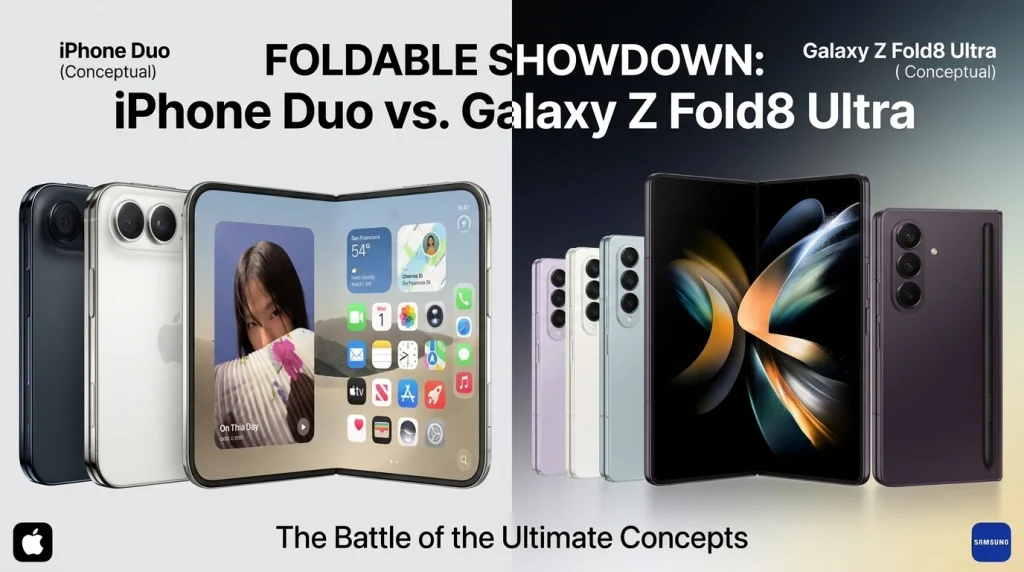
The iPhone Duo is Apple’s compact, titanium book-style foldable with iOS 27 and up to 2TB storage; Samsung’s Galaxy Z Fold8 Ultra is lighter, slimmer and more camera-focused.
- Galaxy Z Fold8 Ultra is 39g lighter and materially thinner, while iPhone Duo folds into a shorter, wider passport-like shape.
- Samsung provides larger 6.5-inch cover and 8-inch inner displays; Apple uses compact 5.4-inch and 7.6-inch panels, both with up to 120Hz ProMotion.
- Galaxy offers a 200MP main camera, 50MP ultrawide and 3x telephoto; iPhone Duo has two 48MP rear cameras and no dedicated telephoto.
- iPhone Duo starts at $1,999 in the US and reaches 2TB; regional Galaxy pricing and configurations should be checked on Samsung’s local store.
Quick comparison
The iPhone Duo vs Galaxy Z Fold8 Ultra decision starts with shape. Apple’s first book-style foldable is deliberately compact when closed, with a 5.4-inch outer screen and a 7.6-inch inner display. Samsung follows the familiar large-phone approach: a 6.5-inch cover screen opens into an 8-inch workspace.
Samsung is the easier recommendation for buyers who want low weight, a slim body, a telephoto camera and the largest screens. Apple makes more sense for people committed to iOS who want a shorter folded device, Apple Pencil support, up to 2TB of storage and Apple’s video ecosystem. These conclusions use official specifications, not hands-on durability, camera or battery testing.
| Feature | Apple iPhone Duo | Samsung Galaxy Z Fold8 Ultra |
|---|---|---|
| Cover display | 5.4-inch OLED, up to 120Hz | 6.5-inch AMOLED 2X, 1–120Hz |
| Inner display | 7.6-inch OLED, up to 120Hz | 8-inch AMOLED 2X, 1–120Hz |
| Weight | 254g | 215g |
| Thickness open | 5.2mm | 4.1mm |
| Processor | Apple A20 Pro | Snapdragon 8 Elite Gen 5 for Galaxy |
| Storage | 256GB to 2TB | 256GB to 1TB |
| Rear cameras | 48MP main + 48MP ultrawide | 200MP main + 50MP ultrawide + 10MP 3x telephoto |
| Charging claim | 50% in about 20 minutes; MagSafe/Qi2 up to 25W | 45W wired; 20W wireless; PowerShare |
| Protection | IP68 | IP48 |
| Software | iOS 27 | Android 17 with One UI 9 |
Design and portability
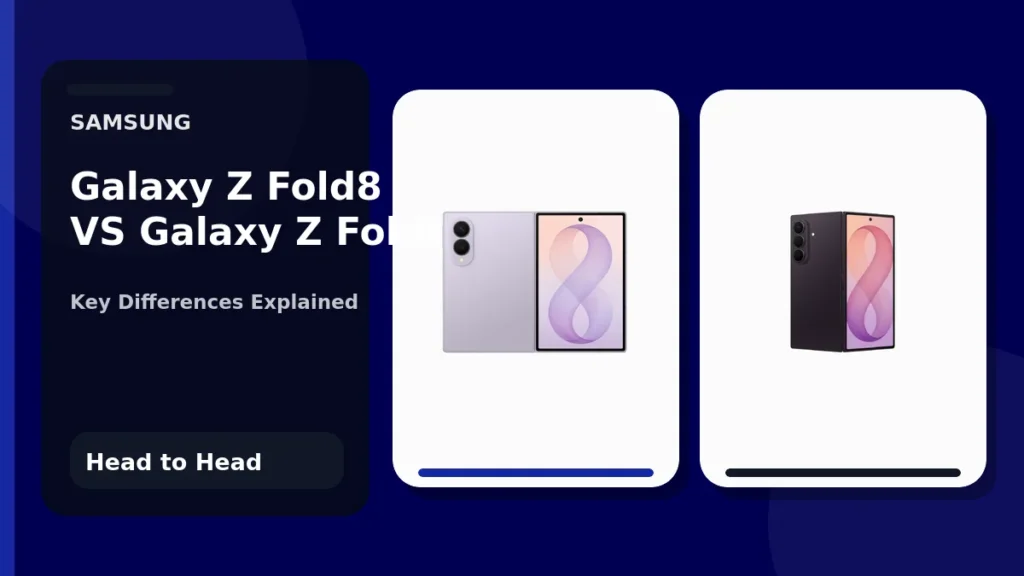
Samsung wins the measurable portability contest. The Galaxy Z Fold8 Ultra weighs 215g, 39g less than the 254g iPhone Duo. It is also 4.1mm thick when open, compared with Apple’s 5.2mm. That difference should be noticeable during one-handed reading and long sessions on the inner screen.
Apple’s advantage is a different kind of compactness. Closed, the Duo measures 84.1 × 117.8 × 11.3mm, creating a shorter and wider shape than a conventional phone. It should fit shallow pockets more easily, although the width and weight may still demand two hands. Its Grade 5 titanium frame and hinge cover are paired with Ceramic Shield surfaces.
Samsung’s thinner engineering is explored in our article on how the Galaxy Z Fold8 generation reduced weight. Figures for the Ultra remain distinct from the standard Fold8.
Displays: compact versus expansive
The Galaxy gives more usable screen area in both modes. Its 6.5-inch cover panel behaves like a normal flagship display, while the 8-inch inner screen is better suited to documents, split-screen apps and video. Samsung lists 1–120Hz adaptive refresh and up to 3,000 nits for the main panel.
Apple’s 5.4-inch outer screen prioritizes reachability. The 7.6-inch inner panel remains tablet-like, but it provides less canvas than Samsung’s. Both Apple panels use OLED and ProMotion up to 120Hz, with the company quoting up to 3,000 nits outdoor brightness. The full iPhone Duo specifications explain the two-screen dimensions in more detail.
Screen size is not automatically better. A compact cover display can be convenient for messages and quick tasks, while Samsung’s larger one reduces the need to unfold. Buyers should decide whether they want a small phone that opens large or a large phone that opens larger.
Performance, memory and storage
Apple uses the A20 Pro with a six-core CPU, seven-core GPU and dual 16-core Neural Engine. Samsung uses Snapdragon 8 Elite Gen 5 for Galaxy. Both are flagship platforms, but their benchmark scores are not directly comparable without controlled cross-platform testing.
The iPhone Duo offers 256GB, 512GB, 1TB and 2TB capacities. Samsung provides 256GB and 512GB models with 12GB RAM, plus a 1TB configuration with 16GB. Apple’s official sheet does not publish RAM, so it would be misleading to turn the listed Samsung memory into a direct win without real workload testing.
For large offline video libraries, the iPhone’s 2TB ceiling is valuable. For Android multitasking, Samsung’s stated memory and mature split-screen tools are clearer buying signals. Neither phone supports removable storage.
Cameras and video
Samsung has the more versatile rear-camera system on paper. It combines a 200MP stabilized main camera, 50MP autofocus ultrawide and 10MP stabilized 3x telephoto. That dedicated telephoto gives it native reach the iPhone Duo lacks, while the high-resolution main and ultrawide sensors support Samsung’s detailed capture and crop options.
Apple pairs a 48MP Fusion Main with a 48MP Fusion Ultra Wide. The outer 12MP Center Stage camera handles conventional selfies, and an under-display FaceTime camera sits inside. Apple also supports up to 4K Dolby Vision at 120fps on the main camera. Samsung counters with 8K recording and pro-oriented tools such as APV and Cine LUT controls.
Specifications cannot choose the better camera. Image processing, motion handling, skin tones, low-light behavior and lens consistency require matched tests. The safe conclusion is that Samsung offers greater focal-length flexibility, while Apple emphasizes high-quality dual cameras and advanced video workflows.
Battery and charging
Samsung lists a 5,000mAh typical battery, 45W wired charging, 20W wireless charging and Wireless PowerShare. Apple does not publish capacity, instead quoting up to 44 hours of outer-display video playback or 31 hours using the inner screen.
Apple says a compatible 60W adapter can reach 50% in around 20 minutes and supports MagSafe and Qi2 wireless charging up to 25W. Charging claims use different methods, so the percentages and wattages do not establish a complete winner. Real endurance will depend on screen usage, brightness, radios, camera activity and software.
Apple’s faster stated half-charge time and 25W magnetic charging are attractive. Samsung’s reverse wireless charging is useful for earbuds and accessories. Independent testing is needed to compare heat and sustained charging speed.
Software and large-screen workflow
iPhone Duo launches with iOS 27 and extends Apple’s ecosystem across its folding display. The compact outer screen and inner canvas are designed to preserve app continuity, and Apple Pencil USB-C support gives note-takers another input option. Buyers already using a Mac, Apple Watch or AirPods will value familiar services and handoff behavior.
Galaxy Z Fold8 Ultra launches with Android 17 and One UI 9. Samsung has years of foldable multitasking experience, including taskbars, split views, floating windows and S Pen-oriented workflows where supported. Galaxy AI and Knox features are integrated across the device.
The better platform depends less on a feature count than on the user’s existing devices and applications. Check whether essential banking, work, drawing and authentication apps fully support each inner display before switching ecosystems.
Durability and repair considerations
Apple lists IP68 protection, while Samsung lists IP48. The first digit means Apple claims stronger sealing against dust; both use an “8” water-resistance digit. That does not make either hinge immune to debris, impacts or long-term wear.
Apple uses titanium and Ceramic Shield materials. Samsung emphasizes its thinner hinge and foldable structure. Manufacturer ratings are laboratory classifications, not guarantees against accidental damage. A protective case, careful cleaning and a clear understanding of local repair pricing matter more with foldables than with conventional slab phones.
Warranty terms can vary by country. Buyers should verify screen-protector policies, hinge coverage, accidental-damage plans and repair turnaround before importing a model.
Price and availability
Apple lists a $1,999 US starting price for iPhone Duo. Pre-orders begin October 16, 2026, and availability starts October 23. Night Sky and Star White are the official colors. Storage upgrades will increase the price, particularly the 2TB model.
Samsung launched Galaxy Z Fold8 Ultra earlier, with pricing, storage, colors and promotions varying by market. Its US offer page is the correct place to check current totals and trade-in terms. Headline promotional prices often assume an eligible trade-in, so compare the full unlocked price before choosing.
Availability is a practical advantage for Samsung today because the iPhone Duo is not yet on sale as of September 13, 2026. Regional network bands, eSIM rules, warranty service and taxes should be confirmed before importing either phone.
Which foldable should you buy?
- Choose Galaxy Z Fold8 Ultra for the lighter and thinner body, larger displays, dedicated 3x telephoto camera, broad Android multitasking and immediate availability.
- Choose iPhone Duo for iOS, a shorter folded shape, Apple Pencil support, up to 2TB storage, 25W MagSafe/Qi2 charging and Apple’s video features.
- Wait for reviews if hinge durability, camera quality, battery life or app compatibility will decide the purchase. Official specifications cannot settle those areas.
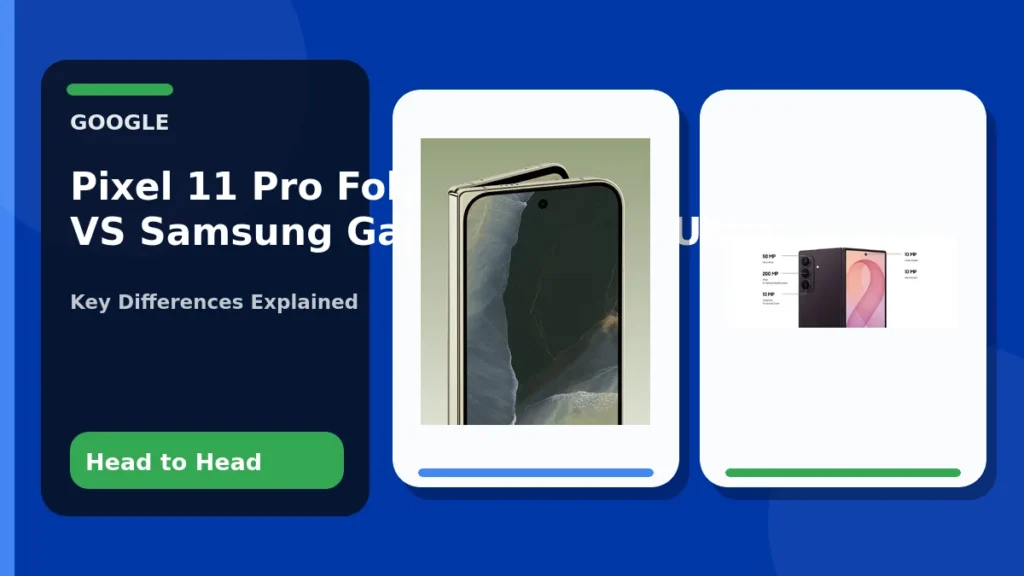
Android buyers comparing other foldables can also read our Pixel 11 Pro Fold vs Galaxy Z Fold8 Ultra comparison.
Verdict
Galaxy Z Fold8 Ultra is the stronger all-round hardware choice on specification. It is significantly lighter, thinner, larger-screened and more versatile for photography. It is also available sooner.
iPhone Duo is not trying to copy Samsung exactly. Its compact folded shape, iOS integration, 2TB option and Apple-focused creative tools give it a clear audience. For existing Apple users who have waited for a foldable, those ecosystem benefits may outweigh Samsung’s measurable hardware advantages.
The final choice should follow workflow rather than novelty. Pick Samsung for maximum foldable utility and camera flexibility; pick Apple for compactness and ecosystem continuity. Wait for controlled reviews if long-term hinge behavior or real battery life is the deciding factor.