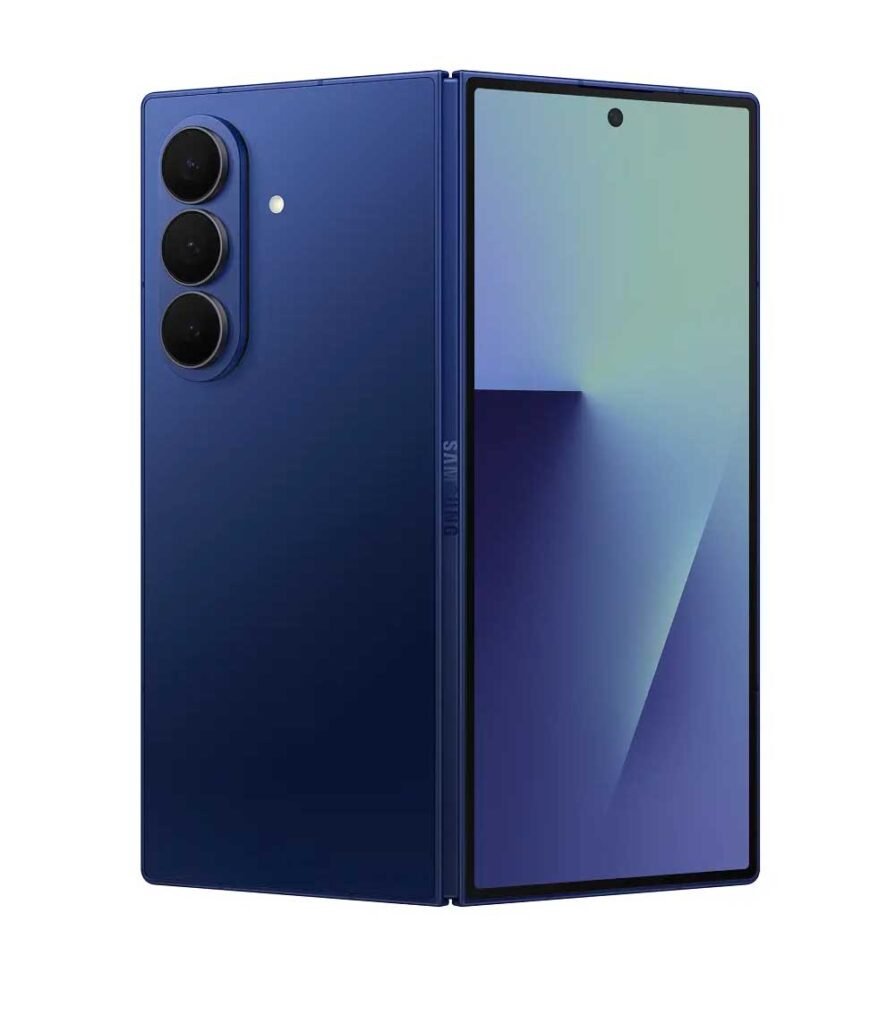
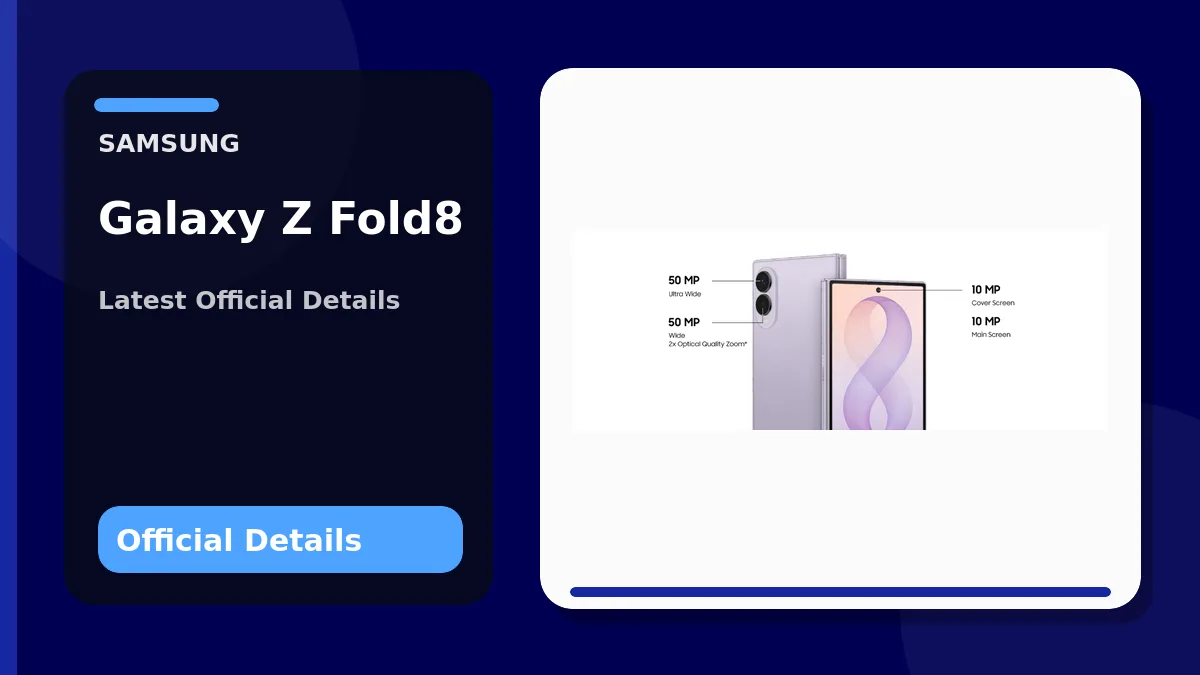
- Galaxy Z Fold8 weighs 201 grams, 52 grams less than Galaxy Z Fold5 and 14 grams less than Fold7.
- Samsung attributes the reduction to Flex Titanium, ultra-thin precision machining, a redesigned hinge and lighter material placement.
- Engineers reviewed about 270 components and more than 180 auxiliary-part types, eliminating around 15 types and optimizing the rest.
- The lighter design did not come from one missing flagship component: Fold8 retains a 4,800mAh battery, flagship Snapdragon chip and dual 50MP rear cameras.
What Samsung revealed
Galaxy Z Fold8 weighs 201 grams, and Samsung has now explained how it removed weight without treating the phone as a stripped-down foldable. In an engineering report published September 9, 2026, the company described changes to the display stack, hinge, structural materials, circuit board, antenna and hundreds of small supporting parts.
The result is a 52-gram reduction from the 253g Galaxy Z Fold5 and a 14-gram drop from the 215g Fold7. Samsung calls Fold8 the world’s lightest fold, although that claim depends on the company’s product-category definition and the market available at the time of publication.
The important story is not one exotic material. Samsung says the 201g target required coordinated changes throughout the device while retaining a 4,800mAh battery, Snapdragon 8 Elite Gen 5 for Galaxy and two 50MP rear cameras.
Quick take
Samsung’s weight-saving work has three layers. First, core foldable parts became thinner and more precise, including the display supports and hinge. Second, materials were selected for the different jobs of strength, repeated movement and heat transfer. Third, engineers revisited almost every internal part, sometimes chasing savings as small as 0.001g.
That approach matters because a lighter foldable is easier to carry only if the hinge remains stable, the display stays supported and thermal performance does not collapse. Samsung’s report explains its design choices, but it is not independent durability or battery testing. Buyers should read it as an official engineering account, not a laboratory verdict.
Galaxy Fold weight changes by generation
| Model | Weight | Change noted |
|---|---|---|
| Galaxy Fold (2019) | 276g | First generation |
| Galaxy Z Fold5 | 253g | Reference point for the 52g reduction |
| Galaxy Z Fold6 | 239g | 14g lighter than Fold5 |
| Galaxy Z Fold7 | 215g | Targeted to undercut the 218g Galaxy S25 Ultra |
| Galaxy Z Fold8 | 201g | 14g lighter than Fold7 and 52g lighter than Fold5 |
The reduction accelerated in recent generations. Weight alone does not show changes in screen size or form factor, but it highlights why Samsung had to move from obvious component changes to increasingly small structural optimizations.
Flex Titanium and the thinner display structure
Fold8 and Fold8 Ultra use Samsung’s Flex Titanium structure. The key layer is a titanium alloy film only tens of micrometres thick—about one-third the width of a human hair, according to Samsung. The goal is to support the foldable display at an extremely small thickness while maintaining the required mechanical performance.
Beneath the display, some supporting metal plates are machined to roughly 0.2mm, with the thinnest areas reaching about 0.15mm. Thin metal can bend or warp during manufacturing, so Samsung says it refined machining sequences, tooling, cooling conditions and process parameters to maintain shape and flatness.
This is a precision problem rather than a simple “use less metal” decision. A small deformation in a support plate could affect assembly accuracy or the surface quality of the folding display.
Why the hinge could not simply be scaled down
A foldable hinge must distribute forces each time the device opens and closes. Its requirements also change with the dimensions and internal architecture of the product. Samsung says it engineers the hinge for each form factor instead of shrinking one design proportionally.
The company balanced load distribution, strength, durability, interior space and mass. That helps explain why reducing the phone by fractions of a millimetre can demand more engineering rather than less: thinner parts have less material available to absorb force, and the available internal volume becomes more contested.
Samsung’s official report does not publish cycle-test results or a repairability score for these changes. The engineering rationale is detailed, but long-term hinge wear still requires independent testing and real-world use.
Materials chosen by job
Samsung used different materials where their properties were most useful. Flex Titanium supports the folding display, while Advanced Armor Aluminum provides exterior rigidity. Inside the rear structure, Clad Metal combines characteristics from different metals to reduce weight while maintaining required thermal behavior.
Thermal management becomes more difficult as a phone gets thinner because there is less room to spread heat. Samsung says it uses higher-performing graphite and tailors the cooling layout to each model’s dimensions and performance target.
Fold8 Ultra provides a related example: its graphite heat-dissipation layer is about 7% larger by volume than Fold7’s, despite both models weighing 215g. The standard Fold8 engineering story shows how careful material placement can reduce mass; the Ultra shows how similar savings can be reinvested.
Hundreds of parts, thousandth-of-a-gram savings
Once the largest structural changes were exhausted, Samsung reviewed approximately 270 components and more than 180 types of auxiliary parts. Those included the display, hinge, cameras, circuit boards, antennas, brackets, tapes and fasteners.
Around 15 auxiliary-part types were eliminated. Engineers then reviewed roughly 170 remaining types, trimming oversized areas, refining shapes, optimizing dimensions and consolidating multiple pieces where possible. Some changes were measured in increments as small as 0.001g.
The printed circuit board was redesigned to remove unnecessary circuits and improve component placement. Samsung also reworked the Magnetic Flux Channel antenna to reduce overlap and interference with surrounding parts. No single change explains the finished weight; many small reductions accumulated into whole grams.
Savings reinvested in battery, cameras and cooling
Making a phone lighter can be easy if major capabilities are removed. Samsung says its objective was different: recover space and mass, then use them for the experiences buyers notice. Galaxy Z Fold8 still carries a 4,800mAh typical battery, flagship Snapdragon processor and 50MP wide plus 50MP ultra-wide rear cameras.
Fold8 Ultra illustrates the reinvestment strategy more clearly. It matches Fold7’s 215g weight but increases battery capacity from 4,400mAh to 5,000mAh. Samsung says the larger cell added about 6g, which engineers recovered elsewhere through material, circuit and layout changes.
That same Ultra model also includes a 200MP main camera, the first 50MP ultra-wide on a Galaxy Z Fold and the expanded graphite layer. Our Galaxy Z Fold8 vs Z Fold8 Ultra comparison explains how those choices separate the two models.
What 201 grams means for buyers
A 201g foldable is closer in mass to many large conventional phones than earlier book-style foldables. That should reduce pocket weight and hand fatigue, especially for reading or scrolling on the cover screen. It does not automatically make Fold8 easy to use one-handed because its short, wide proportions remain unusual.
Weight also should not be confused with thinness. Fold8 measures 9.7mm folded and 4.5mm unfolded. The Fold8 Ultra is heavier at 215g but thinner at 8.9mm folded and 4.1mm unfolded. Buyers deciding between them need to consider shape and balance, not only the number on a scale.
For the complete display, camera, battery and connectivity details, see our Galaxy Z Fold8 specifications. Buyers preferring a pocketable clamshell can also review the Galaxy Z Flip8 specifications.
What Samsung’s report does not prove
The report is useful because it names materials, dimensions, component counts and engineering priorities. It does not provide independent drop testing, repairability data, thermal benchmarks or long-term hinge measurements. Those questions require controlled third-party tests.
Samsung’s “world’s lightest fold” wording also includes a footnote and should be understood within the company’s classification and launch timing. New models from competitors can change category leadership quickly.
Buyers should therefore treat the 201g figure as verified manufacturer data and the engineering explanation as Samsung’s account of how it was achieved. Claims about improved comfort, durability or sustained cooling should remain qualified until independent reviews measure them.
Final assessment
Galaxy Z Fold8’s 201g weight is the product of system-wide engineering rather than one headline component. Flex Titanium, precision-machined display supports, a form-specific hinge, optimized structural materials, PCB and antenna redesigns, fewer auxiliary parts and countless tiny trims all contributed.
The strongest part of Samsung’s explanation is its scale: about 270 components and more than 180 auxiliary-part types were reviewed, with some savings tracked to 0.001g. That makes the 52g reduction from Fold5 easier to understand without pretending the work came from a single breakthrough.
For buyers, the achievement matters because Fold8 retains the core features expected from a flagship foldable. Whether the lighter design also delivers the desired durability, battery life and thermal performance is the next question for independent testing.
What to Read Next
Frequently Asked Questions
How much does the Samsung Galaxy Z Fold8 weigh?
What is Flex Titanium in Galaxy Z Fold8?
Did Samsung reduce the battery to make Fold8 lighter?
Is Galaxy Z Fold8 more durable because it is lighter?
Sources & References
- Samsung’s Fold8 engineering report — Official explanation of the weight reduction
- Samsung Galaxy Z Fold8 announcement and specifications — Official specifications and launch context