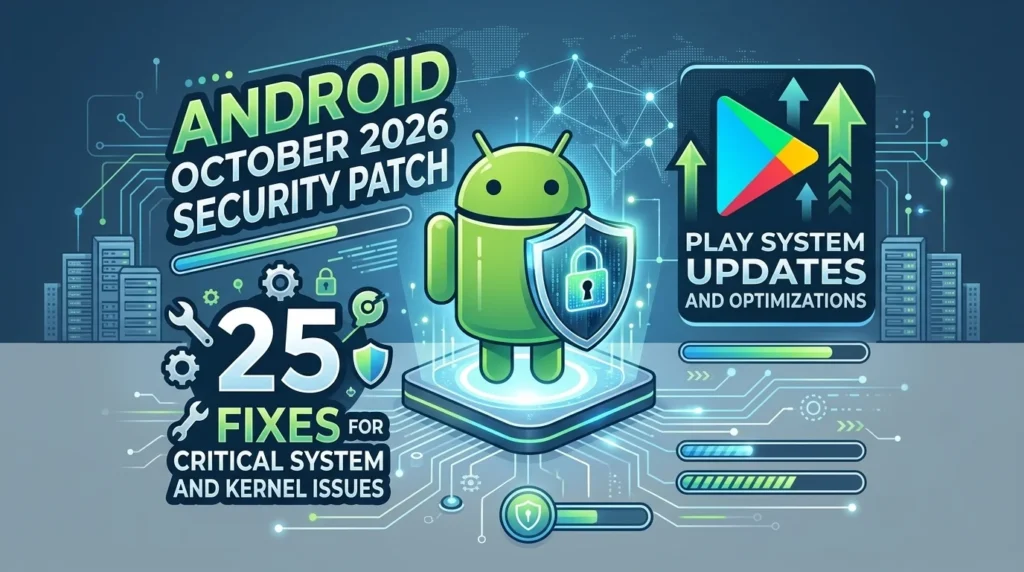
Google published its October 2026 Android Security Bulletin on October 5 and updated the document on October 8. Its October 1 patch-level tables identify 25 vulnerabilities: seven rated Critical and eighteen rated High. For phone owners, the useful question is not simply whether a patch exists; it is whether their particular device has received and installed the relevant manufacturer update. Google says the Android security patch level 2026-10-01 or later addresses the issues associated with this bulletin.
This guide explains the Android-wide bulletin, the distinction between firmware and Google Play system updates, and how to verify a device’s actual patch date. It is a cross-brand explanation—not a claim that every Samsung, Pixel, Xiaomi, Motorola or other Android handset received the update on October 5.
October 2026 Android security update: key points
- Publication: October 5, 2026; official bulletin revised October 8 to add AOSP patch links.
- Listed issues: 25 across the Framework and System tables, with seven Critical and eighteen High severity entries.
- Minimum listed level: Android security patch level 2026-10-01, when the device maker has implemented the relevant fixes.
- Separate channel: Google Play system updates can deliver fixes to certain modular components, but do not substitute for every Android firmware fix.
- Rollout: Actual availability depends on the model, manufacturer, region and carrier.
What Google fixed in the October bulletin
Google groups the vulnerabilities by the Android component they affect. The Framework section contains seven entries; the System section contains eighteen. That makes 25 unique entries in those two tables. The bulletin’s additional Google Play system component listing points to some of the same CVEs rather than adding a new batch of three to the total.
| Part of the bulletin | Verified October 2026 detail |
|---|---|
| Framework | Seven listed vulnerabilities, including critical denial-of-service issue CVE-2026-58865; the affected Android versions vary by entry. |
| System | Eighteen listed vulnerabilities, including critical privilege-escalation issues and a high-severity remote-code-execution issue (CVE-2026-49878). |
| Severity across these two groups | Seven Critical and eighteen High entries in the October 1 vulnerability tables. This is a count of bulletin entries, not a claim that all Android models are equally affected. |
| Google Play system components | The bulletin separately identifies Telephonycore (CVE-2026-58859) and WiFi (CVE-2026-45524 and CVE-2026-49878) as Project Mainline components. These CVEs overlap the bulletin list, not three extra vulnerabilities. |
| Official patch-level statement | Google says Android security patch level 2026-10-01 or later addresses the issues associated with this bulletin, when the manufacturer has actually incorporated the fixes. |
One Framework example is CVE-2026-58865, described by Google as a Critical denial-of-service issue affecting the listed Android 14, 15, 16, 16 QPR2 and 17 versions. The System list includes CVE-2026-55269, a Critical elevation-of-privilege issue affecting the listed Android 16, 16 QPR2 and 17 versions. The bulletin also lists CVE-2026-49878 as High severity remote code execution for Android 14 through 17 in the specified versions. A CVE’s presence in the bulletin does not prove that it has been exploited in the wild, and this article makes no such claim.
Why the security patch date matters more than the Android version
An Android 17 phone may have a September security patch, while a supported Android 15 or 16 phone may receive a newer manufacturer security build. Major OS version and monthly security patch level answer different questions. Google’s Android bulletin covers fixes needed to declare the specified platform patch level; individual device and chipset vendors may disclose additional issues in their own bulletins.
The bulletin also discusses more than one patch-level convention in its FAQ, but its visible October vulnerability tables are specifically under 2026-10-01. Do not infer a separate list of October 5 fixes from the wording alone. For a specific handset, trust its installed patch date and the manufacturer’s matching build notes.
Google Play system update vs Android security update
Google Play system updates, also called Project Mainline updates, can update eligible system modules independently of a full operating-system build. The October bulletin identifies Telephonycore and WiFi components, naming CVE-2026-58859, CVE-2026-45524 and CVE-2026-49878. These are not proof that every phone has already received those fixes via Google Play, or that every Framework and System fix can arrive without an OEM firmware update.
In practical terms, check both the Android security update date and the Google Play system update date. They may differ without either date necessarily indicating a malfunction. A Play system update cannot be assumed to fix an unrelated vendor driver or device-specific vulnerability.
Pixel, Samsung and other Android brands: who gets it first?
Google’s October bulletin is an Android platform advisory, not a universal rollout calendar. Google says Pixel software updates are distributed gradually and may depend on carrier and device. Readers tracking actual Pixel firmware versions can consult our October 2026 Pixel update and build-number report, which is distinct from this platform-level explanation.
Samsung published its own October 2026 Security Maintenance Release with Google, semiconductor and Samsung-specific fixes. Its bulletin identifies 27 Samsung Vulnerabilities and Exposures (SVE) items, which should not be confused with the 25 entries counted in Google’s Framework/System tables. For Samsung-specific details, see our Galaxy October security update coverage. Independent October 6 reporting from MalaysianWireless also describes Samsung’s phased rollout.
Other manufacturers have their own build and carrier schedules. A regional firmware announcement should not be generalized to every market. The distinction also applies outside Google’s standard Android ecosystem: our Huawei EMUI security update explainer discusses a separate vendor update path rather than implying identical delivery mechanisms.
How to check whether your phone has the October 2026 patch
- Open Settings and look for About phone (or About tablet), then Android version. Menu labels vary by manufacturer.
- Read the Android security update date. The October bulletin’s stated baseline is 2026-10-01 or later.
- Look at Google Play system update separately; do not mistake its date for the Android security patch date.
- Open Settings → System → Software updates, or the equivalent OEM Software update menu, and check for an available package.
- Install an offered official update, follow restart prompts, then recheck the patch date and the manufacturer’s release notes.
| What to check | What it tells you |
|---|---|
| Android version | Your OS generation (such as Android 16 or 17). It does not, by itself, prove the October fixes are installed. |
| Android security update | The date to compare against 2026-10-01. Check it after installing and restarting, rather than relying on an ‘up to date’ message alone. |
| Google Play system update | A separate date for supported modular system components. It can update independently and does not replace the full manufacturer firmware patch. |
| Manufacturer’s release notes | Confirms the specific firmware build, eligible model, regional rollout and any brand- or chipset-specific patches. |
Google’s support guidance recommends Wi-Fi and charging the device to at least 75% before a potentially large update. Back up important data as a sensible precaution, especially if the manufacturer advises it. Use your device’s normal update channel; avoid random firmware files or purported patch ZIPs from unverified sites.
What if your phone still shows September 2026?
A September date does not automatically mean the update mechanism is broken. The Android bulletin announces patches for manufacturers; it does not install firmware on every handset immediately. First check whether your model is still in its official security-support window, then inspect the manufacturer’s country-specific update notice. Some carrier variants receive builds later than unlocked models.
If the phone has reached end of security support, installing apps or changing a setting will not turn an unsupported firmware build into an October-patched device. Keep apps updated, use Play Protect where supported, avoid unknown APK sources and consider a supported replacement for sensitive daily use. These are risk-reduction steps, not substitutes for missing platform patches.
Frequently asked questions
Does Android 17 automatically include the October 2026 security fixes?
No. The Android version number and security patch level are separate. Check the installed patch date and build notes on your device.
Is the October 2026 patch available worldwide?
The bulletin is public worldwide, but firmware rollout dates vary by manufacturer, device, carrier and country. No universal availability date was established by Google’s advisory.
Do Google Play system updates install all 25 fixes?
No. The bulletin lists selected Telephonycore and WiFi issues under Project Mainline, not all 25 Framework and System vulnerabilities as Play-delivered fixes.
Does a Critical rating mean hackers are already exploiting the flaw?
No. Severity describes potential impact under Google’s assessment. The October bulletin alone does not establish active exploitation for each listed vulnerability.
Should I install an unofficial October firmware file if the update is delayed?
Not as a routine workaround. Prefer the official manufacturer or carrier channel, confirm your exact model and region, and avoid unverified downloads that may introduce additional risk.
Related reading
- Motorola Signature 27 and GrapheneOS: what is confirmed — a different perspective on device security and support.
- Samsung One UI 9 roadmap — why feature-release schedules should not be confused with monthly security bulletins.
Sources and References
- Android Open Source Project — Android Security Bulletin, October 2026 (published October 5, revised October 8, 2026): official CVE tables, patch level and Mainline notes.
- Google Android Help — Check and update your Android version (accessed October 10, 2026): device settings, separate update dates and installation guidance.
- Samsung Mobile Security — October 2026 Security Maintenance Release (October 2026): Samsung-specific SVE and platform patch information.
- MalaysianWireless — Samsung October 2026 Update Fixes 27 Galaxy Flaws (October 6, 2026): independent corroboration of Samsung’s October security package and phased distribution.