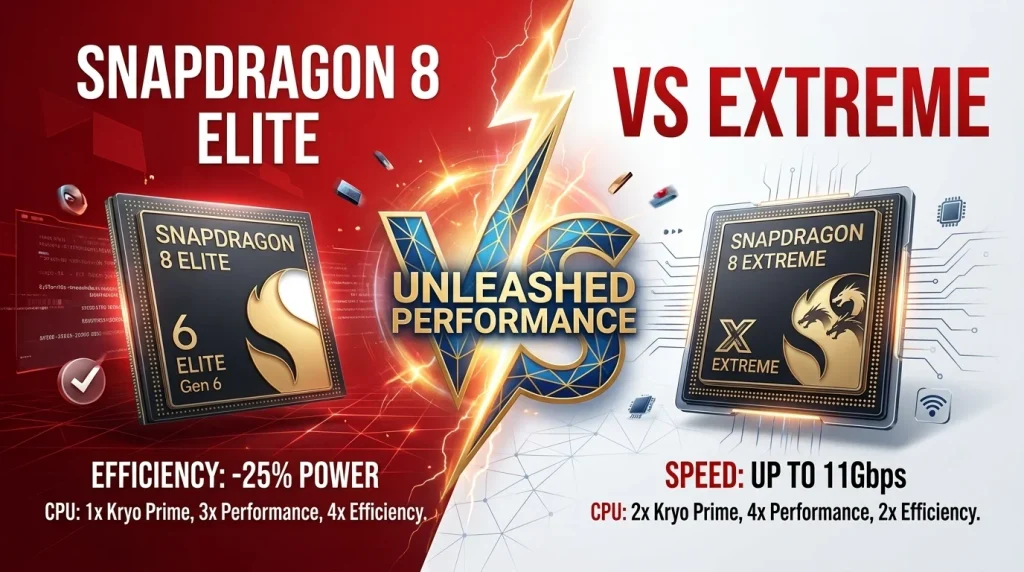
Qualcomm has split its 2026 flagship smartphone platform into two chips: Snapdragon 8 Elite Gen 6 and the higher-tier Snapdragon 8 Elite Extreme Gen 6. Both use an advanced 2nm process, Qualcomm Oryon CPU cores, a rearchitected Adreno GPU, a new Hexagon NPU and the X105 5G modem. The important difference is not that one is flagship and the other is not; Qualcomm explicitly positions both as premium flagship platforms, with the Extreme version adding more graphics, AI and video headroom.
Key takeaways
- Both platforms are built on an advanced 2nm process and use Qualcomm’s custom Oryon CPU architecture.
- Qualcomm’s launch material positions the Extreme as its most powerful mobile platform, while the standard Elite Gen 6 brings many of the same platform features to a broader range of premium phones.
- The Extreme tier adds dedicated Adreno matrix cores and Adreno Neural Fusion for AI-assisted graphics, plus expanded on-device AI capability.
- Qualcomm says phones using the two chips will come from brands including HONOR, iQOO, Motorola, OnePlus, OPPO, REDMI, RedMagic, vivo and Xiaomi.
- Motorola has already identified the Signature 27 as an early Snapdragon 8 Elite Extreme Gen 6 device.
Snapdragon 8 Elite Gen 6 vs Extreme at a glance
| Area | Snapdragon 8 Elite Gen 6 | Snapdragon 8 Elite Extreme Gen 6 |
|---|---|---|
| Positioning | Flagship platform for a broader range of premium phones | Qualcomm’s highest-end mobile platform |
| Process | Advanced 2nm | Advanced 2nm |
| CPU | Custom Qualcomm Oryon | Custom Qualcomm Oryon, tuned for the highest performance tier |
| Graphics | Rearchitected Adreno GPU | Adreno GPU with dedicated matrix cores and Adreno Neural Fusion |
| AI | New Hexagon NPU for on-device AI | Expanded AI resources, including larger shared memory for more demanding models |
| Connectivity | Qualcomm X105 5G platform | Qualcomm X105 5G platform |
Note: This table summarizes confirmed platform-level distinctions. A phone’s actual sustained speed, battery life, camera quality and connectivity depend on the manufacturer’s cooling, memory, software, camera hardware, radio design and power tuning.
Why Qualcomm now has two flagship chips
Qualcomm describes the move as a multi-flagship strategy. That matters because buyers should not automatically read “Extreme” versus standard as a simple good-versus-bad split. The standard Snapdragon 8 Elite Gen 6 still receives the 2nm process, Oryon CPU, Adreno architecture, Hexagon NPU and next-generation connectivity foundation. The Extreme version is intended for manufacturers that want more headroom for demanding AI, gaming and imaging features.
This also gives phone makers more room to differentiate premium models within one generation. A standard flagship can use Elite Gen 6 while an Ultra, Pro Max or gaming-focused model can justify Extreme silicon if the rest of the hardware can exploit it.
What the 2nm move means — and what it does not prove
A smaller manufacturing node can create opportunities for higher performance and better efficiency, but the process label alone does not tell buyers how long a finished phone will last on a charge. Qualcomm is making substantial performance-per-watt claims for the new generation, but those are platform claims rather than independent PhoneSpecX battery tests.
Real-world results will vary with clock management, cooling, display resolution and refresh rate, modem conditions, battery capacity and manufacturer software. We therefore would not rank unreleased phones by battery life or sustained gaming performance from the chipset announcement alone.
Extreme’s clearest advantage: graphics and AI headroom
The Extreme platform adds dedicated Adreno matrix cores and Qualcomm’s new Adreno Neural Fusion. Qualcomm says this can use AI inside the graphics pipeline for features such as super-resolution and frame generation. In practical terms, the feature is aimed at improving visual quality or reducing the rendering workload in supported games.
The important qualifier is supported. A silicon capability is not the same as universal game support, and performance still depends heavily on thermal design. For context, our earlier POCO F9 Ultra benchmark explainer discusses why peak figures and sustained gaming behavior should be treated separately.
On-device AI gets a larger role
Both chips use Qualcomm’s updated Hexagon NPU, but the Extreme tier is designed for more demanding local AI workloads. Qualcomm says the Extreme version has a larger shared-memory pool and is intended to support larger Mixture-of-Experts models on-device.
That could matter for private, low-latency assistants and generative features that do more processing locally. It does not mean every phone using the chip will ship with the same AI tools: OEM software, model licensing, memory capacity and regional availability will decide what users actually receive.
Camera upgrades depend on the phone around the chip
Qualcomm’s new imaging platform adds Intelligent Pixel Control and more advanced video capabilities, with the Extreme tier positioned for the most demanding capture modes. But an ISP cannot compensate for every hardware decision. Sensor size, optics, stabilization, autofocus, image tuning and thermal limits remain critical.
Motorola’s Signature 27 coverage is an early example of how a manufacturer is pairing Qualcomm’s newest platform with its own camera strategy.
Which phones will use the new Snapdragon chips?
Qualcomm has confirmed that devices using Snapdragon 8 Elite Gen 6 and/or Elite Extreme Gen 6 will come from HONOR, iQOO, Motorola, OnePlus, OPPO, REDMI, RedMagic, vivo and Xiaomi. Qualcomm’s announcement does not assign every individual model to one of the two chips, so model-by-model claims should wait for each manufacturer’s confirmation.
The Motorola Signature 27 is already confirmed by Motorola as an early Elite Extreme Gen 6 device. Our Snapdragon Summit 2026 guide provides the event context behind this new generation.
What buyers should actually compare
For most buyers, the chipset name should be the start of the comparison, not the conclusion. A well-cooled Elite Gen 6 phone with a large battery and disciplined software could be a better fit than a thinner Extreme phone for long gaming sessions. Conversely, the Extreme tier makes more sense when a manufacturer combines it with robust cooling, fast memory and features that use its extra graphics, AI or video capabilities.
Until independent devices are tested, the safest conclusions are architectural: Qualcomm has moved its flagship family to 2nm, created two premium tiers, and reserved some of the most ambitious graphics and AI resources for Extreme.
Frequently asked questions
Is Snapdragon 8 Elite Extreme Gen 6 faster than Snapdragon 8 Elite Gen 6?
Qualcomm positions the Extreme as the higher-performance platform. It also receives additional graphics and AI resources. Actual phone performance will still depend on cooling and manufacturer tuning.
Are both chips made on 2nm?
Yes. Qualcomm states that both Snapdragon 8 Elite Gen 6 platforms use an advanced 2nm process.
Does the standard Elite Gen 6 lose flagship features?
No. Qualcomm calls both platforms flagship products, and the standard chip shares the core Oryon, Adreno, Hexagon and connectivity foundation. Extreme adds capabilities rather than turning the standard version into a mid-range chip.
Will every 2027 Android flagship use the Extreme chip?
No such claim has been confirmed. Qualcomm has named participating manufacturers, but each brand decides which platform goes into each model and region.
Should I wait for independent benchmarks?
Yes if sustained performance, heat, battery life or gaming efficiency matters to your purchase. Platform-level claims cannot replace testing of a finished retail phone.
Sources and References
- Qualcomm — Snapdragon 8 Elite Extreme Gen 6 and Elite Gen 6 announcement, September 22, 2026
- Motorola News — Motorola Signature 27 platform confirmation, September 22, 2026
- 9to5Google — Snapdragon 8 Elite Gen 6 and Extreme technical overview, September 22, 2026
- Notebookcheck — independent launch coverage and platform comparison, September 22, 2026