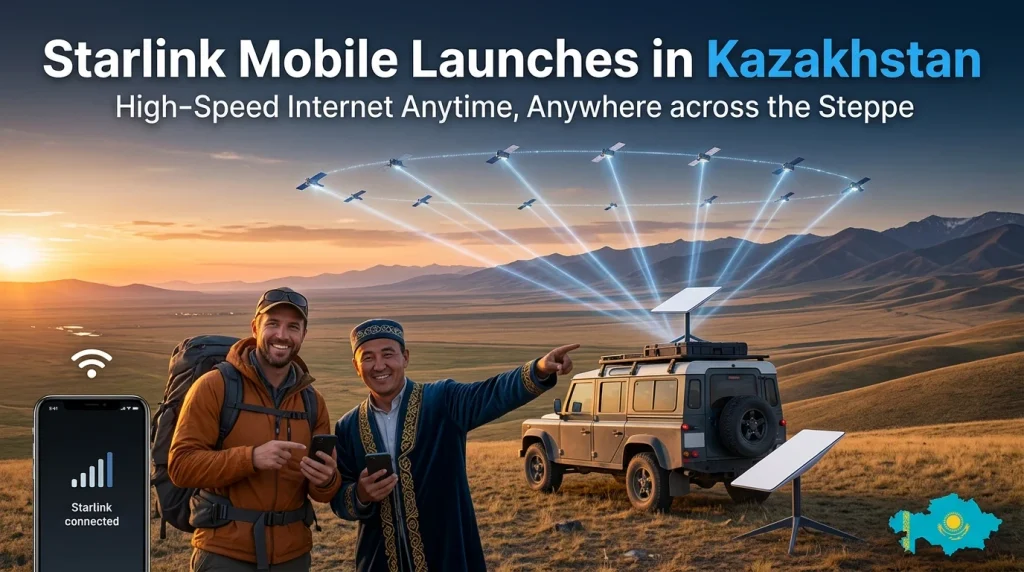
Beeline Kazakhstan has launched Starlink Mobile for compatible smartphones, bringing satellite-to-phone connectivity to customers outside terrestrial mobile coverage. The consumer service uses Starlink Direct to Cell, so supported phones do not need a satellite handset, external antenna or separate satellite terminal. The initial service is free for Beeline Kazakhstan customers during a promotional period and is intended for remote roads, mountains and other cellular dead zones.
What launched in Kazakhstan
VEON announced the commercial launch on September 29, 2026, following Beeline Kazakhstan’s earlier rollout announcement. Kazakhstan is the first Central Asian market where the partners say Direct to Cell has progressed from practical testing to a consumer service. The project follows a November 2025 cooperation memorandum involving Beeline Kazakhstan and the country’s Ministry of Artificial Intelligence and Digital Development, with practical trials beginning in December 2025.
| Item | Verified launch detail |
|---|---|
| Market | Kazakhstan, for Beeline Kazakhstan customers |
| Technology | Starlink Mobile Direct to Cell |
| Special satellite hardware | Not required on a compatible smartphone |
| Initial capabilities | Messaging, apps and basic internet services where terrestrial coverage is unavailable |
| Current device note | Beeline’s launch information identifies compatible Android devices at this stage; broader operating-system support is planned |
| Introductory price | Free during the initial promotional period for Beeline Kazakhstan customers |
How Starlink Mobile works on a normal phone
Direct to Cell is designed to let a compatible cellular phone connect to Starlink satellites when the normal terrestrial network is unavailable. The satellite connection complements Beeline’s ground network rather than replacing it. VEON says no dedicated satellite phone, antenna or other special equipment is needed.
Conditions still matter. Beeline and VEON say the service works best with a clear line of sight to the sky, so buildings, terrain and other obstructions can affect satellite connectivity. This makes the service particularly relevant on highways outside cities, in mountains and in remote areas where conventional cell towers do not provide coverage.
What users need to do
Beeline’s instructions say customers should update the Janymda app, activate Starlink in the app and enable data roaming on the phone. When terrestrial coverage is unavailable, the satellite network can be selected manually as Beeline Starlink; some devices may display the network identifier 401 04.
The launch information does not establish that every Android phone is compatible. Users should therefore check eligibility through Beeline rather than assuming that Android alone guarantees access.
What you can use over the satellite link
VEON describes access to apps and messaging in cellular dead zones, while regional launch information describes messaging and basic internet services. That is more capable than an emergency-SOS-only link, but it should not be interpreted as a promise that satellite service will match terrestrial 4G or 5G performance for every app or location.
The distinction matters for phone buyers: this launch is primarily about extending useful connectivity into places with no normal signal. It is not evidence that satellite connectivity replaces a conventional mobile network in covered areas.
Why the Kazakhstan launch matters
Kazakhstan has large remote areas, long intercity routes and mountainous terrain. Direct-to-phone satellite coverage can fill specific gaps without requiring customers to carry a second satellite device. It can also add resilience when terrestrial infrastructure is unavailable or damaged.
The rollout also shows how satellite-to-mobile service is expanding through carrier partnerships. VEON has separately announced Starlink Mobile plans in other markets, so Kazakhstan provides a useful real-world reference point for how standard smartphones can transition between terrestrial and satellite coverage.
What remains unclear
The launch materials do not provide a complete public model-by-model compatibility list, permanent post-promotion pricing, or a guarantee of identical app performance across all locations. Those details should not be inferred. Device support and commercial terms may evolve as the service expands.
Frequently asked questions
Do I need a Starlink dish or satellite phone?
No. The launch is specifically designed for compatible smartphones without a satellite phone, external antenna or other special satellite equipment.
Does Starlink Mobile work everywhere in Kazakhstan?
It is intended for areas without terrestrial mobile coverage and requires suitable satellite visibility. A clear view of the sky gives the best conditions, so availability can vary with location and obstructions.
Is the service free?
Beeline Kazakhstan says customers can use it free during the initial promotional period. Permanent pricing after that period has not been established in the cited launch materials.
Will every Android phone work?
No such claim has been made. The service is described as available on compatible Android devices at launch, so users should verify their specific device with Beeline Kazakhstan.