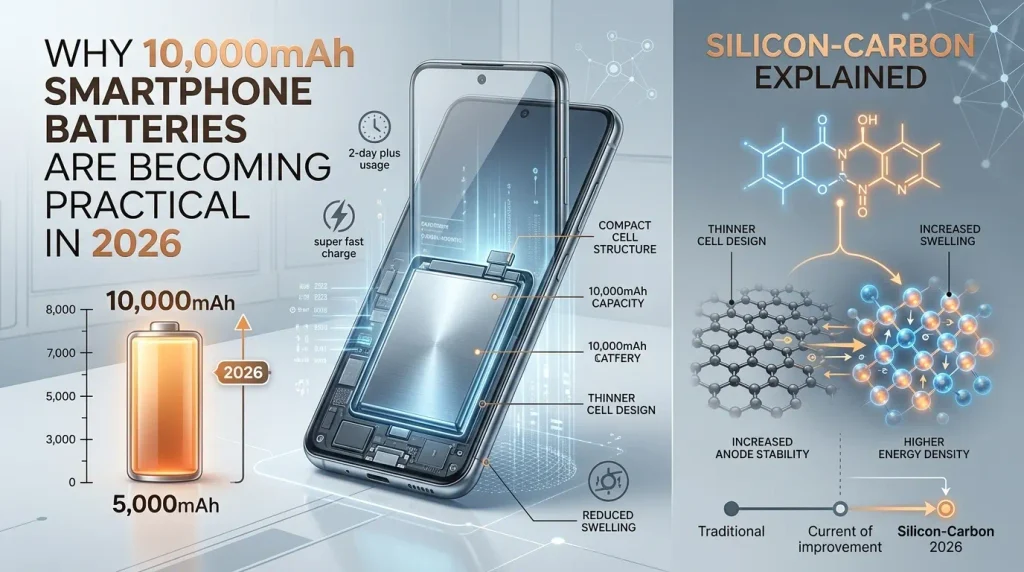
Smartphone batteries around 10,000mAh are becoming technically practical in 2026 largely because manufacturers are increasing energy density with silicon-carbon anodes. The important point is not that silicon-carbon magically doubles battery life: it lets engineers store more energy in a constrained volume, while actual endurance still depends on the display, chipset, radios, software, thermal management and user workload. This is an evidence-based technology explainer, not a hands-on battery test.
Key takeaways
- Silicon can store more lithium than graphite, but its expansion during charging makes pure-silicon anodes difficult to use in consumer phones; commercial designs therefore use engineered silicon-carbon composites.
- HONOR says its 2026 Magic V6 uses a 25% silicon-content battery with energy density up to 921Wh/L, enabling a 6,660mAh cell in a thin foldable.
- HONOR also demonstrated a next-generation Silicon-carbon Blade Battery with 32% silicon content and more than 900Wh/L energy density, illustrating where capacity is heading.
- Higher mAh is capacity, not a direct battery-life score. Two phones with the same capacity can deliver very different runtime.
- Large cells create a second engineering problem: charging time. Faster wired charging can compensate, but heat management and long-term battery health remain important.
What a silicon-carbon smartphone battery actually changes
Conventional lithium-ion phone batteries commonly use graphite-dominant anodes. Silicon can accommodate substantially more lithium, which makes it attractive for increasing energy density, but silicon also expands and contracts significantly as lithium moves in and out. A silicon-carbon composite is an engineering compromise: silicon contributes additional storage capacity while the carbon structure and the rest of the cell design help manage mechanical stress and stability.
The practical result is not a new unit of battery capacity—the familiar milliamp-hour figure still applies—but the possibility of fitting more capacity into a similar physical envelope. That is especially valuable in foldables and slim phones, where battery volume competes directly with hinges, cameras, cooling hardware and structural reinforcement.
Evidence from shipping 2026 phones
HONOR provides unusually specific public figures for the HONOR X80 Pro Max and its foldable battery development. For the Magic V6, HONOR states that its fifth-generation silicon-carbon material reaches 25% silicon content. Its regional buying guide lists a 6,660mAh battery and energy density up to 921Wh/L. The company also showed a 32%-silicon Blade Battery exceeding 900Wh/L at MWC 2026.
The trend is not limited to one form factor. PhoneSpecX has also covered the Redmi Note 17 Pro Max 5G, where very large battery capacity is part of the current mid-range competition, while the HONOR Magic V6 shows why higher energy density matters particularly in foldables.
Why 10,000mAh no longer automatically means a brick-sized phone
Battery capacity historically grew by allocating more internal volume to the cell, which could increase thickness or weight. Higher volumetric energy density changes that relationship: engineers can target more watt-hours within a similar volume. This does not eliminate packaging constraints, but it gives designers more room to balance battery size against cameras, cooling and structural parts.
Motorola’s 2026 Razr Ultra offers a useful independent example of the principle. Android Authority reported that the newer model moved to a 5,000mAh silicon-carbon battery—300mAh more than its predecessor—while retaining the same quoted folded dimensions and 199g weight. That is a smaller capacity jump than the headline 10,000mAh phones, but it demonstrates the underlying design benefit without relying only on raw capacity marketing.
Capacity versus endurance: do not confuse the two
| Metric | What it tells you | What it does not tell you |
|---|---|---|
| mAh | Electrical charge capacity | Guaranteed screen-on time or days of use |
| Wh/L | How much energy can be packaged per unit volume | Whole-phone efficiency |
| Charging watts | Maximum supported charging-power figure under compatible conditions | A constant charge rate from 0% to 100% |
A 10,000mAh phone driving a large, bright, high-refresh display and a power-hungry chipset may not last twice as long as a well-optimized 5,000mAh phone. Radio conditions also matter: weak cellular coverage can increase modem power consumption. Buyers should therefore treat capacity as one input, then look for standardized or reputable independent runtime testing once a device is available.
The charging tradeoff gets more important as batteries grow
More stored energy can mean more time needed to recharge if charging power stays unchanged. Manufacturers increasingly pair large silicon-carbon cells with high-power wired charging. HONOR’s Magic V6, for example, combines its 6,660mAh battery with 80W wired and 66W wireless charging. Those peak wattage figures still should not be converted directly into a predicted full-charge time because charging power tapers and thermal limits vary throughout the cycle.
What buyers should check beyond the headline mAh number
- Regional battery specification: capacity can differ between markets, so verify the exact regional product page.
- Charging standard: maximum speed may require the manufacturer’s compatible charger and cable.
- Independent endurance tests: wait for controlled testing when runtime matters more than capacity.
- Weight and thickness: higher energy density helps, but the complete phone design still determines ergonomics.
- Battery-health features: charging limits, thermal controls and long-term software support can matter more over several years than a small capacity advantage.
Does silicon-carbon automatically mean better battery longevity?
No. Silicon-carbon describes part of the cell chemistry and design approach, not a universal guarantee about cycle life. Silicon expansion is one of the central engineering challenges, and manufacturers use different material formulations, battery-management systems and charging strategies. Long-term degradation claims should be evaluated against the specific manufacturer’s stated test conditions and, ideally, independent aging data.
What comes next
The direction is clear: smartphone makers can use higher-density cells either to increase capacity, reduce thickness, or split the gain between the two. HONOR’s progression from 15% silicon content in the Magic V5 to 25% in the Magic V6, plus its 32% demonstration battery, provides a concrete example of that development. But the best phone battery will still be the one that combines adequate capacity with efficient silicon, display tuning, radios, thermal design and sensible charging behavior.
Frequently asked questions
Is a 10,000mAh smartphone battery twice as good as 5,000mAh?
No. It has roughly twice the charge capacity when compared on the same voltage basis, but real runtime is also determined by power consumption and software behavior.
Are silicon-carbon batteries still lithium-ion batteries?
Yes. In current smartphones, silicon-carbon generally refers to an anode approach within rechargeable lithium-ion battery technology rather than an entirely unrelated battery chemistry.
Why not use a pure silicon anode?
Silicon’s large volume change during charge and discharge creates mechanical and longevity challenges. Commercial cells use engineered composites and battery-management techniques to make higher silicon content practical.
Does a bigger battery always make a phone thicker?
Not necessarily. Higher energy density can fit more stored energy into a similar volume, although the final thickness and weight depend on the entire device design.
Should I buy a phone based only on battery capacity?
No. Compare capacity with measured endurance, charging behavior, display and chipset efficiency, weight, thermal performance, software support and the exact regional specification.
Sources and References
- HONOR — MWC 2026 battery technology and Magic V6 silicon-content announcement (March 1, 2026)
- HONOR — Magic V6 battery capacity and energy-density specifications
- HONOR Malaysia — Magic V5 15% silicon-carbon battery specification
- Android Authority — Motorola Razr Ultra 2026 silicon-carbon battery packaging comparison