
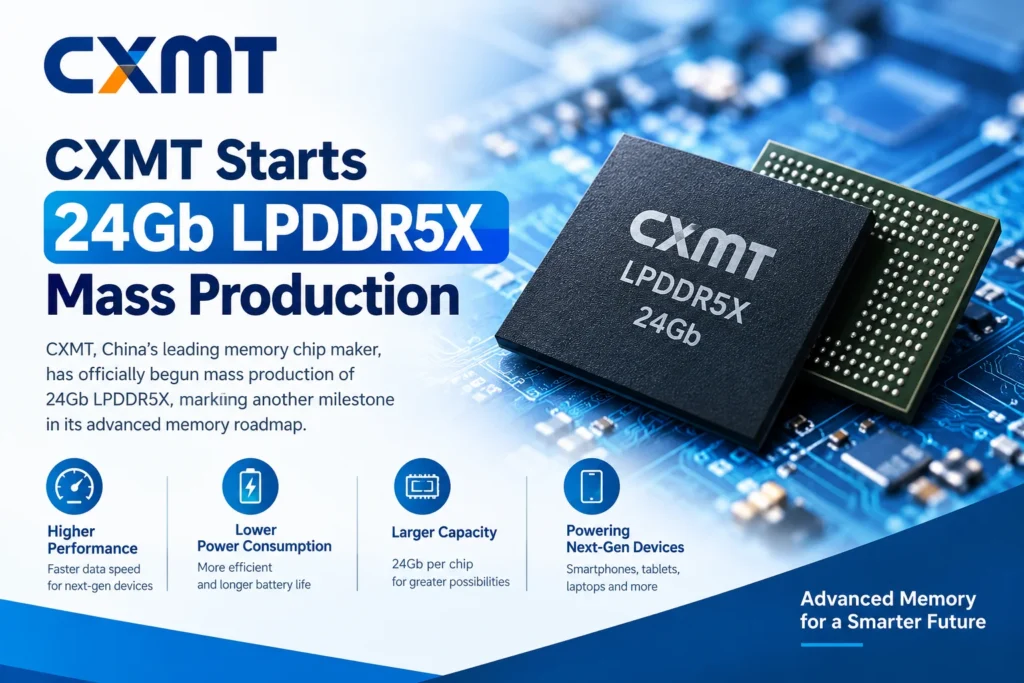
ChangXin Memory Technologies (CXMT) says its fifth-generation DRAM manufacturing platform is now in mass production, alongside two new 24-gigabit (24Gb) LPDDR5X products aimed at smartphones and other portable devices. The important number for phone buyers is density: 24Gb equals 3GB of raw memory per die, 50% more than a 16Gb (2GB) die. That can give device makers more flexibility when building high-capacity mobile memory packages, but it does not by itself prove that phones will become cheaper, faster or more power-efficient.
Highlights
- CXMT announced the G5 DRAM platform on September 20, 2026 and says it has entered mass production.
- The company introduced two 24Gb LPDDR5X products based on the platform, in different package formats for mobile-device designs.
- CXMT says its G5 process uses an 11.95nm active-area half-pitch and can produce at least 50% more gross dies per wafer than its previous platform on an 8Gb-equivalent basis.
- The 24Gb density is 50% higher than the 16Gb maximum listed in CXMT’s earlier LPDDR5X portfolio.
- Independent public data on production yield, real-world phone power consumption and device-level performance is still limited, so manufacturing claims should not be treated as handset benchmark results.
What CXMT actually announced
At the 2026 World Manufacturing Convention in Hefei, CXMT announced mass production of what it calls its fifth-generation DRAM technology platform, or G5. The company says the platform uses self-aligned quadruple patterning (SAQP) to reduce the active-area half-pitch in its memory array to 11.95nm. It also reports a 45:1 capacitor aspect ratio and use of a high-k metal-gate process.
Those are manufacturing metrics, not smartphone specifications. They describe how CXMT is making DRAM rather than how quickly a finished phone will open apps or run games. The company says the new process improves density and manufacturing economics, while Reuters reported that CXMT positioned the technology as a step toward more competitive mobile memory production.
24Gb LPDDR5X: the smartphone-relevant change
The most directly relevant product announcement is the pair of 24Gb LPDDR5X dies. A 24-gigabit die stores 3 gigabytes of data because eight bits equal one byte. CXMT’s previously published LPDDR5X range topped out at 16Gb per die, or 2GB, so the new part increases per-die capacity by 50%.
| Metric | Confirmed information and context |
|---|---|
| New LPDDR5X die density | 24Gb, equivalent to 3GB per die |
| Earlier CXMT LPDDR5X maximum | 16Gb, equivalent to 2GB per die |
| Density increase | 50% more bits per die |
| G5 active-area half-pitch | 11.95nm, according to CXMT |
| Gross dies per wafer | At least 50% higher than G4 on an 8Gb-equivalent basis, according to CXMT; this is before defective dies are excluded |
| Production status | CXMT says G5 and the two 24Gb LPDDR5X products are in mass production |
Why denser DRAM can matter inside a phone
Higher density can reduce the number of memory dies needed to reach a given package capacity or make higher capacities practical within similar package constraints. That matters in phones because board area, package height, heat and power budgets are tightly constrained. A 24Gb die also creates packaging combinations that are awkward with only 16Gb dies.
However, density should not be confused with bandwidth. A phone with more RAM is not automatically faster, and a 24Gb die does not tell us the memory interface width, operating data rate, controller configuration or thermal behaviour of a finished handset. For a broader look at the next memory standard, PhoneSpecX has separately explained Samsung’s LPDDR6 validation on a Snapdragon platform.
Could this affect smartphone prices?
Potentially, but the announcement is not enough to claim that retail phone prices will fall. CXMT says the G5 platform increases gross die output per wafer by at least 50% versus its previous generation on a normalized basis. More gross dies can improve manufacturing economics, but the figure is measured before defective dies are removed. Actual cost depends on yield, packaging, testing, memory-market pricing, customer qualification and supply agreements.
That distinction matters because smartphone prices in 2026 have also been affected by broader memory-cost pressures. One supplier improving density can add competition and capacity, but it does not determine global handset pricing on its own.
LPDDR5X is mature while LPDDR6 is arriving
The timing is notable. CXMT is increasing LPDDR5X density even as the industry begins moving toward LPDDR6. That is not necessarily contradictory: LPDDR5X already has a large ecosystem of compatible mobile platforms, while a new memory generation takes time to spread across price tiers and device designs.
For phone makers, a denser LPDDR5X option may therefore remain useful where compatibility, qualification and cost matter more than adopting the newest standard immediately. The broader performance picture also depends on the system-on-chip; PhoneSpecX’s Dimensity 9600M explainer shows why memory support is only one part of a modern mobile platform.
What remains unknown
CXMT’s announcement does not identify specific commercial smartphone models using the new 24Gb G5 LPDDR5X dies. It also does not provide independently audited production yields, handset-level battery tests, sustained bandwidth measurements or retail cost-per-gigabyte data. Those gaps matter. Until device makers identify shipping products and independent testing becomes available, claims about faster phones, longer battery life or lower handset prices would be premature.
What buyers should take from the announcement
For consumers, this is primarily a supply-chain and component-density development rather than a reason to choose one phone today. More competitive high-density mobile DRAM could eventually give manufacturers more flexibility in RAM configurations and sourcing. The practical benefits will only become clear when named phones ship with the parts and their performance, efficiency and pricing can be compared.
FAQs
What does 24Gb LPDDR5X mean?
It means each DRAM die stores 24 gigabits, equal to 3 gigabytes. The lowercase “b” means bits; eight bits equal one byte.
Is 24Gb the same as a phone having 24GB of RAM?
No. 24Gb describes one memory die’s density. A finished phone’s RAM capacity depends on how dies are combined and packaged.
Will CXMT’s new memory make smartphones cheaper?
Not necessarily. Higher gross die output could improve manufacturing economics, but phone prices also depend on yield, packaging, contracts, other components, taxes and market conditions.
Is LPDDR5X obsolete now that LPDDR6 exists?
No. LPDDR5X remains widely supported, while LPDDR6 adoption is beginning. Both can coexist across different devices and price tiers during a transition.
Which phones use CXMT’s new 24Gb G5 LPDDR5X?
CXMT’s September 20 announcement did not name specific shipping smartphone models using these new dies, so model-level adoption should not be assumed.