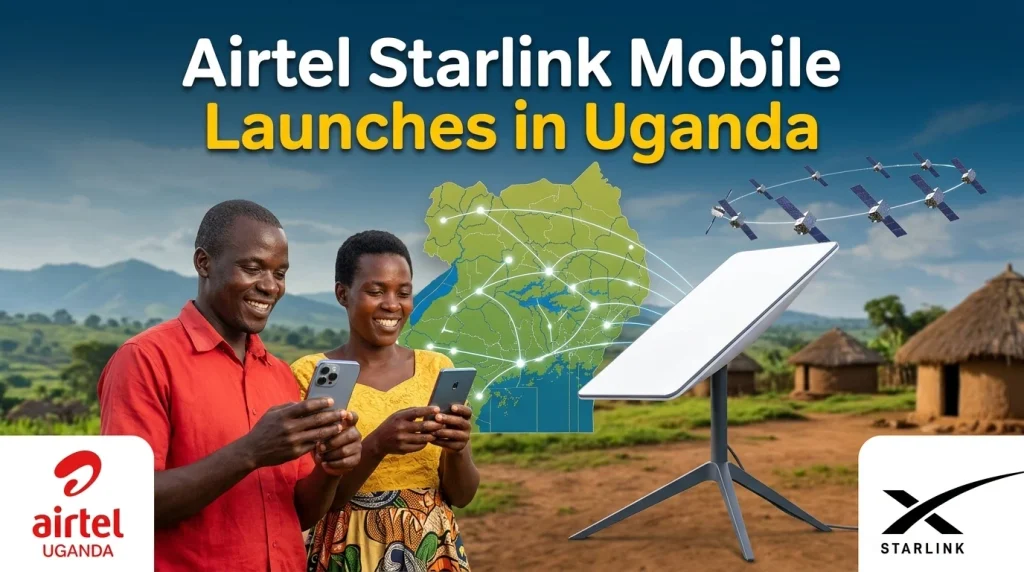
Airtel Uganda and Starlink launched a commercial satellite-to-mobile service on September 24, 2026, giving eligible customers a way to send SMS and use light-data services such as WhatsApp messaging when they are outside conventional Airtel tower coverage. The service is designed for compatible smartphones and does not require a Starlink dish or a separate satellite handset.
The launch is significant because it moves direct-to-cell connectivity in Uganda from testing into commercial availability. Uganda is the second Airtel Africa market to launch the service after the Democratic Republic of the Congo. For users, however, this is not the same thing as full-speed Starlink home broadband on a phone: the current Uganda service is focused on messaging and light data, requires a compatible device and a clear view of the sky, and still has important limits around device support, bundles and voice service.
Airtel Starlink Mobile Uganda: key facts
- Commercial launch: September 24, 2026.
- Network: Airtel Uganda working with Starlink satellite-to-mobile technology.
- Current use: SMS and light-data applications, including WhatsApp messaging.
- Hardware: No satellite dish or separate satellite phone is required.
- Phone requirement: A compatible smartphone is required; Airtel has said current access is on supported Android devices.
- Environment: A clear view of the sky is needed for satellite connectivity.
- Activation: Eligible customers can opt in through the MyAirtel App.
- Introductory access: A 30-day free trial is being offered to eligible customers.
- After the trial: Airtel says access will be tied to eligible Airtel Uganda data bundles, but qualifying bundles and final pricing were not publicly detailed at launch.
- Voice calls: Not announced as part of the current Uganda commercial service.
What works now, and what does not?
| Feature | Uganda launch status as of September 25, 2026 |
|---|---|
| SMS | Supported as part of the commercial satellite-to-mobile service. |
| WhatsApp messaging | Supported as a light-data use case according to launch reporting. |
| Full mobile broadband | Not presented as a substitute for normal high-speed terrestrial 4G/5G. The launch emphasizes light-data applications. |
| Voice calling | Not announced as part of the current Uganda service. Starlink’s broader Direct to Cell roadmap lists voice separately, so users should not assume it is available locally. |
| Satellite dish | Not required. |
| Separate satellite handset | Not required, but the smartphone must be compatible with the service. |
| iPhone support | Airtel Uganda has not yet announced iOS availability; current customer guidance reported by Pulse Uganda says supported Android devices are the initial target. |
| Price after trial | Not fully detailed at launch. Airtel says eligible data bundles will be required after the introductory period. |
How Starlink Direct to Cell reaches an ordinary phone
Traditional satellite internet usually makes people think of a dish pointed at the sky. Direct-to-cell is different. Starlink says its Direct to Cell satellites carry an eNodeB modem that effectively allows a satellite to act like a cellular base station in orbit. The satellite link is then integrated with a mobile operator’s network in a way that resembles roaming.
Uganda Communications Commission describes direct-to-device, direct-to-cell and direct-to-handset services as approaches that let smartphones and similar devices connect directly to low-Earth-orbit satellites without a specialised user terminal. The regulator explains that LEO satellites can function like LTE/4G or 5G base stations in space.
That architecture explains why the Uganda service can work without a consumer Starlink dish. It also explains the practical requirement for a clear view of the sky: buildings, terrain and other obstructions can make a direct satellite link harder than a normal connection to a nearby terrestrial tower.
How eligible Airtel Uganda customers can activate it
Current customer guidance says eligible users should open the MyAirtel App, register their Airtel number, open the available quick actions and select the Starlink option. Airtel is offering a 30-day introductory trial to eligible customers.
When terrestrial coverage disappears, a supported phone can then use the satellite service where the necessary conditions are met. Users should not expect the experience to behave exactly like normal 4G or 5G. Satellite visibility matters, and the commercial launch is deliberately focused on lower-bandwidth communication.
After the free period, Airtel says customers will need an eligible Uganda data bundle. As of September 25, Airtel had not publicly specified all qualifying bundles or post-trial pricing in the material reviewed by PhoneSpecX, so it would be premature to quote a monthly price.
Android first: compatibility is the biggest practical question
The phrase “compatible smartphone” matters. Starlink’s broader Direct to Cell platform is designed around existing LTE phones, but local carrier deployment still determines which devices, software configurations and spectrum combinations are supported.
Pulse Uganda reported that Airtel Uganda currently describes the service as available on supported Android devices and that an iOS announcement will come later. That means an iPhone owner in Uganda should not assume support merely because some iPhones have other satellite features in other markets.
For context, PhoneSpecX’s iPhone 18 Pro specification coverage and iPhone 18 Pro vs iPhone 18 Pro Max comparison discuss current flagship hardware, but handset-level satellite capability and carrier-operated Direct to Cell access are separate questions. Local carrier support remains decisive.
Why Uganda is a useful test case
Airtel Uganda says it already operates thousands of terrestrial sites, yet difficult terrain and remote communities still create coverage gaps. Satellite-to-mobile service is intended to complement, not replace, that ground network.
The use cases are practical: transport and logistics routes, farming areas, humanitarian work, mining, islands, parks and communities where constructing a conventional tower is difficult or uneconomic. It can also provide a fallback communication path during disasters or temporary terrestrial-network outages.
The commercial launch follows earlier Airtel-Starlink testing in Uganda, including work in Murchison Falls National Park. It also follows the companies’ broader partnership announced in 2025 to expand satellite-to-mobile connectivity across Airtel Africa markets, subject to regulatory approval.
What users should not assume
This is not unlimited Starlink broadband on a smartphone. The launch material focuses on SMS and light-data messaging. There is no basis yet to promise streaming-class speeds, conventional voice calling, universal handset support or a specific post-trial price.
Coverage is not the same as guaranteed indoor service. Airtel and Starlink both emphasize the need for a clear view of the sky. Dense structures, terrain and other obstructions can affect satellite connectivity.
Compatibility is not universal. Even though Direct to Cell is engineered to work with ordinary LTE phones, Airtel controls local eligibility and device support. Users should rely on the MyAirtel App and Airtel Uganda’s current compatibility guidance rather than assuming every LTE phone will connect.
What this means for smartphone users in Africa
Uganda becoming Airtel Africa’s second commercial Starlink Mobile market is more important than a single carrier feature. It demonstrates a model in which existing smartphones can gain a limited safety-net connection outside tower coverage without consumers buying satellite hardware.
The immediate value is communication rather than speed. A message sent from a remote road, park, farm or disaster-affected area can be more useful than a high benchmark number. If Airtel and Starlink expand device support, applications and eligible markets while keeping pricing accessible, direct-to-cell could become a meaningful complement to terrestrial mobile networks across parts of Africa.
For now, the strongest conclusion is narrower: eligible Airtel Uganda customers with supported Android phones have a new way to send SMS and light-data messages outside normal coverage, while voice, iPhone support, broader data capability and final post-trial pricing remain areas to watch.
Frequently asked questions
Does Airtel Starlink Mobile in Uganda need a satellite dish?
No. The commercial service is designed to connect compatible smartphones directly to Starlink’s satellite-to-mobile network without a consumer dish or separate satellite handset.
Can Airtel Uganda customers use WhatsApp over Starlink?
Airtel’s launch information includes WhatsApp messaging among the supported light-data uses. Users still need an eligible account, compatible phone and suitable satellite visibility.
Does Airtel Starlink Mobile support calls in Uganda?
Voice calling was not announced as part of the Uganda launch. The currently described service focuses on SMS and light-data applications, so users should not assume ordinary voice calls are supported.
Does it work on iPhone?
Current Airtel Uganda guidance reported on September 25 says supported Android devices are available first. Airtel has not yet announced iOS availability for this service.
How much does Airtel Starlink Mobile cost in Uganda?
Eligible customers can receive a 30-day introductory trial. Airtel says eligible data bundles will be required afterward, but the reviewed launch information does not establish a complete post-trial price list.
Sources and References
- Uganda Communications Commission — Direct-to-Device: How LEO Satellites Are Transforming Mobile Communications (published September 22, 2026)
- Starlink — Direct to Cell technology overview (accessed September 25, 2026)
- PC Tech Magazine — Airtel Africa Launches Starlink Mobile in Uganda (published September 24, 2026)
- Pulse Uganda — How to Use Airtel’s New Starlink Satellite Service on Phone (published September 25, 2026)