- POCO’s new F9 family includes the F9 Ultra and F9 Pro, both positioned as high-performance flagships.
- The F9 Ultra pairs Snapdragon 8 Elite Gen 5 with an 8050mAh battery, 6.9-inch 185Hz display and 5x periscope camera.
- The F9 Pro uses the V Series version of the same chip family and combines a 6.59-inch 185Hz display with a 6330mAh battery.
- Pricing, colors, memory configurations, charger inclusion and retail timing must be checked on each regional POCO site.
What POCO announced
The official POCO F9 series specifications confirm that POCO has expanded its performance-focused F series with two officially detailed models: the POCO F9 Ultra and POCO F9 Pro. The global launch page calls the family an all-round performance flagship, and the individual product pages show a clear move beyond the brand’s older value-flagship formula.
Both phones combine a Snapdragon 8 Elite Gen 5-family platform, a dedicated VisionBoost D8 graphics-boost chip, 185Hz AMOLED displays, 200MP main cameras, fast wired and wireless charging, Bose-tuned audio and IP68 protection. The important differences are screen size, battery capacity, secondary cameras and audio hardware.
POCO F9 Ultra: the larger flagship
The F9 Ultra uses the full Snapdragon 8 Elite Gen 5 platform, backed by LPDDR5X memory and UFS 4.1 storage. POCO lists a 6.9-inch 2608 × 1200 AMOLED panel with a refresh rate of up to 185Hz. Selected games can use frame-rate enhancement up to 185fps, but support depends on the title, settings, software and operating temperature.
Its 8050mAh typical battery is the largest in the pair. Charging support reaches 100W by cable and 50W wirelessly, with 27W wired reverse charging and 22.5W wireless reverse charging also listed. A 3D IceLoop cooling system uses a 6300mm² loop heat-pipe area plus extensive graphite coverage to manage sustained loads.
POCO F9 Pro: smaller body, similar priorities
The F9 Pro uses Snapdragon 8 Elite Gen 5 V Series, officially identified as SM8850-1-AB, together with the same VisionBoost D8 graphics-boost chip. Its 6.59-inch AMOLED display is smaller than the Ultra’s but keeps the headline 185Hz refresh rate and POCO HyperRGB subpixel structure.
A 6330mAh silicon-carbon battery powers the Pro. It retains 100W wired and 50W wireless charging, including the same listed reverse-charging rates. The cooling hardware is scaled differently, with a 5200mm² loop heat-pipe area within a wider 26,000mm² heat-dissipation design.
POCO F9 Ultra vs F9 Pro: key differences
The Ultra is designed for buyers who want the largest battery, a bigger display, longer optical reach and the more ambitious speaker system. The Pro is the more compact option while preserving most of the series’ core performance, display and charging features.
The models are not merely storage variants. Their camera arrays, battery sizes, display dimensions and speaker configurations differ enough that buyers should choose by use case rather than assuming the Ultra only adds more memory.
Cameras and audio
Both phones use a 200MP main camera with optical image stabilization, but the supporting cameras separate them. The F9 Ultra adds a 50MP 5x periscope telephoto with OIS and a 50MP ultrawide, plus a 32MP front camera. The F9 Pro uses a 50MP 2.5x floating telephoto with OIS, an 8MP ultrawide and a 32MP selfie camera.
POCO also worked with Bose on both models. The Ultra adds symmetrical stereo speakers and an independent subwoofer for a 2.1-channel arrangement. The Pro uses symmetrical stereo speakers without the Ultra’s separate subwoofer. These are hardware distinctions; real audio and camera quality still require independent testing.
Design, durability and colors
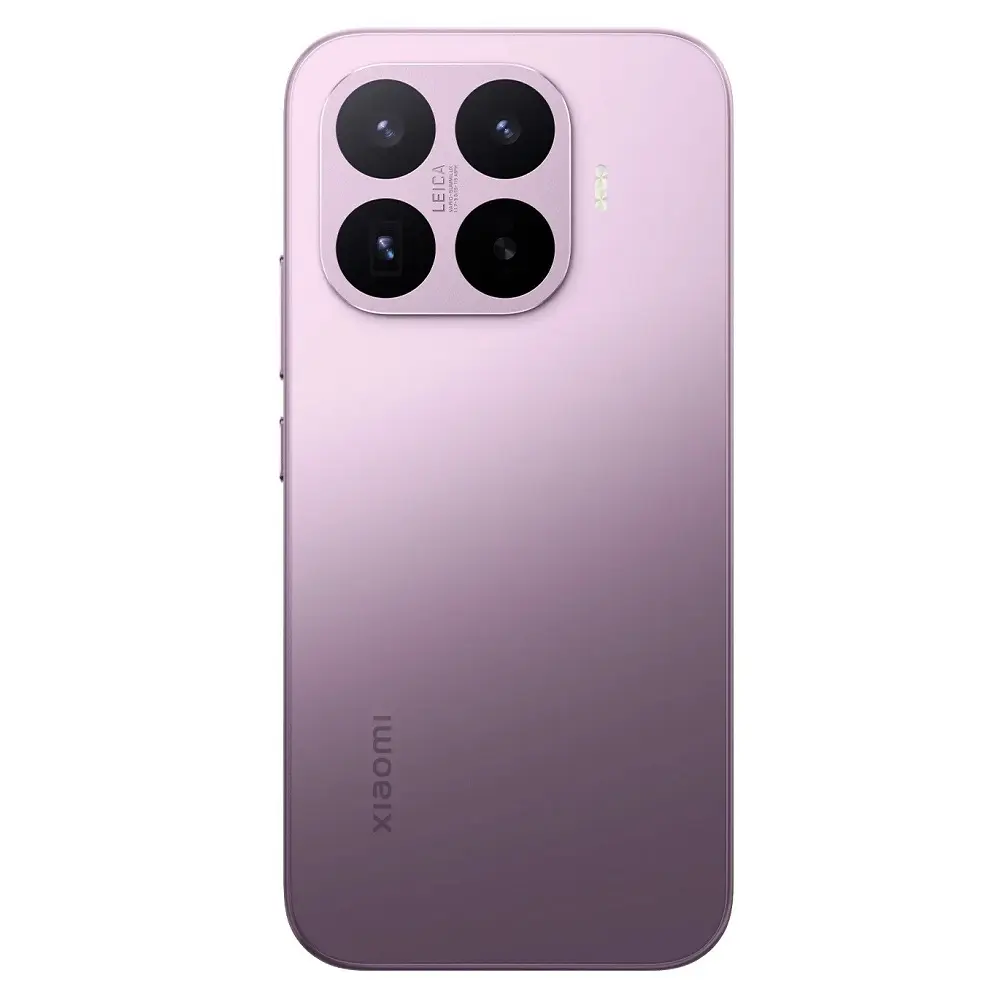
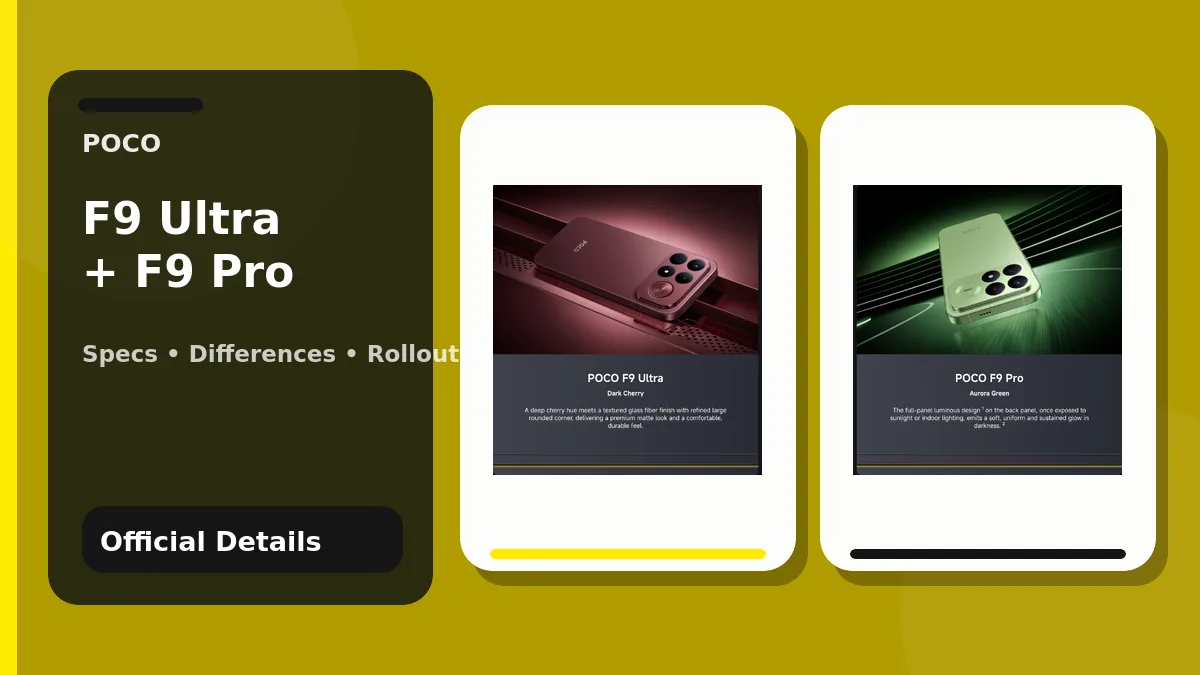
The F9 Ultra is shown in Dark Cherry and Black. POCO describes a fiberglass back, a micro-curved metal frame and a flat metallic camera module. The F9 Pro is offered in several finishes, with Aurora Green receiving a full-panel luminous treatment that stores light and produces an afterglow under suitable conditions.
Both phones carry an IP68 rating. POCO’s published test condition cites immersion up to 1.5 meters for 30 minutes, but water resistance can decline with wear and should not be treated as permanent protection.
Regional rollout and buying details
Xiaomi’s global pages confirm the devices and their core specifications, but market details are not uniform. POCO explicitly says colors, RAM and storage variants may differ by country. Charger inclusion and wireless-charging accessory availability can also vary, so buyers should confirm the exact retail package on their local POCO website.
Pricing and sales dates should likewise be treated as regional information. A price published for one country should not be converted into a promise for another market because taxes, memory configurations, launch promotions and distribution channels can change the final cost.
What the F9 series means for POCO
The F9 family shows POCO competing more directly with conventional premium phones. Features such as 50W wireless charging, 200MP main cameras, IP68 protection and Bose-tuned audio are no longer secondary additions; they are central to the series’ pitch.
The Ultra makes the strongest hardware statement, while the Pro aims to preserve most of that experience in a smaller format. Readers comparing generations can also review the POCO F8 Ultra specifications. For a broader mid-range alternative, see the POCO X8 Pro Max specifications and the POCO X8 Pro Max versus Pixel 10a comparison.