- The 6.1-inch Pro IGZO OLED combines a compact footprint with variable refresh behavior and a quoted 2,000-nit peak.
- Snapdragon 7s Gen 3, up to 8GB RAM, 256GB storage and microSD expansion cover mainstream daily use.
- Both rear cameras use 50.3MP sensors, while the standard camera adds a large 1/1.55-inch sensor and OIS.
- A 5,000mAh battery, Wi-Fi 6E, eSIM, DisplayPort output and ruggedness testing strengthen the practical package.
- Sharp promises up to three Android version upgrades and five years of security updates from release.
Quick highlights
Sharp AQUOS sense10 specifications focus on a compact, practical Android phone rather than a giant-screen flagship. The official package combines a 6.1-inch Pro IGZO OLED, Snapdragon 7s Gen 3, dual 50.3MP rear cameras, a 5,000mAh battery and Android 16 in a 166g body.
The distinctive details are equally useful: microSD expansion, nano-SIM plus eSIM, Wi-Fi 6E, USB-C DisplayPort output, stereo box speakers and extensive water, dust and durability testing. This guide uses Sharp’s official Japanese specifications and global launch material; PhoneSpecX has not performed hands-on testing.
Design, size and colors
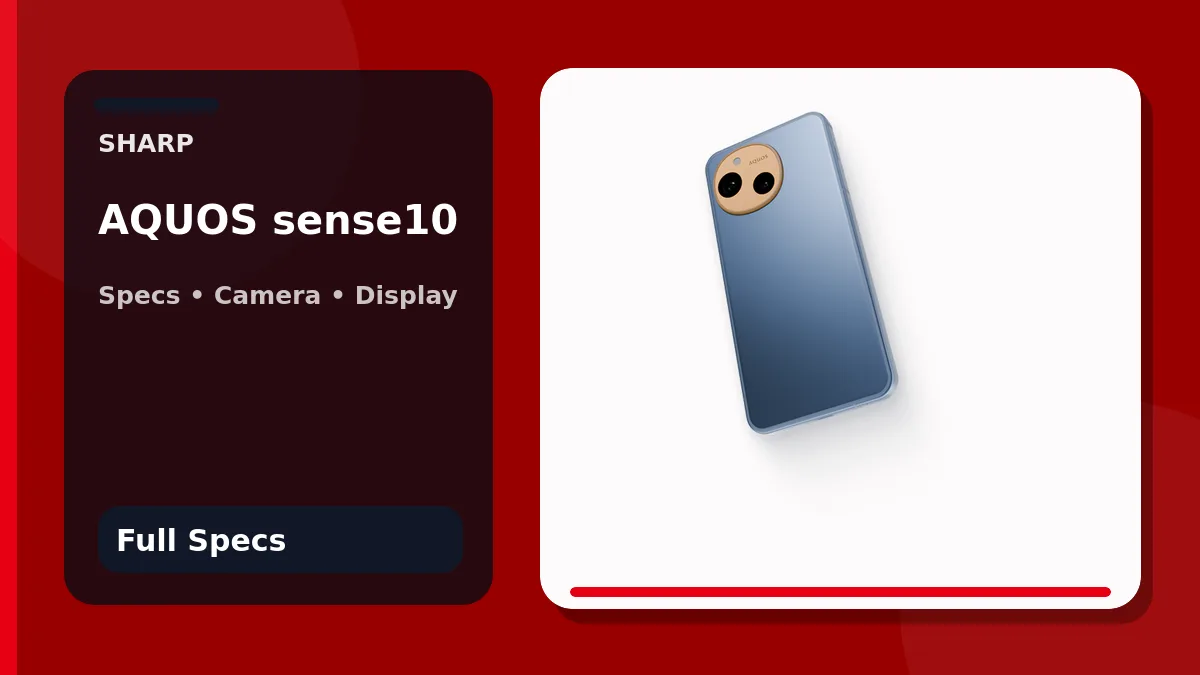
The AQUOS sense10 measures 149 × 73 × 8.9mm and weighs 166g, so it is appreciably easier to handle than many large-screen phones. Sharp uses an aluminum body and offers Denim Navy, Khaki Green, Pale Pink, Pale Mint, Full Black and Light Silver, although exact colors depend on market and carrier.
The rounded camera island gives the rear a recognizable look without making the phone visually busy. Face recognition supports mask use, and fingerprint recognition provides the second biometric option. Buyers prioritizing a compact everyday device should find the 73mm width more manageable than typical 6.7-inch designs.
Pro IGZO OLED display
The 6.1-inch Pro IGZO OLED has a 1080 × 2340 Full HD+ resolution. Sharp quotes 1,500 nits for full-screen brightness and 2,000 nits peak brightness, while its Rich Color Technology Mobile engine handles image tuning.
The panel uses variable drive from 1Hz and advertises a 240Hz high-speed effect in supported games. Sharp explains that this maximum uses black-frame insertion synchronized with 120 display updates per second, so it should not be read as a conventional native 240Hz refresh rate in every app. The variable behavior is designed to balance motion smoothness with power efficiency.
Snapdragon 7s Gen 3 performance
Qualcomm’s Snapdragon 7s Gen 3 platform provides an octa-core CPU with clocks up to 2.5GHz. It targets responsive everyday work, social media, navigation, video and mainstream gaming rather than flagship-level sustained performance.
Sharp lists two memory configurations: 6GB LPDDR4X RAM with 128GB UFS 2.2 storage, or 8GB RAM with 256GB storage. Each version can assign an equal amount of storage as virtual memory, but that feature is slower than physical RAM and does not change the installed hardware. Availability varies by country, carrier and color.
Storage and expansion
A microSDXC slot supports cards up to 2TB, a notable advantage for users with large photo, video or offline media libraries. That expansion complements the 128GB and 256GB internal-storage options rather than replacing their faster UFS storage.
For another Android 16 option with a different price and performance balance, see our NUU X10 5G specifications. Local AQUOS storage and SIM combinations should still be confirmed before purchase.
Dual 50.3MP rear cameras
The standard rear camera uses a 50.3MP sensor measuring 1/1.55 inch, an f/1.9 lens with a 23mm-equivalent field of view, optical image stabilization and electronic stabilization. The large sensor and OIS are intended to improve low-light capture and reduce hand shake.
The ultra-wide also uses a 50.3MP sensor, paired with an f/2.2 lens, 13mm-equivalent focal length and 122-degree field of view. It supports electronic stabilization but not OIS. Sharp’s ProPix engine handles processing, including higher-information night and HDR synthesis compared with the prior generation according to the manufacturer.
AI camera tools and selfies
Sharp highlights AI-assisted shadow removal for food and documents, perspective correction for photographed text, and reflection reduction when shooting through glass. Auto Macro can switch modes as the phone moves close to a subject, while 11 Photo Style filters provide different looks.
The front camera is a 32MP unit with an f/2.2 lens, 25mm-equivalent view and electronic stabilization. Palm-triggered capture and a movable on-screen shutter aim to simplify one-handed selfies. These tools are conveniences; final image quality still depends on lighting and processing, and PhoneSpecX has not independently tested them.
Battery and 36W charging
The 5,000mAh battery is substantial for a 166g phone with a 6.1-inch display. Sharp lists 36W input, USB Power Delivery Revision 3.0 and an approximate 90-minute charging time under its test conditions. Real charging speed depends on the charger, cable, temperature and use during charging.
The company also quotes long standby figures for Japanese LTE configurations, but network conditions and background activity can change results dramatically. The combination of a variable-drive IGZO panel and 5,000mAh capacity is the more useful basis for expectations than a single laboratory endurance number.
Android 16 and update support
The phone launched with Android 16 and AQUOS UX 16.0.000. Sharp promises up to three operating-system version upgrades and security updates for five years from the release date, giving buyers a clearer support window than an unspecified policy.
Vocalist is one of the headline software features. After setup, the AI system can isolate a registered user’s voice and reduce surrounding noise during calls made on the handset. The phone assistant can also transcribe recorded messages and warn about suspicious conversations, with availability and language behavior depending on region.
Connectivity, ports and audio
Wireless support includes 5G sub-6, Wi-Fi 6E, Bluetooth 5.2 and multi-constellation GNSS. The phone accepts nano-SIM and eSIM with DSDV support. Exact bands vary by market, so imported-device buyers should compare the local carrier bands with Sharp’s regional list.
USB-C supports USB 3.2 Gen 1 data rates and DisplayPort 1.4 output. There is no 3.5mm headphone jack. Dual box-type stereo speakers sit at the earpiece and lower edge, while wired and wireless Hi-Res Audio support is available with compatible accessories.
Durability and daily practicality
Sharp lists IPX5/IPX8 water resistance, IP6X dust resistance and compliance across 16 MIL-STD-810G/H test categories, including drop, vibration, humidity, temperature and low-pressure conditions. The phone can also be cleaned with supported alcohol wipes or hand soap under Sharp’s guidance.
These ratings do not make the device indestructible, and water resistance can degrade with wear. Still, the combination of a light body, expandable storage, contactless-payment support in relevant Japanese models and practical biometrics supports the phone’s everyday focus.
Full specifications
| Feature | Sharp AQUOS sense10 |
|---|---|
| Dimensions | 149 × 73 × 8.9mm |
| Weight | 166g |
| Display | 6.1-inch Pro IGZO OLED |
| Resolution | 1080 × 2340 Full HD+ |
| Brightness | 1,500 nits full-screen; 2,000 nits peak |
| Chipset | Snapdragon 7s Gen 3 |
| Memory | 6GB/128GB or 8GB/256GB |
| Expansion | microSDXC up to 2TB |
| Rear cameras | 50.3MP OIS main + 50.3MP ultra-wide |
| Front camera | 32MP |
| Battery | 5,000mAh |
| Charging | 36W USB PD 3.0 |
| SIM | nano-SIM + eSIM, DSDV |
| Wireless | 5G, Wi-Fi 6E, Bluetooth 5.2 |
| Protection | IPX5/IPX8, IP6X, MIL testing |
| Software | Android 16 |
Configurations, colors, bands and payment features vary by country and carrier. Confirm the exact local model before buying.
Price and availability
Sharp announced a Japanese release on November 13, 2025, followed by planned availability in Taiwan, Indonesia and Singapore. The reviewed official material does not establish one universal global price, and local carrier bundles, taxes and storage options differ.
Check Sharp or an authorized regional seller for current pricing and stock. Readers comparing camera-led Android phones can also review the Huawei nova 16 specifications and the higher-performance Realme GT 8 Pro specifications.
Strengths and trade-offs
Strong points
- Compact 166g body with a 6.1-inch Pro IGZO OLED
- Large 5,000mAh battery for the size
- Dual 50.3MP rear cameras with OIS on the main sensor
- microSD, eSIM, Wi-Fi 6E and DisplayPort output
- Clear OS and security-support promise
Trade-offs
- UFS 2.2 and LPDDR4X are not flagship-grade memory standards
- No 3.5mm headphone jack
- 36W charging is moderate
- 240Hz claim relies on a special black-frame-insertion mode
- Pricing and configurations vary significantly by market
Verdict
The AQUOS sense10 is a thoughtfully specified compact midrange phone. Its 6.1-inch IGZO display, 166g weight, 5,000mAh battery, Snapdragon 7s Gen 3 and dual 50.3MP rear cameras create a balanced daily package without following the trend toward oversized hardware.
Expandable storage, eSIM, DisplayPort output and a defined update policy add practical value. Buyers should verify bands, storage and price locally, but the official specification sheet gives the AQUOS sense10 a clear identity: a small, durable and feature-rich Android phone rather than a cut-down budget device.
Pros & Cons
Pros
- Compact 166g design
- Bright Pro IGZO OLED
- Dual 50.3MP cameras
- 5000mAh battery
- microSD and eSIM
Cons
- Moderate 36W charging
- No headphone jack
- UFS 2.2 storage
- Regional availability
- 240Hz mode is conditional