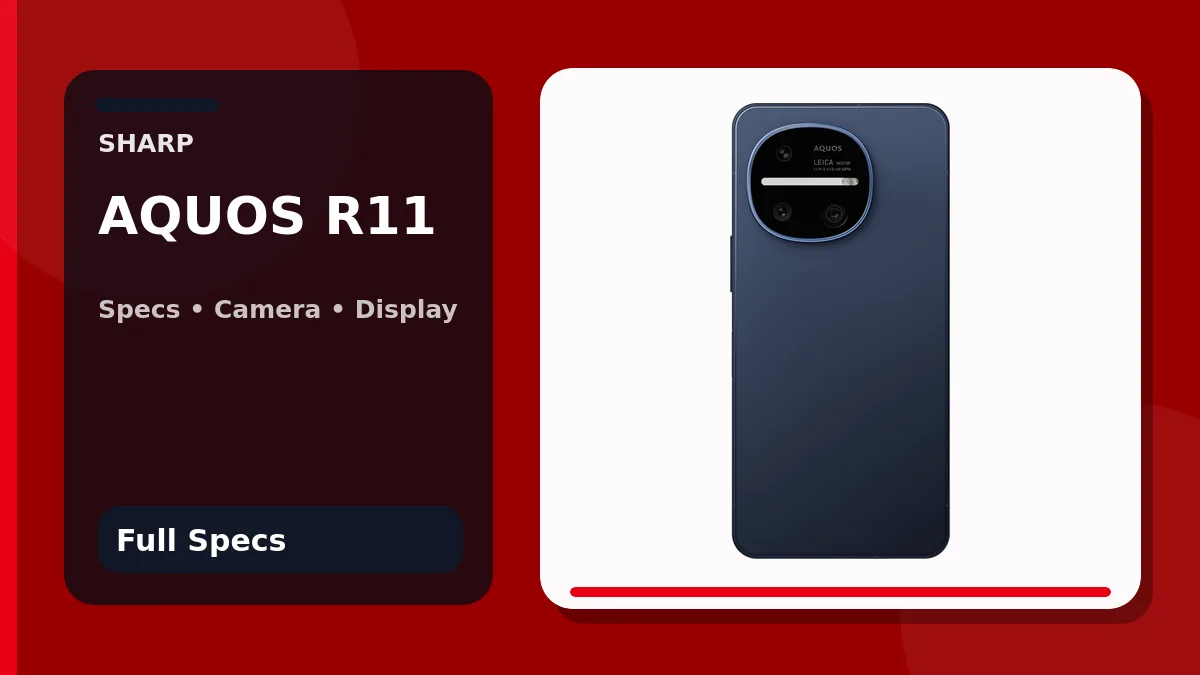
- The 6.5-inch Pro IGZO OLED reaches a manufacturer-rated 3,600-nit peak and uses very slim bezels.
- Snapdragon 8s Gen 4, 12GB LPDDR5X and UFS 4.1 storage provide near-flagship hardware foundations.
- The Leica-supervised rear system adds a 2.9x optical telephoto camera to 50.3MP standard and ultra-wide cameras.
- A 5,100mAh battery, Wi-Fi 7, Bluetooth 6.0, eSIM and DisplayPort output round out the specification.
- Sharp promises three OS upgrades and five years of security updates from release.
Quick highlights
Sharp AQUOS R11 specifications position it as a compact high-end Android phone with a strong camera and display focus. The official hardware combines a 6.5-inch Pro IGZO OLED, Snapdragon 8s Gen 4, 12GB RAM, a Leica-supervised triple camera, a 5,100mAh battery and Android 16.
Sharp also includes Wi-Fi 7, Bluetooth 6.0, nano-SIM plus eSIM, DisplayPort output, Victus 2 glass and extensive ingress and durability ratings. This guide is based on Sharp’s official product, specification and launch pages; PhoneSpecX has not performed hands-on testing.
Design, size and Akarium light
The AQUOS R11 measures 156 × 74 × 8.9mm and weighs 195g. That is not a small phone, but the 74mm width and 94.5% quoted screen-to-glass ratio keep it more manageable than many large flagships. Navy, Ivory and Terracotta colors are listed, with availability varying by market.
A rear lighting feature called Akarium uses a soft glow for ambience and notifications. Both sides use Corning Gorilla Glass Victus 2, while the curved camera treatment was supervised by miyake design. Face recognition with mask support and fingerprint recognition handle biometric access.
6.5-inch Pro IGZO OLED display
The 6.5-inch Pro IGZO OLED has a 1080 × 2340 Full HD+ resolution. Sharp rates it at 1,800 nits full-screen and 3,600 nits peak brightness, its highest quoted peak for an AQUOS phone as of June 2026.
Smart Outdoor View adjusts different screen regions for visibility under strong light, while Virtual HDR is designed to expand the presentation of non-HDR content. The 1.3mm minimum bezel contributes to the high screen ratio without pushing the body unusually wide.
Refresh-rate claim explained
Sharp advertises variable drive from 1Hz to a 240Hz high-speed effect. The maximum relies on black-frame insertion synchronized with 120 display updates per second in supported games and settings, so it is not a universal native 240Hz refresh rate.
The lower end of the range lets static content use less power, while the high-speed mode targets smoother perceived motion. App support and the gaming-menu setting determine whether the 240Hz effect is available.
Snapdragon 8s Gen 4 performance
Qualcomm’s Snapdragon 8s Gen 4 uses a hexa-core CPU clocked up to 3.2GHz. Sharp claims roughly 13% higher CPU and 40% higher GPU performance than the AQUOS R10, although those are manufacturer comparisons rather than independent PhoneSpecX benchmarks.
A new vapor chamber has 2.87 times the effective heat-dissipation area of the R10 design according to Sharp. Its purpose is to reduce thermal buildup around the SoC during demanding tasks, but sustained performance still depends on ambient temperature and workload.
Memory and storage
Every listed configuration has 12GB of LPDDR5X RAM, plus up to 12GB of storage-based virtual memory. Internal storage is either 256GB or 512GB using UFS 4.1, with exact options determined by market and carrier.
There is no microSD slot. Users who prioritize expandable storage and a lighter body can compare the Sharp AQUOS sense10 specifications, though the R11 has the faster chipset and more ambitious cameras.
Leica-supervised triple camera
The 50.3MP standard camera uses a 1/1.55-inch sensor, f/1.9 HEKTOR lens, 23mm-equivalent view, OIS and EIS. A 50.3MP ultra-wide adds a 122-degree field of view with a 13mm-equivalent f/2.2 HEKTOR lens and EIS.
The third camera is a 38.5MP telephoto with an f/2.4 HEKTOR lens, 68mm-equivalent focal length, 2.9x optical zoom, OIS and EIS. That optical reach makes portrait and distant-subject framing more flexible than a digital crop from the main camera.
Camera processing and video
Leica supervised the imaging system, while Sharp’s ProPix PRO engine handles processing. A 14-channel spectrum sensor is designed to improve color reproduction, and Smart Fit Zoom can adjust magnification automatically for framing.
AI features include shadow removal, perspective correction, reflection reduction and blink reduction. The phone also supports Dolby Vision recording, Auto HDR, Auto Macro and Night Video. The 50.3MP front camera uses an f/2.2 lens and EIS. Results remain dependent on conditions, and this article does not claim independent camera testing.
5100mAh battery and charging
The 5,100mAh battery is the largest capacity Sharp had used in an AQUOS smartphone as of June 2026. The company estimates two days based on its own scenario of ten hours of daily video, music, social media and gaming; real endurance will vary substantially.
Charging input is 36W over USB Power Delivery Revision 3.0, with about 90 minutes quoted for a full charge under Sharp’s conditions. The capacity is generous, but wired speed is moderate beside some competing high-end Android phones.
Android 16 and update policy
The AQUOS R11 ships with Android 16 and AQUOS UX 16.0.001. Sharp promises up to three operating-system version upgrades and five years of security updates from the release date, establishing a defined support horizon.
Software additions include Vocalist call-noise isolation, Home Deco customization, nuisance-call controls and Grance AI for AQUOS. Regional availability and language support may differ, so imported models can behave differently from the Japanese configuration.
Connectivity, ports and audio
Connectivity includes sub-6 5G, Wi-Fi 7, Bluetooth 6.0 with Classic Audio, LE Audio and Auracast, plus dual-band multi-constellation GNSS. It supports nano-SIM and eSIM with DSDV. Bands vary by region and should be checked against the intended carrier.
USB-C provides USB 3.2 Gen 1 and DisplayPort 1.4 output. There is no 3.5mm jack. Stereo speakers support Dolby Atmos and 8Way Audio, while Hi-Res wired and wireless playback requires compatible headphones or speakers.
Durability
The phone carries IPX5, IPX8 and IPX9 water-resistance ratings, IP6X dust resistance and compliance across 16 MIL-STD-810G/H test categories. IPX9 adds resistance against specified high-temperature, high-pressure water-jet testing.
Victus 2 glass protects both front and back, and Sharp permits cleaning under its stated alcohol-wipe and hand-soap guidance. Ratings do not make the phone indestructible, and resistance can decline with damage or age.
Full specifications
| Feature | Sharp AQUOS R11 |
|---|---|
| Dimensions | 156 × 74 × 8.9mm |
| Weight | 195g |
| Display | 6.5-inch Pro IGZO OLED |
| Resolution | 1080 × 2340 FHD+ |
| Brightness | 1,800 nits full-screen; 3,600 nits peak |
| Chipset | Snapdragon 8s Gen 4 |
| Memory | 12GB LPDDR5X |
| Storage | 256GB/512GB UFS 4.1 |
| Rear cameras | 50.3MP + 50.3MP + 38.5MP |
| Front camera | 50.3MP |
| Battery | 5,100mAh |
| Charging | 36W USB PD 3.0 |
| Wireless | 5G, Wi-Fi 7, Bluetooth 6.0 |
| SIM | nano-SIM + eSIM, DSDV |
| Protection | IPX5/IPX8/IPX9, IP6X |
| Software | Android 16 |
Memory, colors, bands and carrier features vary by region. Confirm the exact model before purchasing or importing.
Price and availability
Sharp announced sales in Japan and Taiwan beginning on or after July 9, 2026. The official global release does not provide one universal price; storage, carrier bundles, taxes and colors vary across sellers and markets.
Current pricing should be checked with Sharp or an authorized regional seller. For other camera-focused Android choices, compare our Realme GT 8 Pro specifications and Huawei nova 16 specifications.
Strengths and trade-offs
Strong points
- Very bright 6.5-inch Pro IGZO OLED
- Snapdragon 8s Gen 4 with 12GB LPDDR5X
- Leica-supervised triple camera with optical telephoto
- 5,100mAh battery, Wi-Fi 7 and eSIM
- Victus 2 glass and extensive ingress protection
Trade-offs
- No microSD or headphone jack
- 36W charging is moderate
- 240Hz effect is conditional
- Regional availability is limited
- Manufacturer performance and endurance claims need independent testing
Verdict
The AQUOS R11 combines near-flagship performance with a notably complete camera system. Snapdragon 8s Gen 4, fast memory, a bright Pro IGZO OLED and a stabilized 2.9x telephoto give it substance beyond a standard midrange upgrade.
Its moderate charging speed and lack of expandable storage are real compromises, while availability remains regional. Even so, the official specification set makes the R11 one of Sharp’s most ambitious recent phones, especially for buyers who value display brightness, optical zoom and a manageable 74mm-wide body.
Pros & Cons
Pros
- Bright Pro IGZO OLED
- Snapdragon 8s Gen 4
- Optical telephoto camera
- 5100mAh battery
- Wi-Fi 7 and IPX9
Cons
- No microSD
- No headphone jack
- Moderate 36W charging
- Conditional 240Hz mode
- Limited markets