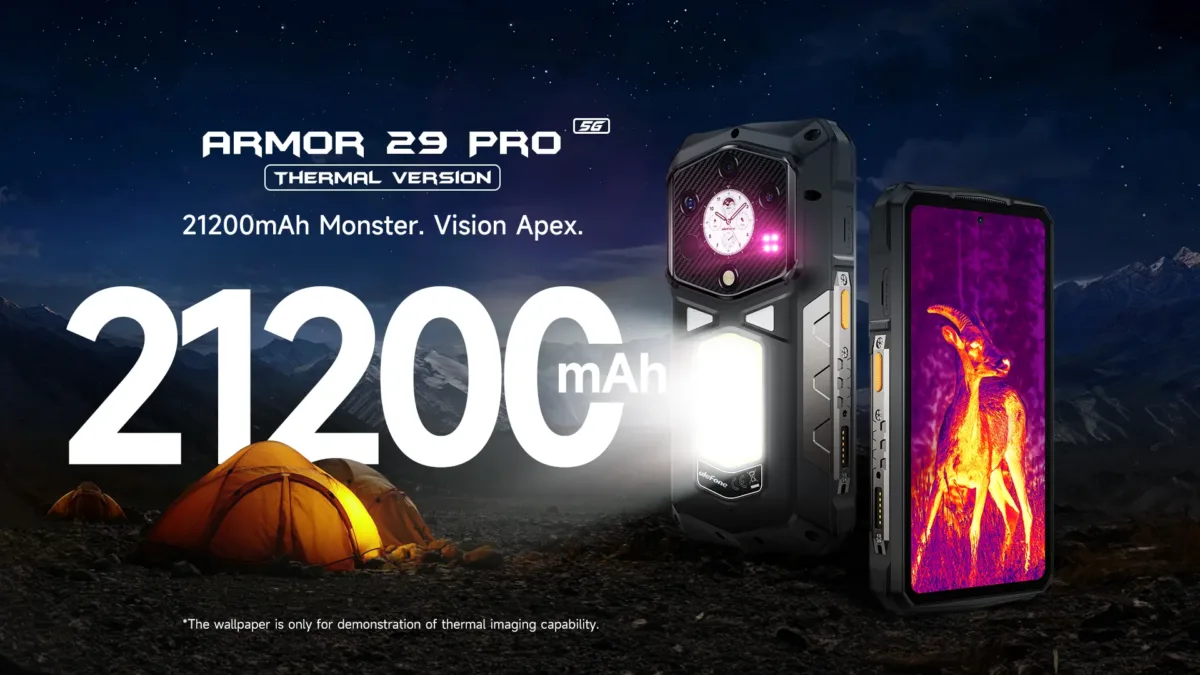
- ThermoVue T2 provides 640 × 512 thermal output at 25Hz, with Ulefone stating ±2°C accuracy.
- The 21,200mAh battery supports 120W wired and 10W reverse charging.
- A 6.67-inch 120Hz AMOLED, Dimensity 7400, 16GB RAM and 512GB storage handle the core smartphone experience.
- At 688g, the specialist hardware delivers endurance and field tools at a major portability cost.
Quick Highlights
The Ulefone Armor 29 Pro Thermal is built for field work rather than pocket-friendly minimalism. Its headline equipment is an integrated ThermoVue T2 thermal camera, a 21,200mAh battery, 120W wired charging and a 1,000-lumen rear work light. Ulefone pairs those tools with a 6.67-inch 120Hz AMOLED display, a MediaTek Dimensity 7400 processor and Android 15. The trade-off is unmistakable: at 688g, this is a specialist rugged handset that weighs far more than a conventional flagship.
Key Specifications
Core hardware includes the 4nm MediaTek Dimensity 7400, with an octa-core CPU rated up to 2.5GHz, 16GB of physical RAM and up to 16GB of virtual memory. Storage is 512GB, with microSD expansion advertised up to 2TB. The main screen is a 6.67-inch AMOLED panel with a 120Hz refresh rate and claimed peak brightness of 2,200 nits. A separate 1.04-inch interactive rear display can show status information and provide quick controls. These specifications give the phone enough capacity for large offline maps, inspection photos and work documents without presenting it as a benchmark-class gaming device.
Full Specifications
The camera system combines a 50MP main camera, a 64MP NightElf 3.0 night-vision camera and a 50MP ultrawide camera, plus a 50MP selfie camera. The thermal module is separate from those conventional cameras. Power comes from a 21,200mAh battery with 120W wired charging and 10W reverse charging. Connectivity includes dual 5G, Wi-Fi 6E, NFC and infrared, while Ulefone’s uSmart connector supports compatible accessories. Protection claims include IP68, IP69K and MIL-STD-810H certification. Ulefone specifies resistance testing for immersion at 1.5 metres for 30 minutes and drops from 1.5 metres; real-world damage can still depend on impact angle, seals and wear.
Performance
The Dimensity 7400 is a modern 4nm 5G platform intended to balance everyday speed and efficiency. Its up-to-2.5GHz CPU, 16GB of RAM and generous storage should suit navigation, communications, document handling and common field applications. Virtual RAM uses storage and should not be treated as equivalent to another 16GB of physical memory. The phone’s exceptional battery capacity is likely to matter more to its target audience than peak synthetic scores. Buyers wanting a slimmer performance-focused phone can also read our [realme GT 8 Pro specifications guide](https://phonespecx.com/realme-gt-8-pro-specifications-camera-battery-guide/), which serves a very different use case.
Thermal and conventional cameras
ThermoVue T2 is the defining feature. Ulefone lists a 640 × 512 thermal output, 25Hz refresh rate and stated temperature accuracy of ±2°C, with SharpenAI processing. Those figures make the module relevant to tasks such as spotting heat patterns, checking insulation or inspecting machinery from a safe position. Thermal readings still depend on surface emissivity, distance and environmental conditions, so the phone should not replace calibrated safety, electrical or medical equipment where certified measurements are required. The 50MP main camera handles normal photography, the 64MP NightElf 3.0 module targets dark scenes with infrared illumination, and the 50MP ultrawide broadens the field of view.
Battery and charging
A 21,200mAh rated capacity is several times larger than the battery in a typical slim smartphone. That reserve is designed for long shifts, remote travel and accessory use, and 10W reverse charging lets the handset act as a power source for compatible devices. Ulefone advertises 120W wired charging and says the phone can reach 20% in 10 minutes under its test conditions. Charging speed varies with temperature, battery level, power source and use during charging. The very large cell also explains much of the 688g weight, so prospective buyers should decide whether endurance outweighs comfort in one-handed use.
Rugged design and work light
IP68 and IP69K ratings address dust, water immersion and high-pressure water exposure under defined laboratory conditions, while MIL-STD-810H testing covers selected environmental procedures rather than making any phone indestructible. Port covers and seals must remain clean and properly closed. The rear lighting array uses 570 LEDs with a stated 5W output and up to 1,000 lumens, plus warning modes. It can be useful for campsites, work areas or emergencies, but users should avoid looking directly into the light or aiming it at drivers. For another heavy-duty option, see the [Ulefone Armor 34 Pro+ specifications](https://phonespecx.com/ulefone-armor-34-pro-plus-price-specs-review/).
Software and connectivity
The Armor 29 Pro Thermal ships with Android 15 according to Ulefone’s current product information. Dual 5G, Wi-Fi 6E, NFC and infrared cover modern network access, contactless functions and compatible appliance control. Band support and services such as VoLTE, Wi-Fi calling, eSIM or payment certification can vary by market and carrier, so buyers should verify the exact regional model before ordering. The uSmart expansion interface is intended for optional tools and accessories. Long-term update duration is not clearly stated on the cited official pages, so it should be confirmed with the seller rather than assumed.
Price and availability
On September 8, 2026, Ulefone’s official online store displayed a US$799.99 sale price against a US$899.99 regular price. This is a time-sensitive store listing, not a permanent global MSRP, and taxes, shipping, promotional discounts and regional availability can change the final cost. Buyers should compare the exact SKU and supported network bands before checkout. The [official Ulefone product page](https://www.ulefone.com/products/armor-29-pro-thermal-version) provides feature details, while the [official store listing](https://store.ulefone.com/products/armor-29-pro-thermal) provides the current sales status and price.
Pros and Cons
The strongest advantages are the unusually high-resolution integrated thermal module, immense battery, fast wired charging, bright rear work light, expandable storage and broad rugged certification. The phone also offers conventional and night-vision cameras rather than relying on the thermal sensor alone. The main drawbacks are equally clear: 688g is extremely heavy, the 21,200mAh battery makes the body bulky, and the specialist hardware pushes the price above many ordinary midrange phones. Update-support duration and market-specific network compatibility also require confirmation.
Alternatives
The best alternative depends on whether thermal imaging is essential. Ulefone’s own rugged range includes models focused on different balances of battery size, lighting and imaging; our [Ulefone Armor X16 Pro specifications](https://phonespecx.com/ulefone-armor-x16-pro-specs-price/) and Armor 34 Pro+ guide provide starting points for comparison. A mainstream performance phone may be substantially lighter and faster in games, but it will generally omit the integrated thermal camera, huge battery, work light and rugged accessory interface. Compare exact specifications, local warranty coverage and network bands rather than choosing on headline battery capacity alone.
Verdict
The Ulefone Armor 29 Pro Thermal is a credible specialist choice for users who genuinely need integrated thermal imaging and multi-day-scale battery capacity in one rugged device. Its 640 × 512, 25Hz ThermoVue T2 system, 21,200mAh battery and 1,000-lumen light distinguish it from ordinary rugged phones. It is not a subtle all-purpose handset: the 688g weight and bulky construction demand a deliberate purchase. For field technicians, outdoor teams and remote-site users who can accept that size, the combination is unusually comprehensive; everyone else should prioritize a lighter phone and carry dedicated tools only when needed.