- Peak CPU and raster-GPU scores rank among the best measured Android results.
- Sustained performance is workload-dependent: Wild Life and Solar Bay retention are strong, while Steel Nomad Light drops more sharply.
- Independent stress testing recorded 59°C peaks, so comfort and thermal management are genuine concerns.
- Real games can run extremely well from a cooler start, but back-to-back hot sessions may reduce frame rates.
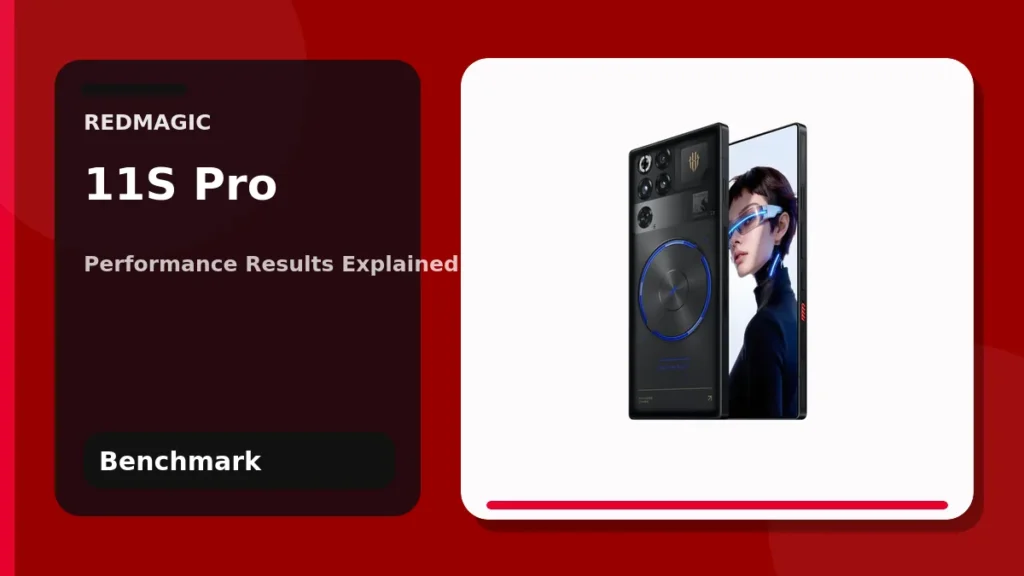
REDMAGIC 11S Pro benchmark overview
REDMAGIC 11S Pro benchmarks place this gaming phone near the top of current Android performance charts, especially when a workload can use its aggressive thermal profile. PhoneArena measured 3,720 single-core and 11,618 multi-core in Geekbench 6, while its 3DMark Wild Life Extreme run started at 8,236 and ended at 6,564. Those are impressive figures, but they are only half the story.
Android Authority’s separate stress testing found strong 77% score retention in Wild Life Extreme, alongside a 59°C peak surface temperature. The phone can sustain speed, but it sometimes does so by tolerating far more heat than mainstream flagships. This article keeps manufacturer claims separate from independent measurements and focuses on what the numbers mean for real gaming.
Quick take
- CPU: PhoneArena recorded Geekbench 6 scores of 3,720 single-core and 11,618 multi-core.
- Raster graphics: Wild Life Extreme measured 8,236 at the high point and 6,564 at the low point in PhoneArena’s test.
- Sustained load: Android Authority reported 77% retention in its Wild Life Extreme stress test.
- Heat: The same outlet measured 59°C peaks in both Wild Life Extreme and Solar Bay stress tests.
- Real games: Call of Duty Mobile held 120 fps for 20 minutes in hot ambient conditions, while a heat-soaked Asphalt Legends run averaged 45 fps.
Test sources and how to read the results
The official REDMAGIC specification sheet establishes the hardware: a Snapdragon 8 Elite Gen 5 Leading Version clocked up to 4.74GHz, RedCore R4 gaming chip, 12GB or 16GB of LPDDR5X Ultra memory, UFS 4.1 storage and an AquaCore system with a 13,116mm² vapor chamber and 24,000RPM fan. Those are manufacturer specifications, not independent proof of performance.
PhoneArena supplied the comparable Geekbench, 3DMark and storage measurements used below. Android Authority supplied a separate stress-and-gaming data set recorded during 33°C ambient weather. Results from different labs should not be merged as if they were one controlled comparison: software versions, performance modes, room temperature and benchmark builds can all change scores.
CPU performance: high peak scores with strong multi-core output
PhoneArena’s Geekbench 6 result of 3,720 single-core puts the REDMAGIC just behind the Galaxy S26 Ultra at 3,753 and iPhone 17 Pro Max at 3,775 in that lab’s comparison. Multi-core reverses the order: the REDMAGIC reached 11,618, ahead of the Galaxy’s 11,259 and the iPhone’s 9,749.
The multi-core advantage suits game streaming, emulation and heavier creator workloads, although Geekbench is a short synthetic test. Android Authority likewise found the device roughly 3% ahead of the Galaxy S26 Ultra in both Geekbench measures in its own test set. The safest conclusion is not that every unit will reproduce one exact number, but that the overclocked Snapdragon platform competes at the very top of the Android CPU class.
GPU benchmark comparison
PhoneArena’s graphics data shows why the REDMAGIC 11S Pro is more interesting as a sustained-performance device than as a simple peak-score champion.
| PhoneArena test | REDMAGIC 11S Pro | Galaxy S26 Ultra | iPhone 17 Pro Max |
|---|---|---|---|
| Wild Life Extreme high | 8,236 | 7,801 | 5,987 |
| Wild Life Extreme low | 6,564 | 3,741 | 3,841 |
| Steel Nomad Light high | 2,372 | 2,761 | 2,592 |
| Steel Nomad Light low | 1,134 | 1,498 | 1,584 |
| Solar Bay Extreme high | 1,238 | 1,245 | 2,187 |
| Solar Bay Extreme low | 1,148 | 834 | 1,372 |
Wild Life Extreme is the clearest win: the phone’s low score remains about 80% of its high score. Solar Bay also retains roughly 93% in PhoneArena’s run. Steel Nomad Light is the exception, falling to about 48% and finishing behind both comparison phones. A gaming phone can therefore dominate one workload without leading every modern graphics test.
Sustained graphics: cooling helps, but workload matters
Android Authority’s separate Wild Life Extreme stress loop retained 77% of peak performance. Competing devices in that data set retained roughly 49% to 60%, so the REDMAGIC’s advantage under prolonged raster load was substantial. The outlet found a similar pattern in ray tracing, but the performance came with a major thermal cost.
PhoneArena’s results reinforce that distinction. The handset’s strong Wild Life and Solar Bay retention contrasts with its much larger Steel Nomad decline. Driver behavior, power limits and the mix of graphics techniques can matter as much as the cooling hardware. Buyers should look at the benchmark that resembles their game, not one headline score.
Thermals: 59°C is the critical caveat
Android Authority measured a 59°C peak and 49°C average during Wild Life Extreme, then another 59°C peak and 50°C average in Solar Bay. Its next-hottest Wild Life competitor peaked at 46°C, while most phones in the comparison stayed below 45°C. That gap is too large to dismiss as ordinary test variation.
The AquaCore loop, vapor chamber and fan help move heat away from the chipset, but the heat still reaches the chassis and surrounding air. Sustaining a score by allowing the phone to become uncomfortable is not the same as delivering cool, efficient performance. Long sessions may call for a controller, stand or external cooler, and users should avoid covering the fan intake or exhaust.
Real-game tests: excellent when cool, mixed when heat-soaked
In 33°C ambient conditions, Android Authority ran Call of Duty Mobile Battle Royale for 20 minutes at the highest available settings and a 120Hz target. The REDMAGIC held 120 fps with few visible hitches and finished at 43°C. A 20-minute Dolphin emulator session running Mario Kart Wii held 60 fps and ended at 41°C.
The weak result came after only a ten-minute cool-down. Asphalt Legends started at 39°C, averaged 45 fps and dipped toward 30 fps, despite ending at 41°C. This sequence matters: the phone performs extremely well from a cooler start, but repeated demanding sessions can create heat soak that an internal fan cannot instantly erase.
Storage performance and loading behavior
PhoneArena measured 2,640MB/s sequential read and 1,670MB/s sequential write from the UFS 4.1 storage. Random results were 51.1MB/s read and 129.8MB/s write. Sequential performance exceeded the Galaxy S26 Ultra values in the same table, while random read speed was much lower than Samsung’s 92MB/s.
Large game installs, capture files and asset transfers benefit from the strong sequential results. App launches and many small-file operations depend more on random access, so storage performance is not a universal win. The phone ships with 256GB or 512GB and has no microSD slot.
What the hardware contributes
REDMAGIC pairs the overclocked Snapdragon with a 24,000RPM fan, large vapor chamber, liquid-cooling loop and performance profiles that can raise power limits. The 7,500mAh battery also gives the system more endurance headroom than many mainstream flagships. Our REDMAGIC 11S Pro specifications guide covers the complete hardware, while the REDMAGIC 11S Pro review addresses cameras, software and daily-use compromises.
The older REDMAGIC 11 Pro specifications provide useful context: the 11S Pro is a performance refresh rather than a complete redesign. Owners of the prior model should not assume benchmark gains alone justify an upgrade.
Who should trust these benchmark results
Competitive mobile players, emulator users and people who record or stream gameplay will get the most value from the REDMAGIC’s high sustained output. The results also show why a cooler environment and deliberate performance-mode choice matter. Using the maximum mode for every task can trade comfort and efficiency for numbers that ordinary games do not need.
Camera-first buyers and people sensitive to chassis heat should not choose solely from the charts. A synthetic stress test intentionally pushes hardware beyond typical play, while a hot-start game sequence can be harsher than a single evening session. Both scenarios are useful because together they define the phone’s ceiling and its thermal limits.
Verdict
The REDMAGIC 11S Pro is one of the fastest Android gaming phones measured by both PhoneArena and Android Authority. Its 11,618 Geekbench 6 multi-core result, strong Wild Life Extreme retention and steady 120 fps Call of Duty run show that the cooling system can support serious sustained performance.
Yet the 59°C synthetic peaks and heat-soaked Asphalt slowdown prevent a simple “fastest is best” verdict. The phone’s advantage is real, but it is achieved through an aggressive thermal strategy. For buyers who prioritize maximum frame rates and can manage heat, that trade is reasonable. For everyone else, cooler mainstream flagships may deliver enough speed with fewer ergonomic compromises.