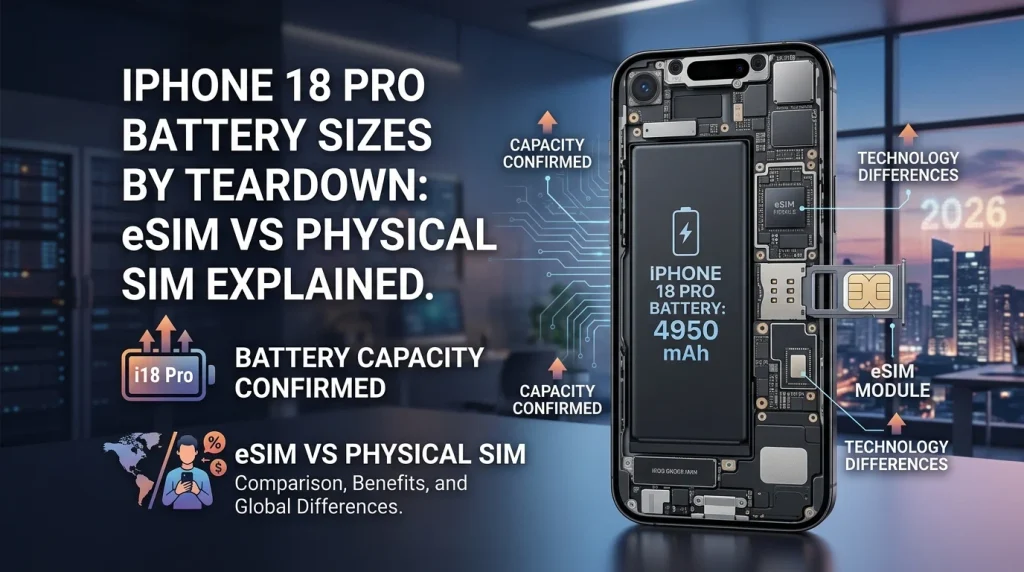
iFixit’s September 20 teardown has now confirmed the battery capacities inside eSIM-only iPhone 18 Pro and iPhone 18 Pro Max models: 4,288mAh and 5,567mAh respectively. Physical-SIM versions use slightly smaller cells because the SIM hardware occupies internal space. That regional hardware difference matters when comparing battery specifications, but capacity alone does not determine real-world endurance.
This is an evidence-based teardown explainer, not a hands-on battery test. Apple publishes battery-life targets rather than mAh capacities, so the cell-label measurements from iFixit provide useful independent hardware evidence alongside Apple’s official runtime and charging specifications.
iPhone 18 Pro battery capacities at a glance
| Model / configuration | Battery capacity | Evidence |
|---|---|---|
| iPhone 18 Pro, eSIM-only | 4,288mAh / 16.76Wh | Cell label documented by iFixit |
| iPhone 18 Pro, physical SIM | 4,056mAh | Regional energy-label / physical-SIM reporting |
| iPhone 18 Pro Max, eSIM-only | 5,567mAh / 21.751Wh | Cell label documented by iFixit |
| iPhone 18 Pro Max, physical SIM | 5,391mAh | Regional energy-label / physical-SIM reporting |
The eSIM-only Pro therefore has 232mAh more nominal capacity than the physical-SIM version, while the eSIM-only Pro Max has 176mAh more. These are modest hardware differences, not a guarantee of a proportional runtime advantage.
Why eSIM-only models have larger batteries
A physical SIM tray, reader and surrounding structure consume internal volume. In markets where Apple sells eSIM-only iPhone 18 Pro models, that space can instead contribute to a larger battery package. iFixit directly documented the 16.76Wh battery in its eSIM iPhone 18 Pro and the 21.751Wh cell in its eSIM Pro Max.
Apple’s regional specifications also show different video-playback figures in some markets. Its U.S.-oriented specification page lists up to 36 hours of video playback for iPhone 18 Pro and up to 45 hours for Pro Max, while Apple’s Nigeria newsroom, describing models with different regional hardware, lists up to 34 and 43 hours respectively. Those are Apple-controlled test claims rather than independent endurance measurements, but they reinforce why buyers should compare the correct regional model.
Battery capacity is only part of the endurance story
Apple says the A20 Pro architecture and redesigned thermal system contribute to efficiency and sustained performance. The company also moved to a next-generation vapor chamber with three times the surface area of the previous generation. Runtime therefore depends on the complete system: display behavior, modem, silicon efficiency, software, radio conditions, workload and battery capacity.
For a broader look at the phones themselves, see PhoneSpecX’s iPhone 18 Pro specifications, camera, battery and price guide. Buyers choosing between sizes can use our iPhone 18 Pro vs iPhone 18 Pro Max comparison, while U.S. buyers can check the iPhone 18 Pro U.S. price, storage and buying guide.
Charging: what Apple officially specifies
| Charging / runtime item | Apple specification |
|---|---|
| iPhone 18 Pro typical use | Up to 24 hours |
| iPhone 18 Pro Max typical use | Up to 30 hours |
| iPhone 18 Pro video playback | Up to 36 hours on the cited Apple specification page |
| iPhone 18 Pro Max video playback | Up to 45 hours on the cited Apple specification page |
| Wired fast charge | iPhone 18 Pro: up to 50% in around 15 minutes with a 60W-capable or higher AVS adapter and USB-C cable |
| MagSafe | Up to 50% in 30 minutes with a 35W or higher adapter and MagSafe Charger |
Charging times are Apple’s controlled estimates and can vary with temperature, adapter, battery state, background activity and other conditions. They should not be treated as guaranteed wall-clock times for every user.
The teardown also reveals a repairability tradeoff
iFixit praised the return of a screwed-in metal battery tray: once the phone is open, the battery-and-tray assembly can be removed without fighting battery adhesive. The teardown also reported difficulty removing the display, with the plastic support frame damaged on three of four units opened. Importantly, iFixit explicitly says four phones are too few to establish a failure rate and that other teardowns have avoided the damage.
That distinction matters. The teardown is useful evidence of a potential service challenge, but it is not evidence that all iPhone 18 Pro displays are defective or unusually fragile.
What buyers should take from the regional difference
If maximum nominal battery capacity matters, verify whether the exact unit you are buying is eSIM-only or includes a physical SIM tray. This is particularly relevant for imported phones, where the model sold by a reseller may differ from the normal configuration in your country.
Do not choose solely on the mAh figure. The Pro Max has the larger battery and Apple’s longer runtime claims, but it is also the larger device. The standard Pro remains the more compact option, and the 232mAh eSIM advantage is too small to predict an exact number of extra hours without controlled testing.
Frequently asked questions
What is the iPhone 18 Pro battery capacity?
iFixit measured the eSIM-only iPhone 18 Pro battery at 4,288mAh (16.76Wh). Physical-SIM versions are reported at 4,056mAh.
What is the iPhone 18 Pro Max battery capacity?
The eSIM-only iPhone 18 Pro Max teardown shows 5,567mAh (21.751Wh). Physical-SIM models are reported at 5,391mAh.
Why does the eSIM iPhone have a bigger battery?
Removing the physical SIM hardware frees internal volume. Apple can use part of that space for a larger battery package.
Does the larger eSIM battery guarantee longer battery life?
No. Capacity is one factor. Display use, cellular modem, signal strength, workload, software and power-management behavior also affect runtime.
Did iFixit find the battery difficult to replace?
Once inside the phone, iFixit described the screwed-in battery tray as a repair-friendly design. Its concern was the display-opening process, where several teardown units suffered plastic-frame damage; iFixit cautioned that its sample was too small to establish a failure rate.
Sources and References
- iFixit — iPhone 18 Pro and Pro Max teardown (published September 20, 2026)
- Apple — iPhone 18 Pro and Pro Max technical specifications (accessed September 21, 2026)
- Apple Newsroom — iPhone 18 Pro and iPhone 18 Pro Max announcement (September 2026)
- MacRumors — independent summary of iFixit’s teardown findings (September 20, 2026)